How to Buy NEAR in India and Store It Safely After Purchase

How to Buy NEAR in India and Store It Safely After Purchase
A coin keeps appearing on trending lists, and curiosity slowly turns into a wish to own it. The harder part is owning it safely.
This guide explains how to buy NEAR in India with rupees, then move the coins somewhere secure.
In short, a buyer registers on an Indian exchange, completes KYC, adds INR, buys NEAR and then picks where the coins live.
Is It Legal to Buy NEAR in India Through an Exchange?
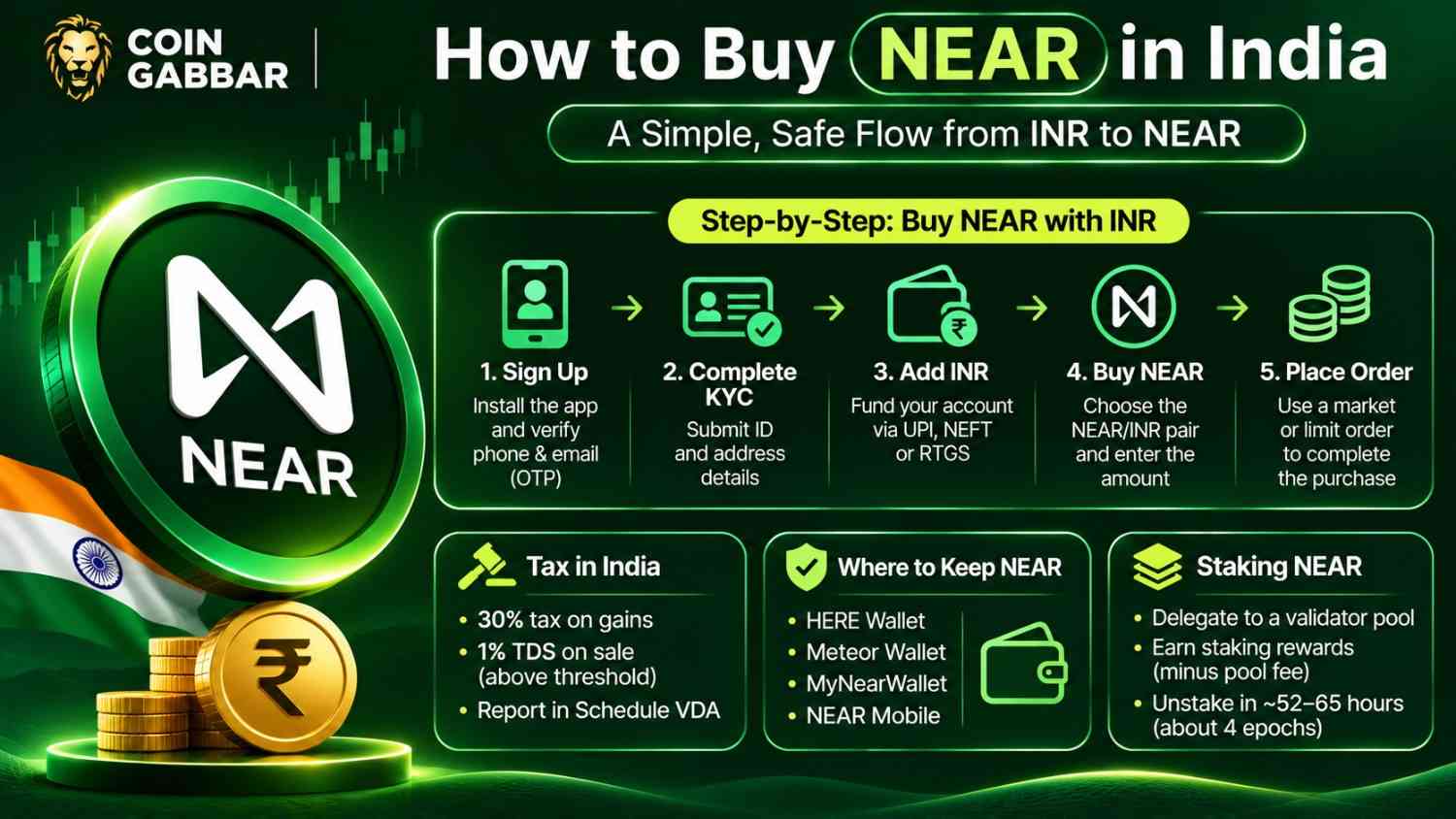
Buying NEAR in India is possible and taxed. Exchanges operating with Indian users will have to register with FIU-IND, and the income from the sale of crypto will be taxed at a flat rate of 30% + 1% TDS. Cryptocurrency is not legal tender and is not backed by the government; therefore, the buyer is at risk of the price fluctuation.
Terms such as KYC and TDS are explained in the crypto dictionary. India classed crypto exchanges as reporting entities under anti-money laundering law in March 2023, Business Today reported.
Registration is a compliance step, not a safety seal. The exchange's own legal page should confirm it.
Is NEAR Available on Indian Exchanges With INR Pairs?
CoinSwitch and Mudrex both run NEAR buying pages for Indian users. A buyer who wants to buy NEAR with INR on Mudrex can start at ₹100, per the platform. Fees run 0.12% to 0.45% per trade, also its own claim.
Payment works by UPI or NEFT and RTGS after KYC. CoinGecko lists NEAR on 97 exchanges worldwide but does not say which offer INR pairs.
Check | What to look for |
Registration | FIU-IND status stated on the site |
Pair | NEAR/INR or NEAR/USDT market |
Withdrawal | NEAR withdrawals switched on |
Source: CoinGabbar checklist; Mudrex Learn and NEAR page, 2026.
How to Buy NEAR in India Step by Step With INR?
Steps can't be customized, but screens can per app.
Install & verify phone & email with OTP on app:
KYC completion denied by app docs.
Fund INR with UPI/NEFT/RTGS.
Buy INR pair in NEAR Market.
Enter an amount and enter a limit or market order.
CoinGecko showed NEAR at ₹311.37 on 14 November 2026. A ₹5,000 order buys about 16.06 NEAR before fees.
A USDT pair needs two trades, INR to USDT and then USDT to NEAR. Under CBDT Circular 13 of 2022, as Inc42 reported, an exchange deducts TDS on both legs.
How Are NEAR Gains and Sales Taxed for Indian Investors?
Tax belongs in any plan for how to buy NEAR in India. The Income Tax Department's VDA guidance sets the core rules.
Rule | Detail |
Tax rate | 30% plus surcharge and cess |
Deductions | Cost of acquisition only |
Loss set-off | Not allowed |
TDS | 1% under Section 194S |
Source: Income Tax Department, January 2026. The TDS threshold is ₹50,000 a year for specified individuals and HUFs, and ₹10,000 for others.
A buyer pays ₹5,000 and sells for ₹6,000. The gain is ₹1,000, so the base tax is ₹300 before cess. TDS on the sale is ₹60.
Buyers report transfers in Schedule VDA. KoinX's guide says staking rewards are taxed at slab rates on receipt, and a later sale is taxed again.
How Does a Buyer Withdraw NEAR to a Personal Wallet?
The last stage of how to buy NEAR in India is the withdrawal. The buyer picks NEAR and the native NEAR network, then pastes the wallet address.
NEAR's documentation describes named accounts such as alice.near. It also describes implicit accounts of 64 hexadecimal characters. Whoever holds the private key controls the account.
A small test transfer comes first. The first and last characters of the address should match. A memo applies only when the receiving side asks for one.
Which Wallet Types Can Store NEAR After Purchase?
NEAR's documentation lists HERE Wallet and NEAR Mobile as non-custodial mobile wallets. Meteor Wallet runs in a browser and as an extension. MyNearWallet is browser-based.
Self-custody means the buyer alone holds the seed phrase. It belongs on paper, offline. It never belongs in a photo, a chat, or a screenshot.
Hardware wallet support differs by wallet and needs a check first.
Can Holders Stake NEAR After Buying It, and How?
Staking means delegating NEAR to a validator pool. The NEAR wiki says the delegator earns a share of rewards, minus the pool's fee, with no hardware needed.
Staked tokens are locked. Unstaking releases them after about 52 to 65 hours, or 4 epochs.
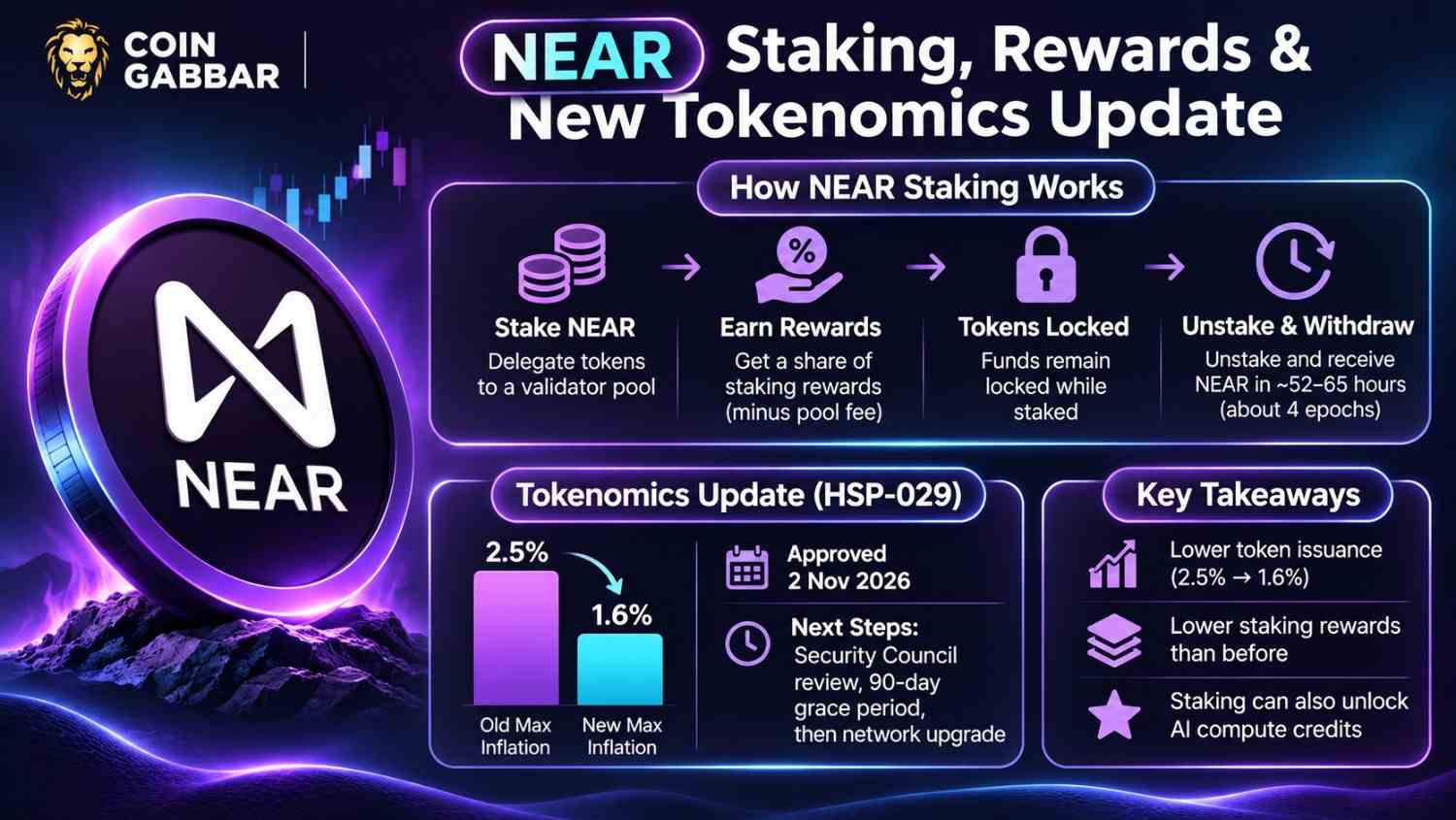
NEAR's July 2025 estimate of 4% to 4.5% base rewards used the old 2.5% rate. It is dated. Staked NEAR can also unlock AI compute credits, as the NEAR AI staking explainer shows.
What Risks Should NEAR Buyers Watch Before Investing?
NEAR's House of Stake approved proposal HSP-029 on 2 November 2026, according to 24/7 Wall St. It cuts maximum inflation from 2.5% to 1.6%.
Risk | Data as of 3 Nov 2026 |
Price | $3.83, about 81% below the $20.44 peak |
Supply | Cap falls from about 32.8M to 21M NEAR a year |
Source: 24/7 Wall St. Supply figures are estimates.
The change still needs Security Council review, a 90-day grace period and an upgrade. Lower issuance also means lower staking rewards. Scam wallets and fake apps are another risk. Downloads should use official links. The NEAR Protocol explainer covers the basics.
What Does the Expert View Say About NEAR Right Now?
CoinGabbar analysis suggests NEAR's usage story is real, but its price tells a cautious one. NEAR reported over $37 billion in all-time Intents volume on 3 November 2026. The confidential perpetual futures launch shows Intents reaching new products.
The other side is just as clear. October's record $2.4 million in Intents revenue sits well below the roughly $80 million of new NEAR a year the lower cap allows, per 24/7 Wall St. Demand would have to lift the price.
For Indian buyers, the path for how to buy NEAR in India is simple. Buy through a registered platform. Track every TDS entry. Watch governance on issuance. This analysis considers exchange rules, tax guidance, token supply changes and recent price behavior.
Disclaimer: This article is for information only. It isn't financial, legal or tax advice. NEAR is volatile, and a buyer can lose some or all of the money invested. Tax rules change, and no outcome is promised. A licensed advisor can confirm the details.
















