How to Plan Crypto Inheritance Before 2027: Wallets, Keys, and Heirs


How to Plan Crypto Inheritance: Secure Wallets, Protect and Prepare
Crypto can sit in plain view on a blockchain for years after its owner dies. Anyone can look up the balance. Still, seeing a wallet is not the same as opening it, and relatives who lack the keys and a recovery note may never touch the funds. A solid crypto inheritance plan therefore solves three separate jobs: finding the holdings, regaining access, and proving legal ownership. For coins parked on an exchange, the CoinGabbar guide to choosing a crypto exchange (published 4 June 2026, updated 19 August 2026) explains why custody and withdrawal rules matter.
How to plan crypto inheritance: What happens to crypto when an owner dies?
The answer starts with where the coins live. Two setups dominate: an exchange account, where a company holds the keys, and a personal wallet, where the owner does.
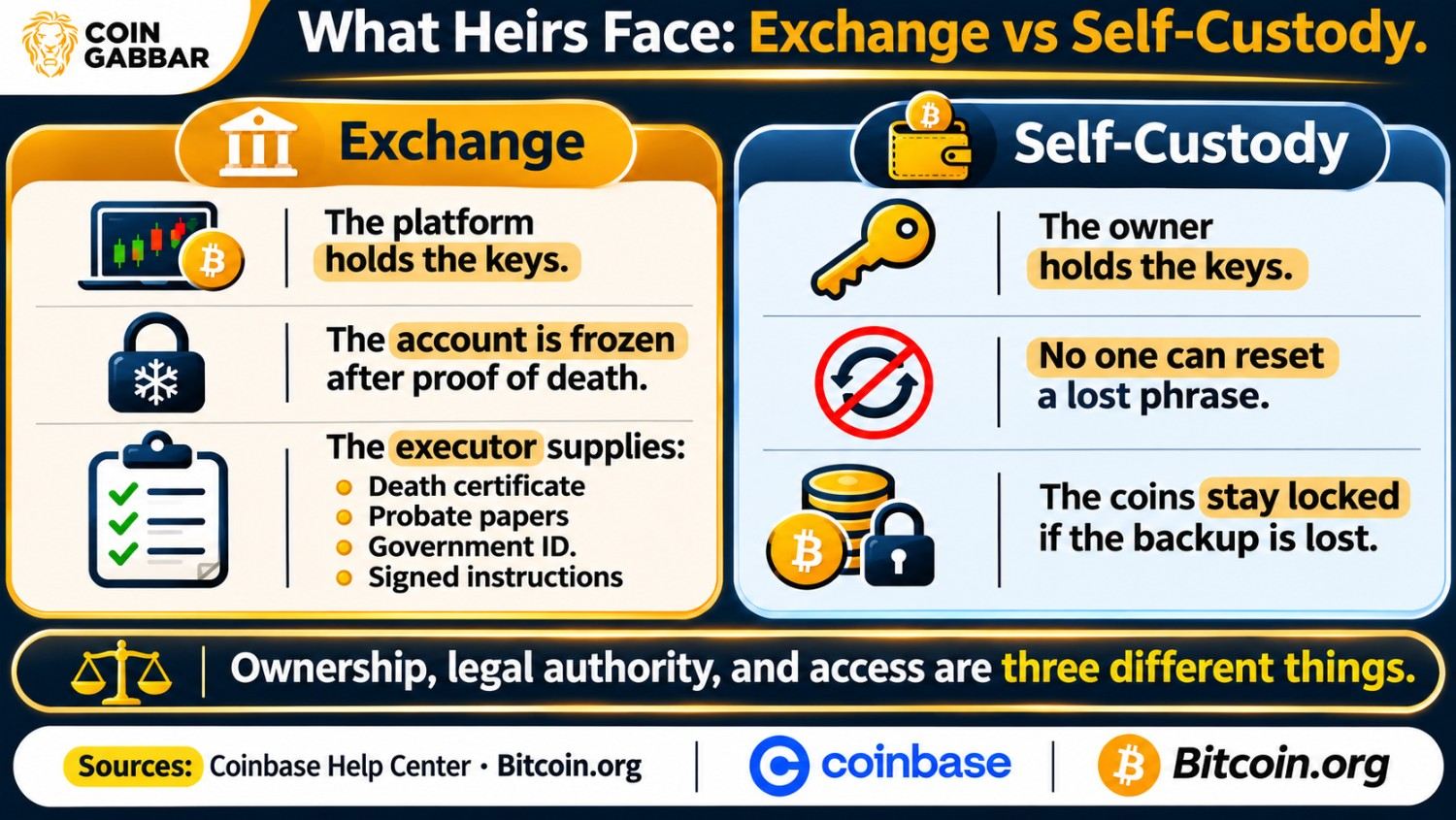
Exchanges usually freeze an account after a death and ask for paperwork. Coinbase's published executor steps, checked on 28 November 2026, ask for a death certificate, probate documents, a government ID, and a signed letter of transfer instructions. Those same steps say that individual accounts cannot yet name a beneficiary. Other platforms write their own rules, so the terms of the specific exchange are worth reading in advance.
Self-custody works the other way around. Nobody can phone a wallet maker and ask for a reset, because no company stands behind the keys. If the backups vanish with the owner, the coins can stay locked even though the address remains public.
Put simply, ownership, legal authority, and technical access are three separate things, and a complete plan has to cover each one.
How to plan crypto inheritance: Can crypto holdings be listed safely?
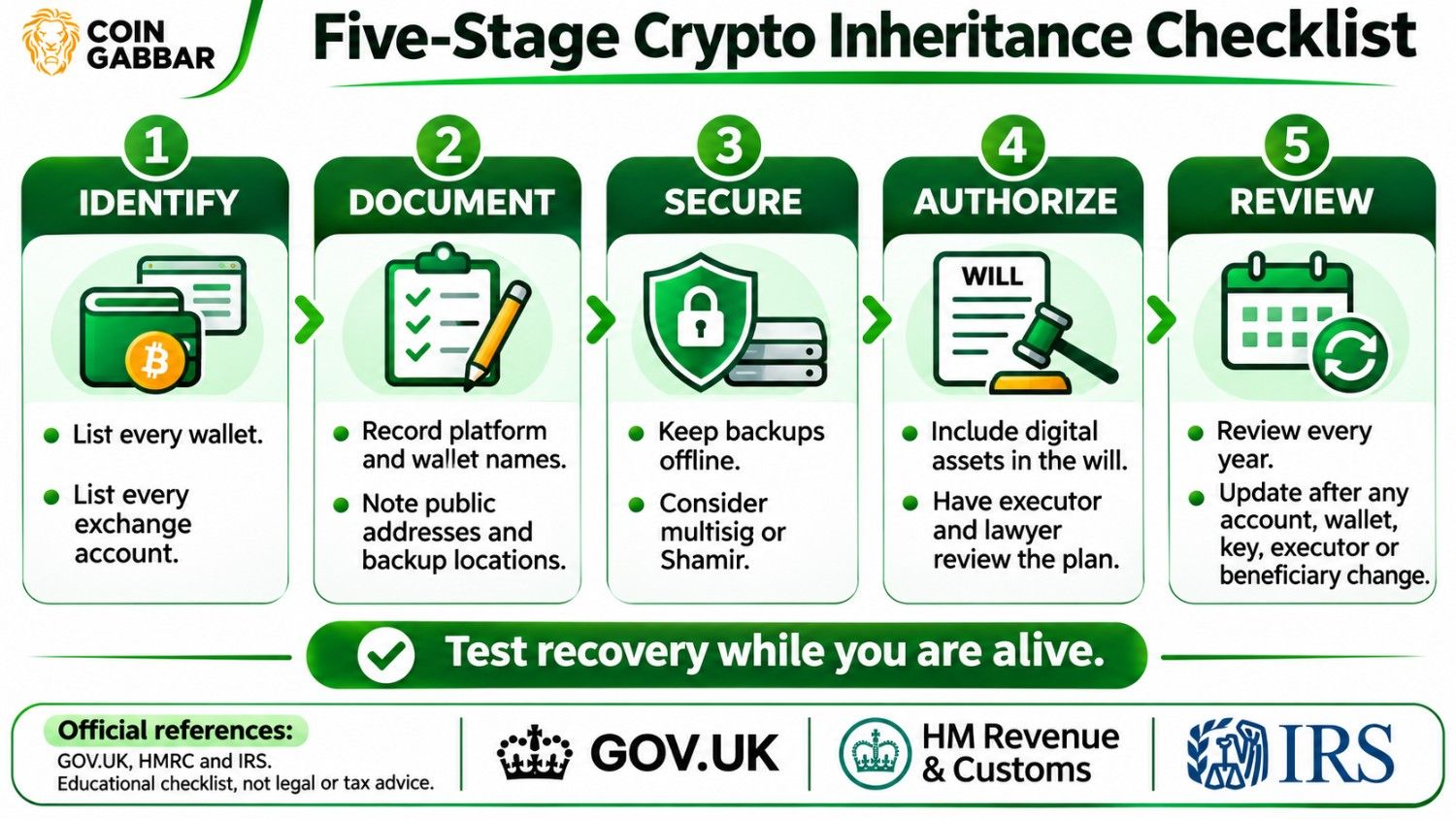
Heirs cannot claim what they never find. A private inventory closes that gap, and it can be short. Each entry needs a platform or wallet name, an account identifier, and any relevant public addresses. The list should cover:
exchange and custodial accounts
hardware and software wallets
Bitcoin, Ethereum, and other token holdings
stablecoins, NFTs, and tokenized assets
staking and lending positions
the places where wallet backups and recovery notes are kept
Private keys and seed phrases stay out of this document. An encrypted digital copy plus a separate offline copy lowers the risk of losing the list itself.
Tax authorities expect the same detective work. HMRC's Cryptoassets Manual, section CRYPTO25000 (updated 28 November 2025), tells executors to check exchange accounts, bank statements, emails, phone apps, devices, and personal papers. It adds that cryptoassets that cannot be accessed should still be identified and explained when the estate is reported.
How to plan crypto inheritance: Can seed phrases be passed on securely?
A seed phrase is a string of words that can rebuild a wallet's keys, so whoever holds it can usually move the funds. The CoinGabbar seed phrase security guide (published 20 April 2026, updated 19 August 2026) covers what goes wrong when recovery details leak. Three methods are common.
Secure offline backup
The phrase goes into a protected physical spot or a durable backup medium, and a separate note tells the executor where to look. Plain email, cloud folders, and ordinary documents add needless risk. Bitcoin.org's wallet security advice, accessed on 28 November 2026, points to safe backups, several storage locations and sensible wallet protection.
Multisignature wallet
A multisig wallet needs more than one key to approve a payment. In a 2-of-3 setup, any two of three independent keys can sign. The owner might hold one, a trusted relative another, and an independent backup holder the third.
Multisig is a wallet design and not a way to chop up a seed phrase. Three separate recovery phrases do not add up to a multisig wallet.
Shamir Secret Sharing
This method splits one secret into several shares, and in a 2-of-3 version any two shares rebuild it. The SLIP-0039 standard, created on 18 December 2017, defines the approach for compatible wallets. It uses 20-word shares for 128-bit secrets and 33-word shares for 256-bit secrets. It is its own format and generally does not work with a standard BIP-39 recovery phrase.
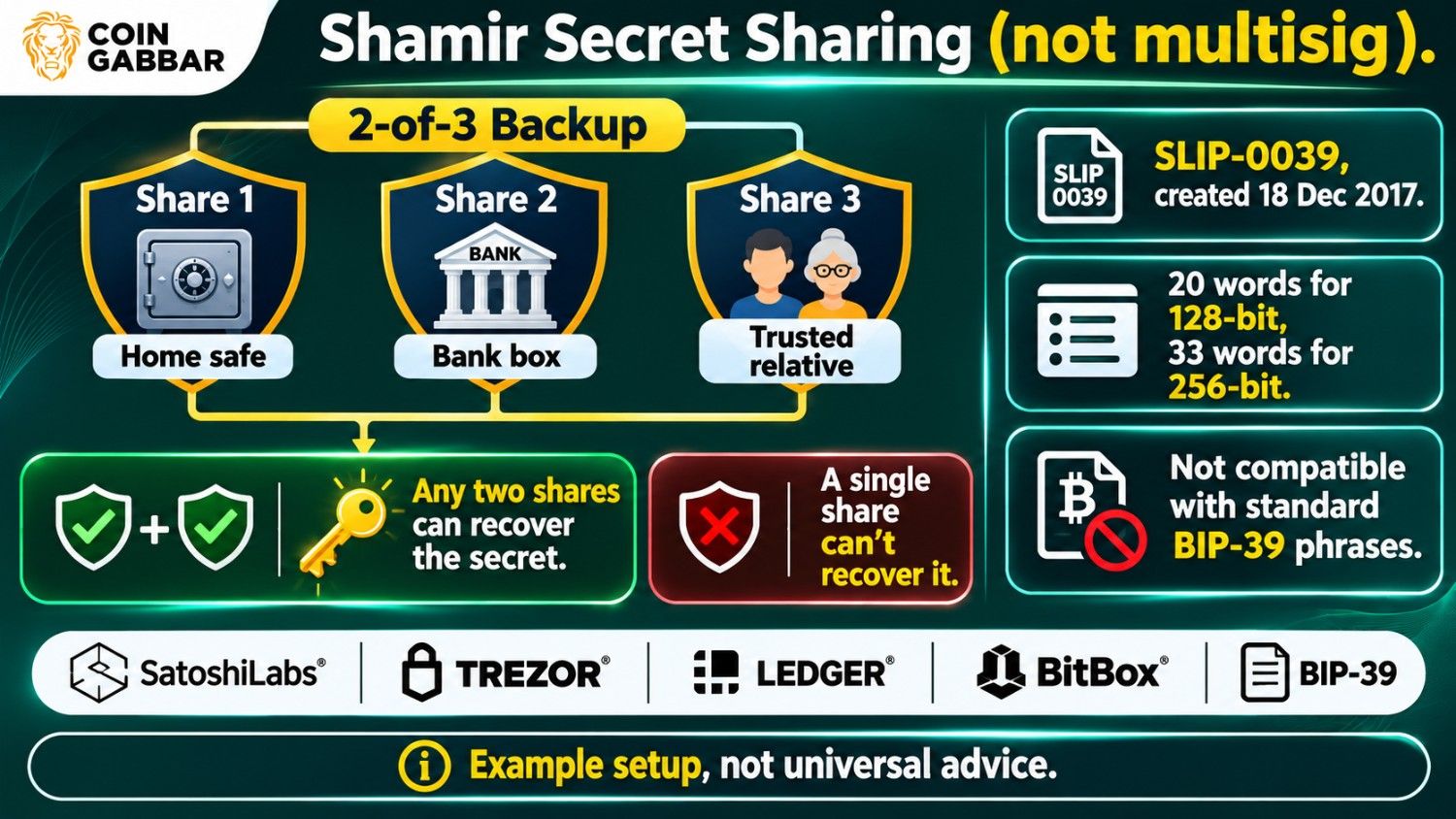
A quick way to keep the three apart: multisig spreads out signing power, while Shamir spreads out the power to rebuild a secret.
Offline backup: spreads recovery copies, and its main risk is a single point of loss.
2-of-3 multisig: spreads signing authority, and its main risk is a lost wallet configuration.
2-of-3 Shamir: spreads secret shares, and its main risk is too few surviving shares.
These are example setups and not universal advice. Wallet compatibility and recovery tests still matter most.
How should crypto be included in a will?
A will should name the digital assets that form part of the estate, the people meant to receive them, and the executor or trustee. It should also point to where the inventory and recovery notes are stored and name a backup beneficiary.
Seed phrases and private keys never go in the will itself, because people involved in probate may be able to read the filed documents. A separately secured instruction document explains recovery more safely.
In the US, the Revised Uniform Fiduciary Access to Digital Assets Act (RUFADAA) was approved on 10 to 16 July 2015 by the National Conference of Commissioners on Uniform State Laws, and its published text is dated 8 March 2016. This model law covers fiduciary access to digital property once a state adopts it, and it treats digital assets differently from the content of private electronic messages.
A sealed letter of instruction can list wallets, exchanges, backup locations, the executor, and useful professional contacts. It does not replace a valid will, and it must never hold an unprotected recovery credential.
How can inheritance planning affect crypto taxes?
Tax turns on the country, the size of the estate, and what heirs do next. Receiving crypto and selling it are two separate events.
In the UK, HMRC's inheritance guidance (updated 28 November 2025) counts cryptoassets as part of the estate, and their value on the date of death matters for inheritance tax reporting.
In the US, IRS Publication 559 (2025 edition) says inherited property generally takes a tax basis tied to fair market value on the date of death, with exceptions. That is a general property rule and not one written for crypto.
Purchase records, transaction histories, and valuations make correct reporting easier. Before selling or moving anything, heirs should speak with a tax professional in their own country.
How often should a crypto inheritance plan be reviewed?
A check once a year is the minimum. A fresh review is also due whenever the owner:
opens or closes an exchange account
moves assets to another wallet
changes a recovery phrase or wallet setup
replaces a hardware wallet
switches executor or beneficiary
moves to another country
The recovery steps should be tested while the owner is alive. An executor or trusted representative can learn the process without ever being handed the actual secret.
The CoinGabbar guide to secure seed phrase storage (published 22 March 2025, updated 19 August 2026) offers more backup advice, and the guide to crypto wallet phishing (published 7 April 2026, updated 19 August 2026) shows why recovery phrases must stay private.
Key Takeaways
Discovery, technical access, and legal transfer are three different problems.
A will can name who inherits, but it cannot unlock a self-custody wallet.
Seed phrases do not belong inside an ordinary will.
Multisig and Shamir backups fix different security problems.
Recovery steps deserve a trial run while the owner is still alive.
Disclaimer: This is for educational purposes only. It is not legal advice, financial advice, cybersecurity advice, or tax advice. Laws of inheritance and exchange vary and change. Legal and tax advisers should check each case for legality before any closing. (Updated 05:36 UTC 28 Nov 2026) Never give your recovery phrases or private keys to someone you don't know.