Sirius Network Contribution Power: CP, SST and SRT Explained

Sirius Network Contribution Power: Formula, SST Points and SRT Rewards
Sirius Network uses three short names that look almost identical: CP, SST and SRT. Most new users mix them up within minutes.
Sirius Network Contribution Power sits at the centre of the three. It decides how much of a user's daily activity counts toward SST points, which in turn feed the planned SRT token.
This guide explains each term in plain words, shows the official formula, and marks what the project has published versus what is still open. All details come from the official Sirius Network website and whitepaper.
Key Takeaways
Contribution Power (CP) is a weighting factor. It is not a coin and not a balance.
SST is an off-chain point record. SRT is the planned token. No fixed SST-to-SRT ratio exists.
Every future reward is a plan, not a promised payout.
What Is Sirius Network?
Sirius Network calls itself a mobile-first contribution mining project. Its tagline reads "Contribute First. Own Next. Build Together."
Users join through an app and take part in 24-hour cycles. No purchase is needed to start.
An account begins with a Sirius ID, not an email or phone number. Activity is then recorded as SST points.
Source: official website.
What Is Contribution Power in Sirius Network?
Sirius Network Contribution Power is the multiplier that decides how much recorded activity counts.
SST shows how much a user did. CP weighs it. Hours worked and the rate those hours are measured at make a fair comparison.
Searches such as "what is Contribution Power Sirius" or "Sirius Contribution Power explained" lead to the same answer. CP is a calculation input, nothing more.
How Does Sirius Contribution Power Work?
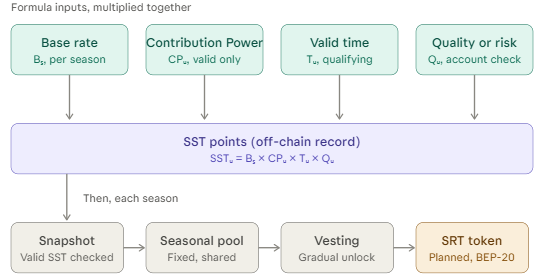
The official homepage gives a formula for SST issuance with four inputs:
Symbol | Input | Meaning |
Bₛ | Season base rate | Starting rate for the current season |
CPᵤ | Valid Contribution Power | Weighted, accepted activity |
Tᵤ | Valid time | Time that qualifies |
Qᵤ | Account quality or risk | A trust check on the account |
SSTᵤ = Bₛ × CPᵤ × Tᵤ × Qᵤ
The inputs multiply, so one weak value lowers the whole result. This is the Sirius Network CP formula explained in one line.
CoinGabbar's architecture coverage says CP builds through time, referrals, learning, missions and quality. The exact weights are not published in the sources checked.
What Feeds Contribution Power?
Consistent joining of the daily 24-hour cycle
Direct referrals that are eligible and active
Learning and mission activity, listed as planned modules
Account quality, which includes identity checks
The project states a +5% boost per eligible, active, direct referral. Its KYC update reportedly adds 5 SST for each direct referral who completes KYC. An invite alone earns nothing.
The Sirius Network SST Token Question
Many searches use the phrase "Sirius Network SST token. " The label misleads.
Per the whitepaper, SST means Sirius Contribution Points. It is off-chain, has no stated value and is not tradable. Routine mining does not automatically generate USDT.
The setup is sometimes called a dual-token model. In practice, SST records work and SRT is the only planned token.
Sirius Network SRT Token: The Planned Utility Token
It is planned as a BEP-20 token on BNB Smart Chain. Maximum supply is fixed at 5,000,000,000.
Planned uses include missions and services, network roles, governance and real-world asset cases that follow legal assessment. This makes SRT a planned utility token and reward token on paper only.
Tokens earned through contribution mining are designed to enter long-term vesting.
Point | SST | SRT |
What it is | Contribution points | Planned ecosystem token |
Where it lives | Inside the app (off-chain) | BNB Smart Chain (planned) |
Supply | Set by the season formula | Fixed at 5 billion |
Tradable | No, per the official whitepaper | Planned on-chain |
Conversion | No fixed ratio | Allocated from season snapshots |
Sirius Network Rewards Based on Contribution Power
Rewards follow fixed seasonal community pools, not a fixed rate.
At a season snapshot, valid point is weighed against identity, reputation, quality and risk. The pool is fixed, so each season splits the same amount among all eligible users.
1,000 points therefore never equals a set token count. The share also depends on everyone else's activity.
Path from CP to SRT: Sirius ID → daily participation → CP weighting → SST → Passport and reputation → season snapshot → seasonal pool → vesting → SRT
Sirius Network Roadmap
The Sirius roadmap moves from the network to on-chain tokens in four stages. Every date is a project target, not a commitment.
Period | Planned milestone | Status |
Q4 2026 (Oct to Dec 2026) | Global contribution network launches | Target, unconfirmed |
Expansion stage (date not stated) | Multilingual communities, learning, testing and partner missions, ambassador, developer and merchant scenarios, valid-user and verification, season snapshot and migration data preparation | Listed on homepage |
2027, Phase I | SST snapshot system built, along with SRT, vesting, staking, mission escrow and governance contracts, then tested and audited | Planned |
2027, Phase II | Listed on the roadmap | Details not verified |
2028 | On-chain SRT access | Planned |
Two points stand out. The audit is a planned step, so no completed audit is confirmed. The snapshot and migration work also comes before any token access, so SRT cannot be claimed before those stages finish.
Roadmap source: official website and whitepaper, checked 28 Nov 2026 (IST).
Confirmed vs Unconfirmed
Item | Status |
CP multiplies into the formula | Stated on official site |
24-hour cycles, no purchase to start | Stated by project |
+5% per eligible, active, direct referral | Stated by project |
Fixed 5 billion SRT cap | Planned, per whitepaper |
Exact CP weights | Not found in verified sources |
SRT price, listing or payout | Not published |
SST token value | None stated |
Risks Before Joining
Unverified value: Token points and any future SRT value are unconfirmed.
KYC and privacy: The data an app collects should be read before documents are submitted.
Wallet safety: A seed phrase must never be shared. The Sirius ID is an access identifier, not a private key, but it still needs protection.
Team and audit: Team identity and audit status need independent checks. An official link is not proof of safety.
Conclusion
Sirius Network Contribution Power decides how much of a user's activity counts toward SST. It feeds a seasonal pool, and SRT sits at the end as a planned token.
Disclaimer: This article is for information only. It is not financial, investment or legal advice. Details come from the official Sirius Network website and whitepaper as seen on the date below. Plans and dates may change.