

A new policy letter is putting a trading model from traditional finance in front of US regulators.
This update on Injective onchain order books centers on a comment dated November 23, 2026, in which Injective Labs asks the SEC to widen its tokenized stock exemption.
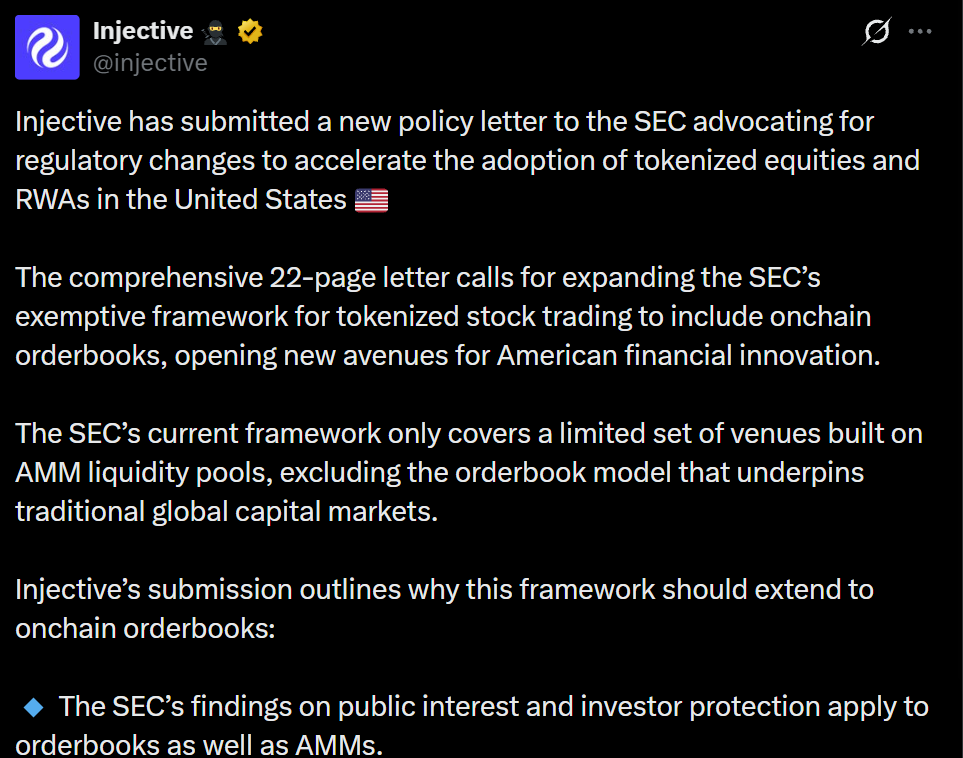
Source: Injective post
The current relief recognizes only venues built on liquidity pools, which leaves out the matching model behind most global exchanges. The letter is a recommendation, not an approval.
The submission responds to the SEC's request for comment on its temporary exemptive relief for tokenized stock trading (File No. 4-927).
The official SEC comment letter explains that a "tokenized securities venue" is currently defined as one that provides AMM liquidity pools and sets access standards.
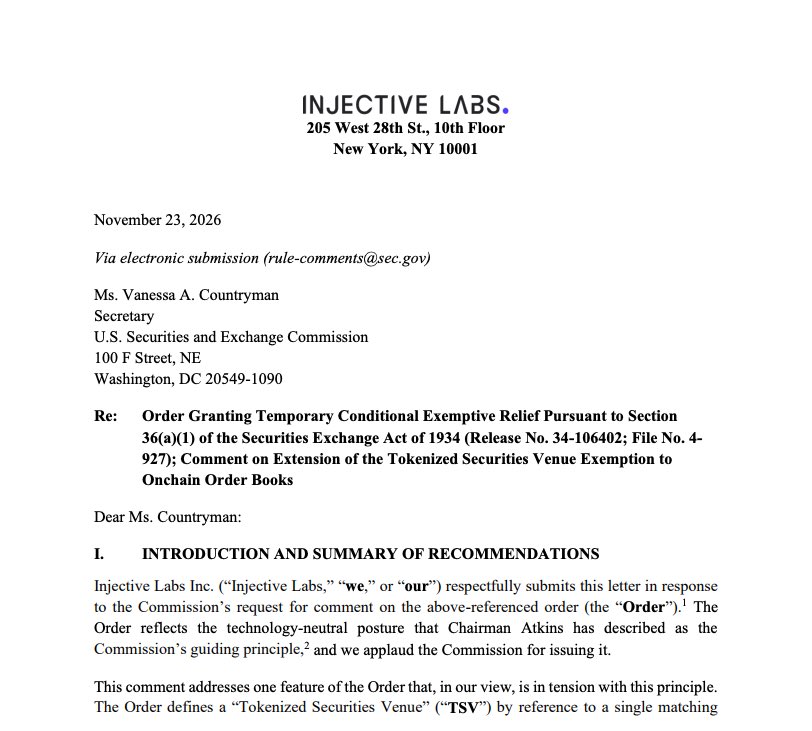
The letter argues this leaves out central limit books, even though the public-interest reasoning behind the relief does not depend on how trades are matched.
The core of this news on Injective on-chain order books is two recommendations:
Amend the venue definition to include permissioned books, whether built with smart contracts or natively in a blockchain's protocol.
Apply every existing condition to these venues and add safeguards designed for books.
The letter builds on two earlier submissions to the SEC's Crypto Task Force and a discussion with Task Force staff on October 14, 2026.
It states that Injective is a proof-of-stake Layer 1 built on the Cosmos SDK with native EVM support. Its mainnet launched in November 2021.
The letter says it does not recommend any less-stringent application of existing conditions.
It adds these five:
Safeguard | What it means |
Surveillance program | Written policies to detect spoofing, layering, wash trading and marking the close, with records available to SEC staff |
Self-trade prevention | The matching engine blocks a participant, or a commonly controlled one, from trading against itself |
Minimum price increments | Prices must follow the Rule 612 increments for the underlying stock |
Price limits | In regular hours, limits follow the stock's Limit Up-Limit Down bands, and outside them the venue applies its own disclosed volatility control |
Protocol-level halts | Halts must be enforced on every path to the matching engine, not just a front-end, with a disclosed reopening process |
The SEC's findings rest on the benefits of trading on a public ledger. According to the letter, Injective onchain order books show how a protocol-native venue can deliver each of them:
Self-custody: No intermediary holds assets. The protocol locks the assets behind each trade and releases them on a match or cancellation.
Round-the-clock access: Trading is not limited to exchange hours.
Fast settlement: Matching and asset exchange happen in the same block.
Public verifiability: Every order, cancellation, match and transfer is recorded on a ledger anyone can read.
The letter also makes four comparison points with liquidity pools:
Price alignment: Pools price by asset ratio and rely on arbitrageurs to fix gaps afterward. A book's price comes from competing quotes that participants can update continuously.
Comparable data: Book data can be compared directly with the exchange data the SEC already collects.
No pooling layer: Liquidity providers post resting orders from their own accounts instead of joining a common fund.
Simpler retail risk: Impermanent loss, a pool-specific risk, does not apply, and inventory risk falls only on those who post resting orders.
The letter uses Injective's frequent batch auction to show how a book can reduce ordering advantages.
Blocks arrive roughly every two-thirds of a second. In each block, market orders are filled first against the resting book as it stood at the block's start.
Crossing limit orders are matched next, and each stage clears at one uniform price.
The letter is careful about limits. It does not claim batching removes all front-running or MEV risk.
Block producers can still affect execution, and an immediate-execution order type that runs outside the batch may carry different risks.
It proposes that venues disclose which order types join the batch and how they enter matching. It also notes that books face spoofing and layering, while pools face sandwich attacks.
The letter says it does not seek individualized relief and makes no claim that any implementation, including the protocol's own, already meets the proposed conditions.
It adds that validators should not be treated as the venue merely because they run matching logic.
The responsible venue would be a US person who controls the market's rules and sets access.
Any venue would need to satisfy every condition before relying on an expanded exemption.
INJ is trading at $6.36, up 3.86% in 24 hours. The 24-hour chart shows a steady climb toward the day's high.
Metric | Value |
Price | $6.36 (+3.86%, 24h) |
Market cap | $635.83M (+3.86%) |
Unlocked market cap | $635.99M |
Volume (24h) | $71.17M (−9.48%) |
Volume/Market cap | 11.15% |
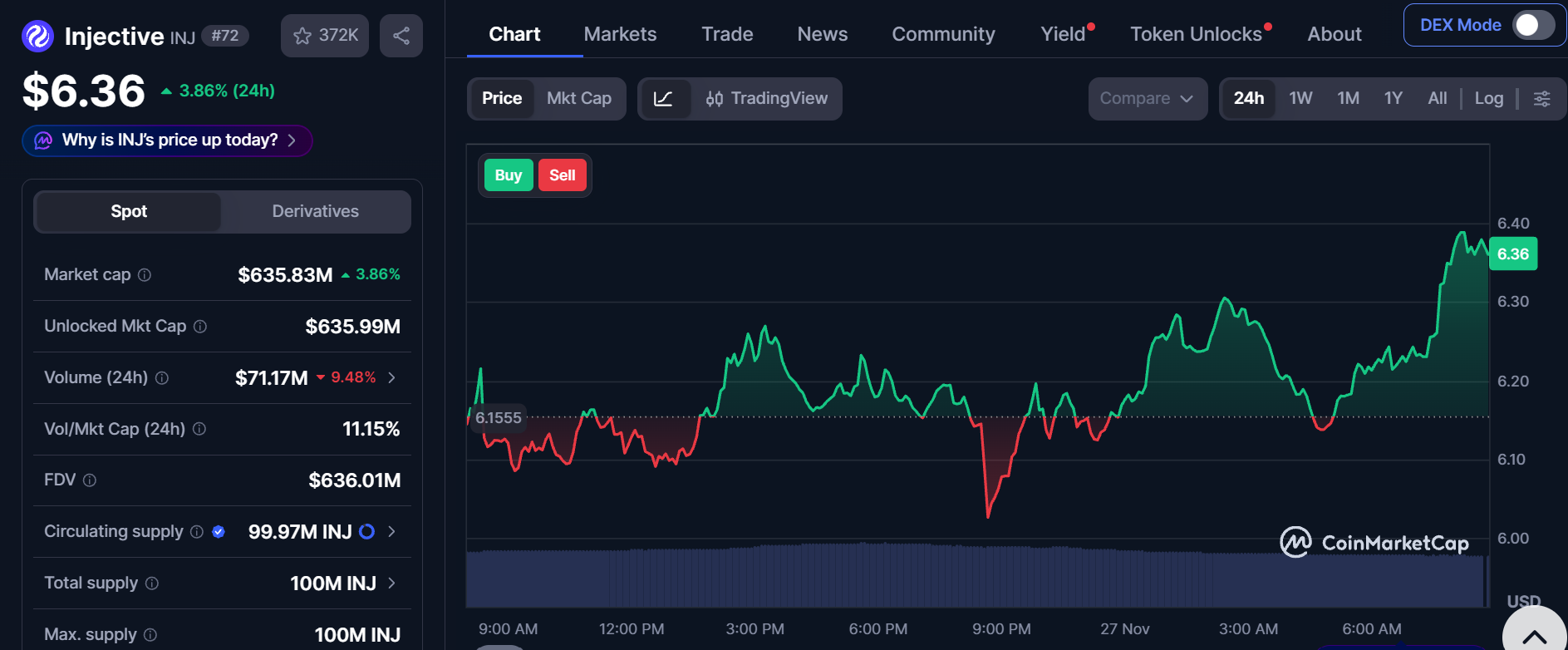
Note: This data is as of 27 November 2026, around 9:00 AM, the time shown on the CoinMarketCap chart. Prices and market figures change every minute, so check the live price page before making any decision. This is not financial advice.
Source: CoinMarketCap Live Data
Injective onchain order books are now part of the SEC's public comment file on tokenized stock trading. The letter makes a technology-neutral case, backed by five extra safeguards. Whether the SEC extends its exemption is still undecided, so watch for any official SEC update on File No. 4-927.
This article is for educational and informational purposes only and is not financial or investment advice. Crypto assets are high risk, their prices can be very volatile, and you can lose some or all of your money. Always do your own research and consider speaking with a licensed financial advisor before making investment decisions.
Frequently Asked Questions (FAQ)




Owned by:-
DCG Tech FZCO, UAE
Delivery Partner:-
Gabbar MediaTech Pvt Ltd.
Copyright © 2026 Coin Gabbar. All Rights Reserved


