Kamino Backpack Market Enables USDC Loans Against Tokenized Equities

Solana Users Can Now Borrow USDC Against Stocks
Crypto news update: Kamino Finance has opened the Kamino Backpack Market on Solana. Holders of Backpack Securities tokenized stocks can lock them in and borrow USDC, with no need to sell a single share.
The lender announced the launch on an official X thread. WallStreetX also covered the same news.
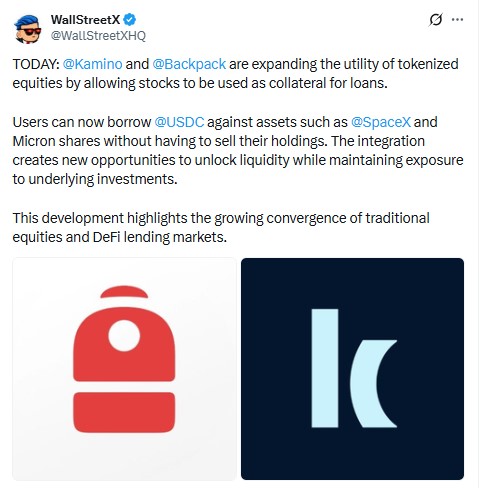
Source: WallStreetX Official X Post
Which Tokenized Stocks Can Be Used as Collateral
The pool accepts four tokenized stocks at launch:
Micron (MU)
SK Hynix (SKHY)
SpaceX (SPCX)
SanDisk (SNDK)
The issuer says each token is backed 1:1 by a real share or security entitlement. Eligible account holders can redeem tokens for the shares under its terms. Dividends are reinvested into more tokens, and stock splits are handled through a multiplier on the token.
How the Kamino Backpack Market Works for Borrowers
Built on Solana, the pool is isolated, with its own reserves and risk settings. Trouble elsewhere on the protocol does not flow into it. Users can deposit, borrow, repay, and withdraw at any time. Several stocks can back one loan, and interest builds continuously.
In practice, a holder unlocks cash while keeping price exposure to the stock, much like a securities-backed loan.
Allez Labs curates the Kamino Backpack Market. It sets loan-to-value (LTV) ratios, liquidation thresholds, and supply caps. Launch figures it reported are below. Check the live settings, because they can change.
Asset | Max LTV | Liquidation threshold |
MU, SKHY | 40% | 60% |
SPCX, SNDK | 30% | 50% |
Key Risks Borrowers Should Check Before Using It
Like any on-chain crypto lending, borrowing on the Kamino Backpack Market carries real risk. Positions can be liquidated if collateral falls against the loan. That danger grows on weekends and holidays, when US stock exchanges close and oracle prices may lag.
Smart contract, oracle, and issuer risks all apply.
The issuer’s custody protections cover the underlying shares, not the positions on the protocol.
Eligibility rules, regional limits, and account requirements apply.
Why the Update Matters for Tokenized Stock Lending
Armani Ferrante, who runs the issuer, said ownership should carry the same utility on-chain as in a brokerage account. The lender’s CEO, Michael Weisz, said stocks become useful when they enter lending with clear onchain risk rules.
The protocol says it is the largest onchain lender for tokenized equities by collateral volume, with about $50 million supplied as of October 2026.
For readers following the latest crypto updates, the Kamino Backpack Market shows stocks on chain turning into working collateral. More tokens are expected to join over time, so watch for the next update.
Disclaimer: This article is for educational and informational purposes only and should not be considered financial or investment advice. Always conduct your own research before making investment decisions.






