

The KRW1 stablecoin is a token built to hold a 1:1 value with the South Korean won. BDACS, a Seoul digital asset custodian, issues it. BDACS says Korean won held at a bank back the tokens. It is not a government currency, and no deposit insurance applies.
KRW1 Stablecoin Status on 26 Nov 2026
Three facts need to stay apart. The first is the design, which BDACS has published. The second is the live issuance and reserve data. The third is the law, which is still a proposal.
Item | Status on 26 Nov 2026 |
Issuer | BDACS, a registered virtual asset service provider (VASP) (2026-11-24 22:04:28) |
Stated backing | Won reserves at a partner bank, per BDACS |
Dashboard check | 0 tokens issued and 0 won in reserves shown on 26 Nov 2026 |
Stablecoin law | Proposed by the FSC on 24 Nov 2026 |
Injective deal | Memorandum of understanding (MOU), not a live service |
The dashboard reading matters most. A 1:1 claim only counts when a dated issuance figure and a matching reserve figure sit side by side.
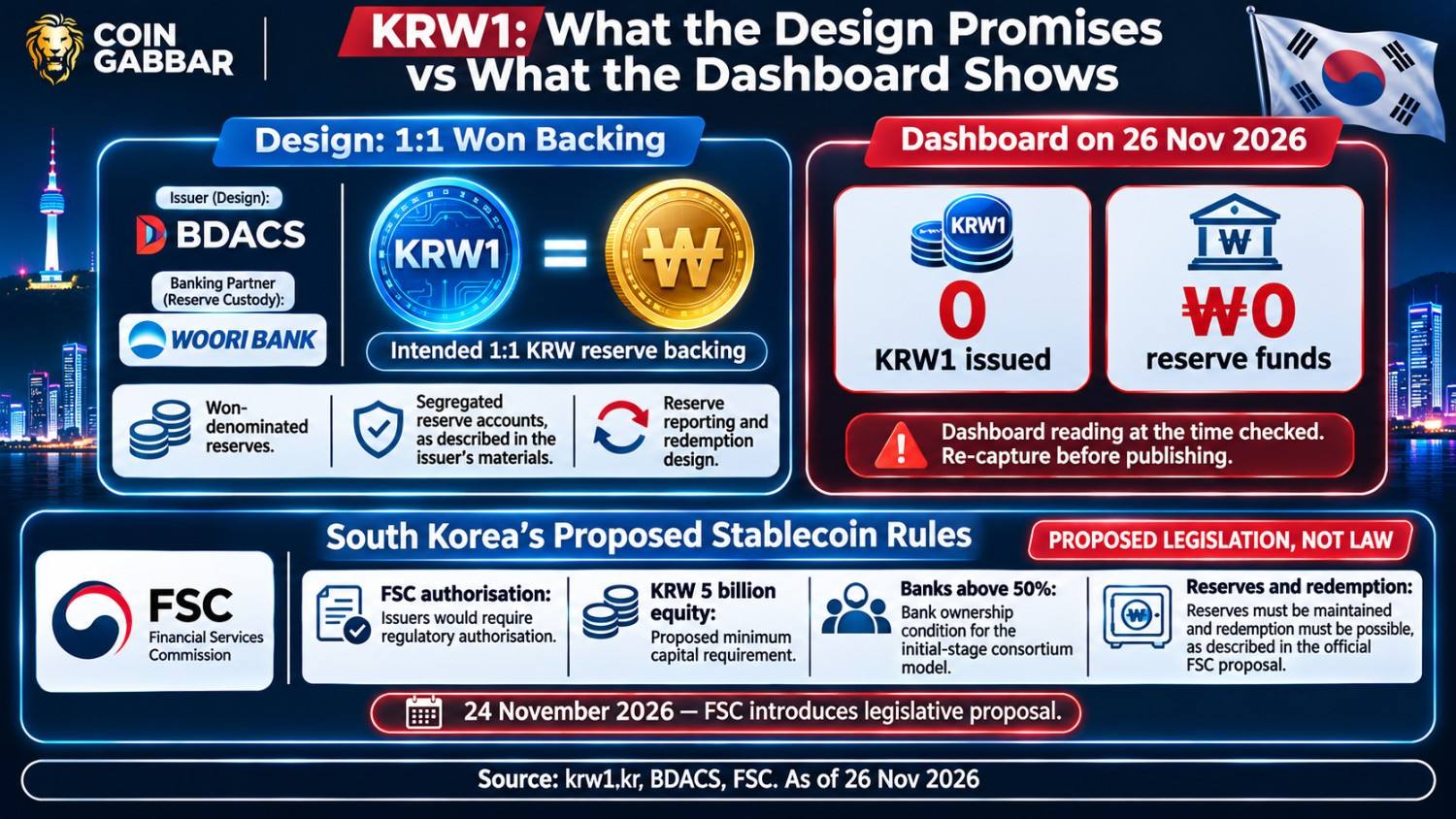
On 26 Nov 2026, the public page showed neither. The dashboard is dynamic, so the figures should be rechecked before any decision.
Who Is Behind the KRW1 Stablecoin? BDACS Explained
BDACS stands for Beyond Digital Asset Custody Service. It offers custody and related services in South Korea. The company holds a VASP registration.
The Injective announcement of 20 October 2026 said BDACS held more than 80 billion won in assets under custody in the first half of 2026. That number describes the custody business. It is not the token reserve, supply, or market value.
BDACS first announced Stablecoin on 18 September 2025 on Avalanche, with Woori Bank as a banking partner. CoinGabbar covered that launch on the day. The project then sat at the proof-of-concept stage.
A VASP registration is not a stablecoin issuance license. A bank partner also does not turn a private token into a bank deposit. Both points matter for how readers judge KRW1.
How the KRW1 Stablecoin Works
The Won stablecoin follows four steps, like most fiat-backed coins.
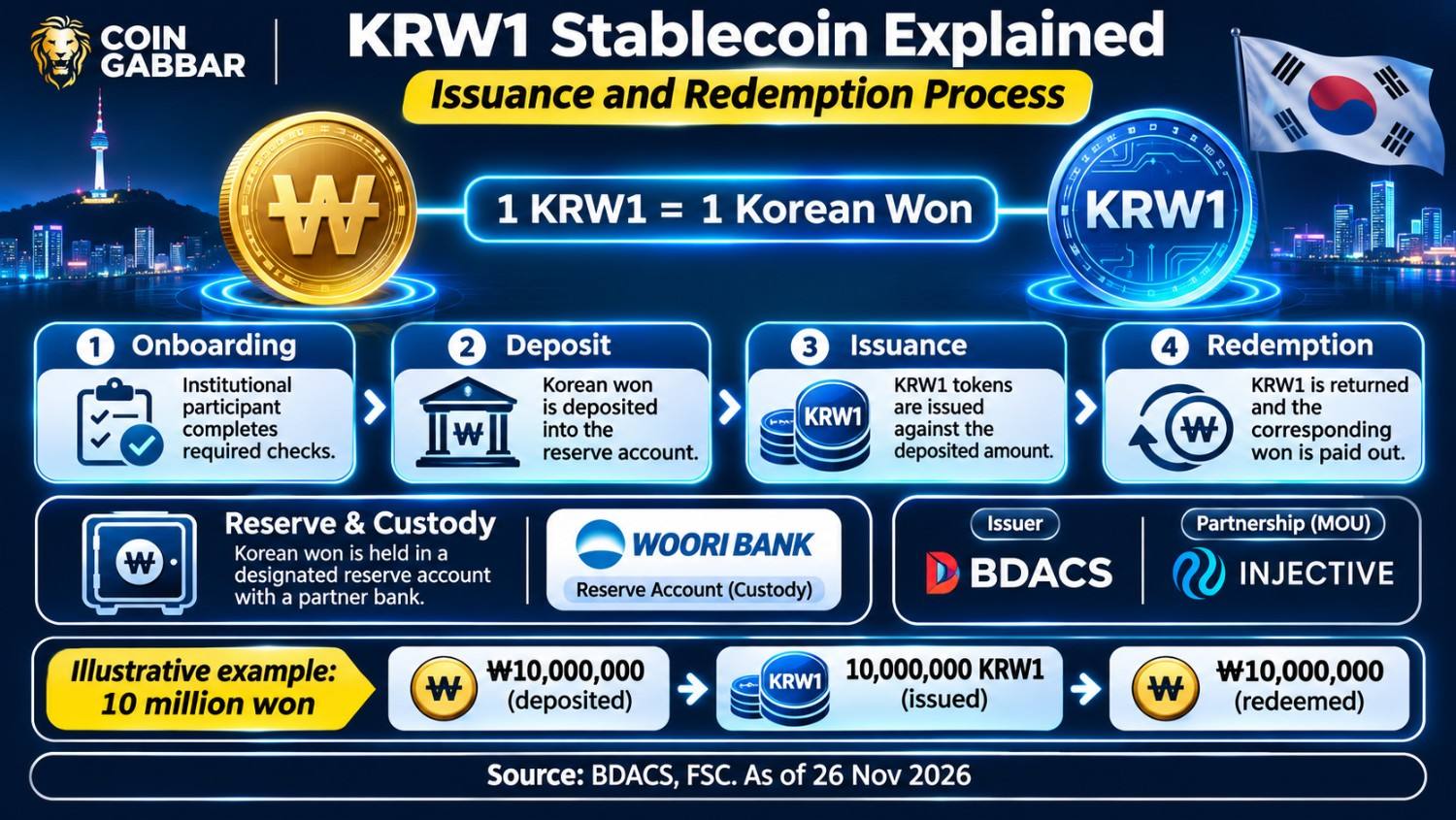
Onboarding: an approved firm passes identity and money-laundering checks.
Deposit: the firm sends the deposit to the reserve account.
Issuance: the issuer creates the same amount of this token on a blockchain.
Redemption: the holder returns tokens, receives them, and the tokens are burned.
Here is an illustrative stablecoin example from CoinGabbar. A firm deposits 10 million won and receives 10 million tokens. If the firm redeems later, it expects 10 million won back, and the tokens leave circulation. The numbers are a teaching example, not real KRW1 data.
The whitepaper also lists approved wallet addresses and identity checks. Fees, minimums, and settlement times depend on the terms set by the issuer.
KRW1 Stablecoin and Injective: What Is Confirmed?
On 20 October 2026, BDACS and Injective announced an MOU. It explores stablecoin as a well-settlement asset for real-world assets (RWAs) on Injective. The announcement states that institutional minting and redemption remain subject to approval from regulators.
An MOU records intent. It does not prove live markets, deep liquidity, or exclusive use across the network. CoinGabbar tracked the deal in its Injective weekly update on tokens on 25 October 2026.
The use case is simple. A Korean bond token priced in won can settle in tokens. A dollar coin would add a currency swap first.
What Did the FSC Propose on 24 November 2026?
The Financial Services Commission (FSC) presented a draft of the act at a committee meeting on 24 November 2026 at 3:00 P.M. KST. The FSC release is the primary source.
The proposal includes these terms:
FSC authorization for issuers of domestic stablecoins
At least 5 billion won in equity capital
Bank-majority consortia, with banks above 50% in the first stage
Room for fintech firms to be the largest single shareholder
Reserves that cover the tokens outstanding
Redemption at equivalent value
Limits on interest paid only for holding the token
These are proposed rules, not law. Details can change before a vote. For wider context, the CoinGabbar explainer on Korean bank stablecoins from 23 November 2026 covers the bank side.
BDACS would face one open question. Its VASP registration does not equal authorization under the proposed regime. How it fits a bank-majority consortium has not been announced.
KRW1 Stablecoin vs. USDT and USDC
Feature | KRW1 | USDT | USDC |
Peg | Korean won | Dollar | Dollar |
Issuer | BDACS | Tether | Circle |
Main use | Won settlement for firms | Trading and dollar liquidity | Payments and settlement |
Maturity | Early stage | Established | Established |
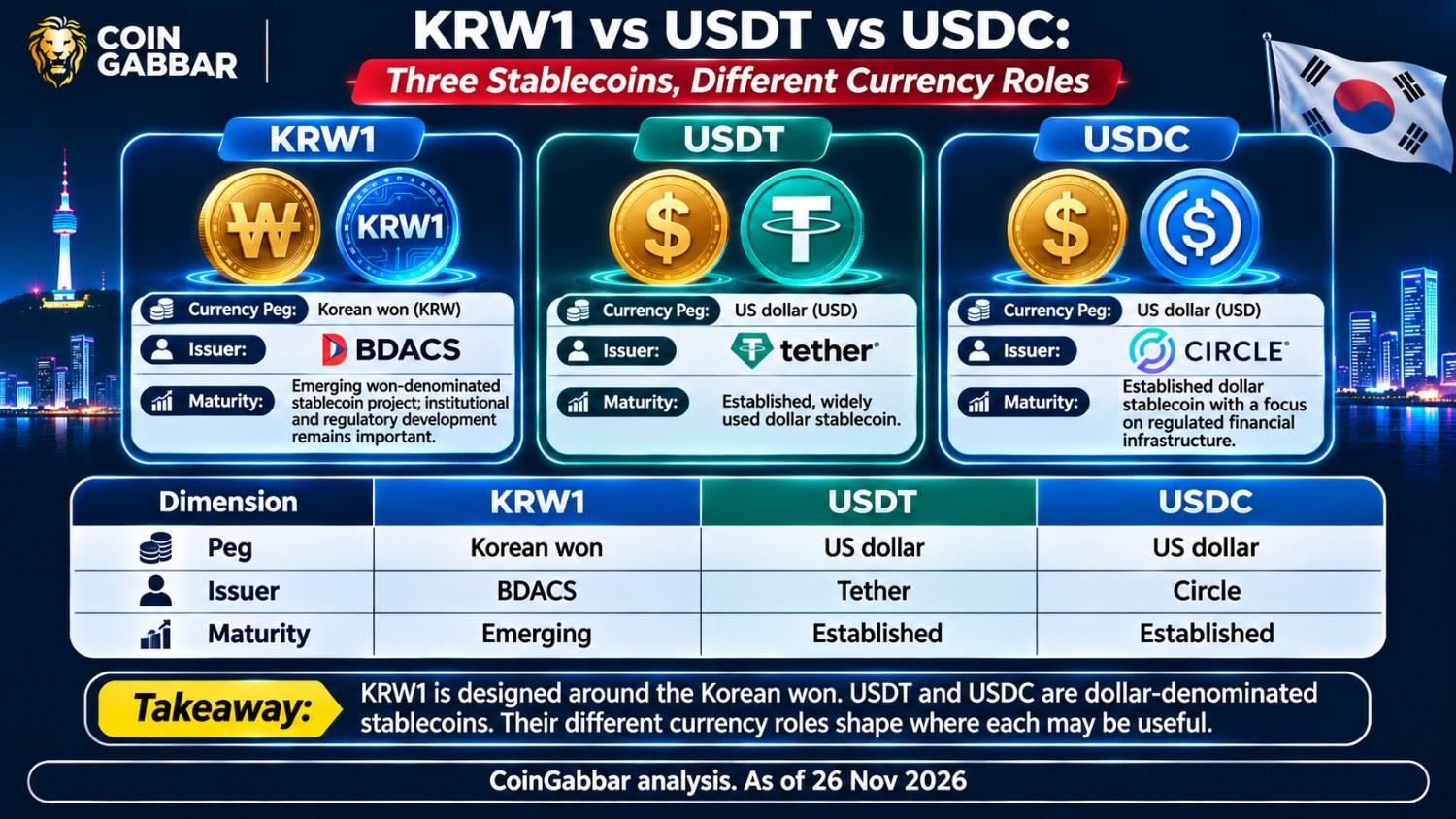
The KRW1 stablecoin aims for local-currency settlement. USDT and USDC have much larger markets and deeper liquidity. KRW1 would need working redemption, verified reserves, and real demand before it could compete. For more on dollar coins, see the CoinGabbar guide to best stablecoins.
Expert Opinion: What Should Readers Watch?
From a CoinGabbar research view, Korean Won links three trends: private won tokens, institutional RWA settlement, and the new Korean digital asset law.
Partnership news is the weakest signal. The strongest signals are dated issuance data, a matching reserve balance, and an independent attestation. A zero reading on the dashboard means the live reserve position cannot yet be confirmed from public data.
The Injective MOU gives KRW1 a clear use case. It still needs milestones, such as named institutional users and live settlements.
What to Watch Next for the KRW1 Stablecoin
A dated token issuance figure and a matching won reserve
An independent attestation for the same period
Confirmed injective settlement activity
The bill text and any change to the bank-majority rule
Regulatory sign-off for BDACS to issue and redeem
This token could become a useful won settlement tool. The path of the KRW1 stablecoin depends on proof of reserves, working redemption, and approval, not on announcements alone. CoinGabbar will update this page when any of those points change.
Disclaimer: This article is for information only. It is not financial, investment, tax, or legal advice. Stablecoins carry issuer, reserve, redemption, and regulatory risks. Check current terms with official sources.
Frequently Asked Questions (FAQ)




Owned by:-
DCG Tech FZCO, UAE
Delivery Partner:-
Gabbar MediaTech Pvt Ltd.
Copyright © 2026 Coin Gabbar. All Rights Reserved












