


How to Secure a Bitcoin Miner After the Hashrate Hijacking Wave
To secure a Bitcoin miner right now, delete every plain-text stratum+tcp:// pool address. Then move to Stratum V2 or TLS with certificate checks, and compare your local hash rate with your pool dashboard.
Braiin, a mining pool operator, reported 24 hash rate hijacking incidents between Nov. 7 and Nov. 20, 2026. The attacks are still active. This guide covers the timeline, the attack method, and seven steps to secure a Bitcoin miner today. New to the topic? Start with Bitcoin mining basics.
Hashrate is the computing power a miner sends to a pool. One exahash per second (EH/s) equals one quintillion hashes per second. Hijacking sends that power to the wrong place, so a thief collects the reward. All dates below are in 2026.
Date | What happened? | Reported by |
Nov 7 | Start of the window in which Brian counted 24 incidents. Early cases hit mining sites in Brazil and Argentina. | Braiins report |
Nov 14, about 6 p.m. Pacific | Attackers began redirecting hash rates from over a dozen Luxor client accounts to the OCEAN pool. | Luxor CEO and company posts |
Nov 15 | Luxor patched its Commander platform within two hours. It pledged to pay affected clients in full. | Luxor |
Nov 20 | Four episodes each hit about 1,050 to 1,600 sites for roughly 6 to 49 minutes, diverting 0.6 to 1.9 EH/s. | |
Nov 25 | Braiins released Braiins OS 26.11 with certificate and hostname checks, plus a free Stratum V2 proxy. | Braiins |
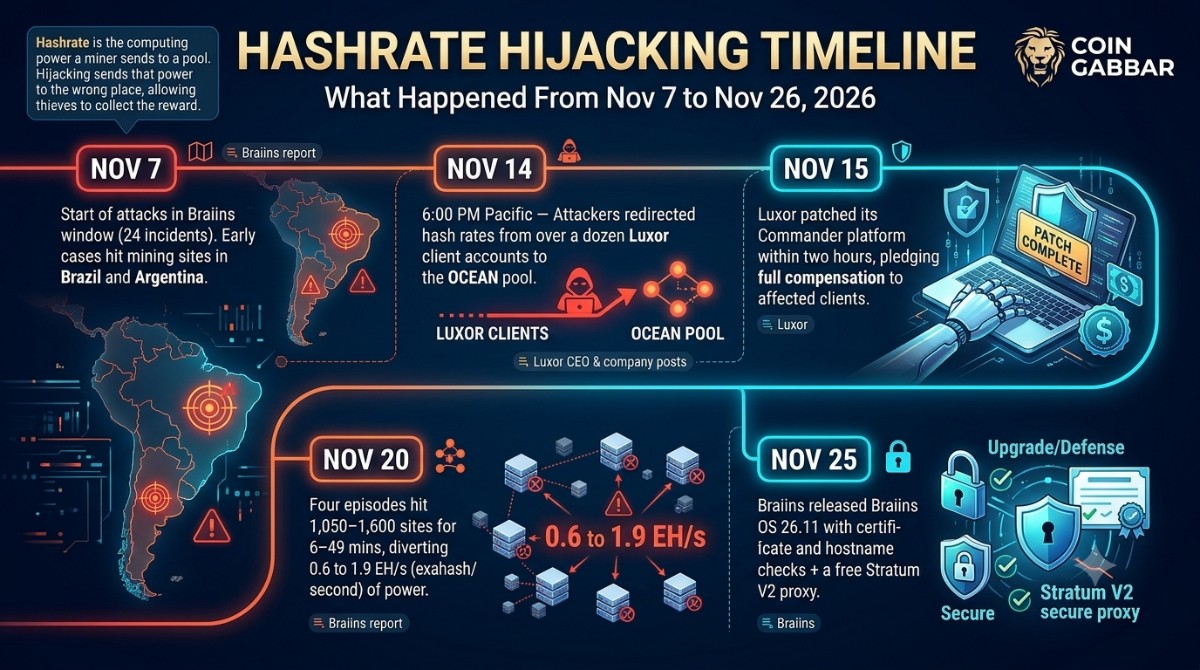
Counts and totals come from the companies themselves, so independent verification is still limited.
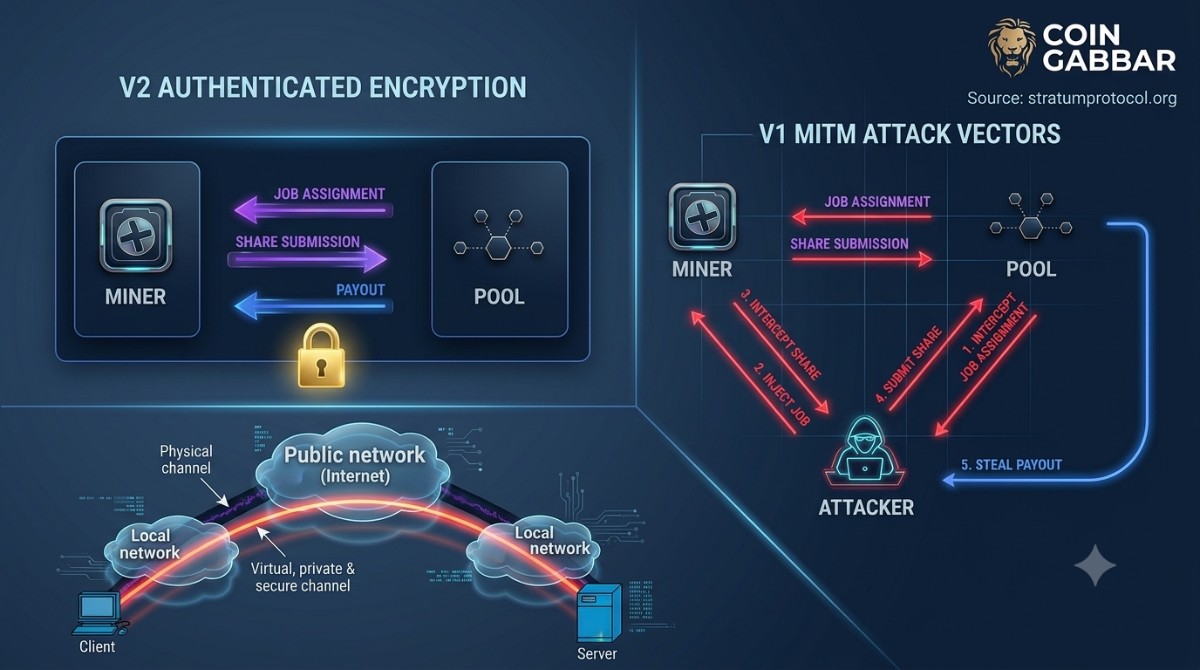
Stratum V1 is the older protocol miners use to talk to pools. It sends plain text with no encryption, authentication, or integrity checks. A miner therefore cannot prove that the server it reaches is the real pool.
Attackers exploit this through route manipulation. Border Gateway Protocol (BGP) is the system that tells internet traffic which path to follow. Braiins says the attacker used Stratum V1 and BGP manipulation without breaching any miner or Braiins Pool.
The danger is silence. Hijacked machines kept hashing at full power while dashboards showed zero hashrate.
The idea is not new. Braiins notes that Dell SecureWorks documented the same routing trick in 2014, with roughly $83,000 in rewards taken. Academic routing attack research also shows how hijacked routes can isolate mining power. For basic terms, see this hashrate definition.
Many reports mix the two events, but they differ. Luxor said attackers broke into the commander's fleet management software. Luxor said Luxor p and LuxOS were not affected. Its CEO blamed an AI-enabled vector but gave no technical detail.
Early reports of 64,000 machines and 13 EH/s remain unconfirmed by Luxor. Luxor CEO warns of rising AI-enabled cyberattacks after mining hijack +3.
Braiins described a different method: network route abuse against unencrypted connections. Miners therefore face two layers of risk: the network path to the pool and the tools that manage the fleet. A plan to secure a Bitcoin miner must cover both.
Bitcoin's total hashrate was about 1,016 EH/s on Nov. 20. The largest diversion was 1.9 EH/s. Dividing the two gives about 0.19% of network power. The smallest burst, 0.6 EH/s, is about 0.06%.
Figure | Value | Status | Source |
Incidents, Nov 7 to Nov 20 | 24 | Reported | Braiins |
Peak diverted hashrate | 1.9 EH/s | Reported | Braiins |
Network hashrate, Nov 20 | about 1,016 EH/s | Reported | Braiins |
Peak share of network | about 0.19% | CoinGabbar calculation | 1.9 divided by 1,016 |
Theft of up to 2% of output | Unverified | Secondary estimate | D-Central, via a third-party report |
Methodology: peak share equals the peak diverted EH/s divided by the network EH/s from the same report. Bursts lasted minutes, so the figure shows scale, not total loss.
At this size, the events hurt individual miners' income. They do not come close to the share needed to attack Bitcoin consensus. Readers new to mining can see how BTC mining works.
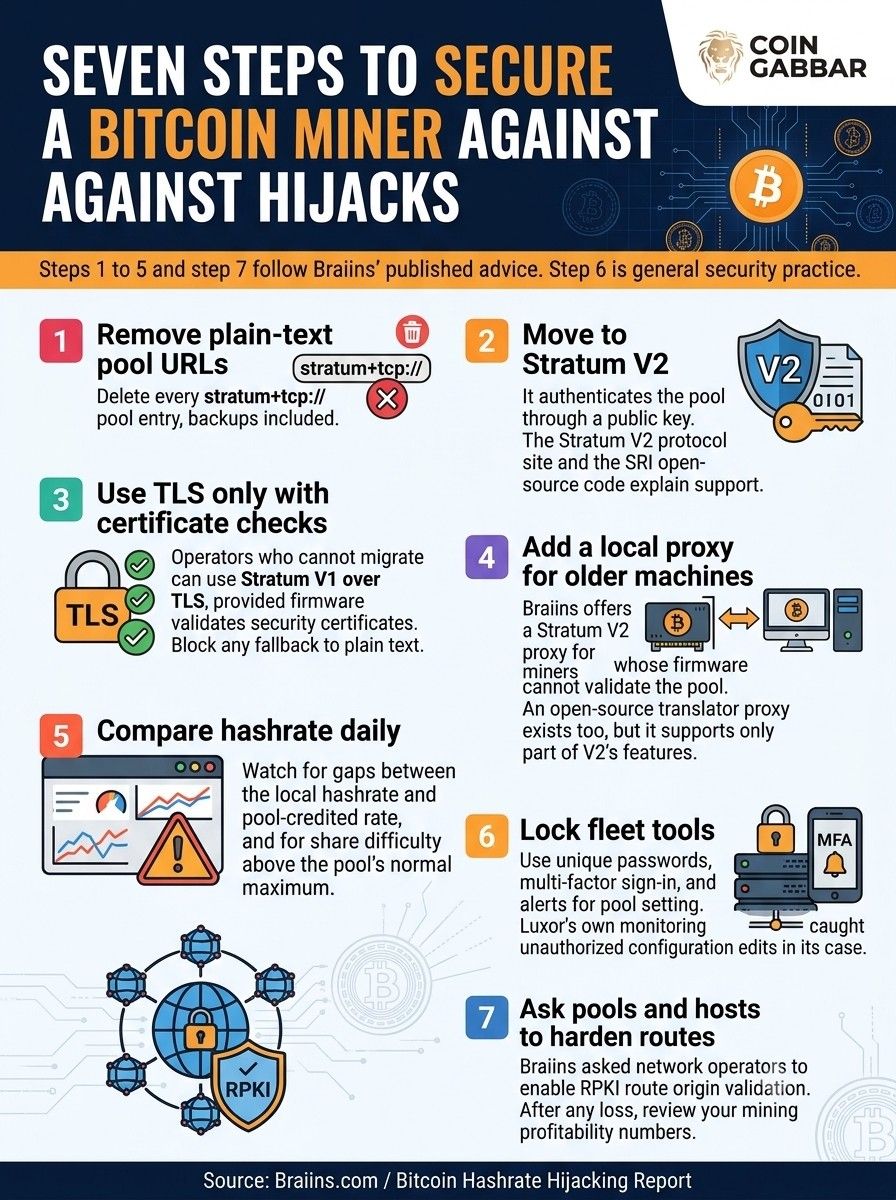
Steps 1 to 5 and step 7 follow Braiins' published advice. Step 6 is general security practice.
Remove plain-text pool URLs: Delete every stratum+tcp:// entry, backups included.
Move to Stratum V2: It authenticates the pool through a public key. The Stratum V2 protocol site and the SRI open-source code explain support.
Use TLS only with certificate checks: Operators who cannot migrate can use Stratum V1 over TLS, provided firmware validates security certificates. Block any fallback to plain text.
Add a local proxy for older machines: Braiins offers a Stratum V2 proxy for miners whose firmware cannot validate the pool. An open-source translator proxy exists too, but it supports only part of V2's features.
Compare hashrate daily: Watch for gaps between the local hashrate and pool-credited rate and for share difficulty above the pool's normal maximum.
Lock fleet tools: Use unique passwords, multi-factor sign-in, and alerts for setting changes. Luxor's own monitoring caught unauthorized configuration edits in its case.
Ask pools and hosts to harden routes: Braiins asked network operators to enable RPKI route origin validation. After any loss, review your mining profitability numbers.
Encryption does not stop a route hijack itself. It makes it much harder for a fake pool to pass as the real one. Pool choice alone may not help either: Braiins found most large pools still offered only unsecured Stratum V1 connections.
Treat the evidence with care. Braiins builds Stratum V2 tools, so it gains from V2 adoption. One summary noted the account rests on a single report that has not been independently corroborated. The "AI-enabled" label is also the Luxor CEO's claim, pending the promised post-mortem.
We will update this page after three events: Luxor's post-mortem, any new Braiins notices, and pool announcements of Stratum V2 support. For a wider industry context, see the US Bitcoin mining ecosystem and our crypto mining hub.
Disclaimer: This article is for information only. It is not financial, legal, or cybersecurity advice. Mining carries risk. Consult a qualified security professional before changing your setup.
Frequently Asked Questions (FAQ)




Owned by:-
DCG Tech FZCO, UAE
Delivery Partner:-
Gabbar MediaTech Pvt Ltd.
Copyright © 2026 Coin Gabbar. All Rights Reserved












