LI.FI Argus Integration Opens Cross-Chain Swaps on Arc

LI.FI Brings Swaps and Bridging Inside the Launchpad App
Latest crypto news: the LI.FI Argus integration is now live. On November 2, 2026, the team said users of Argus can swap and bridge any asset from any chain inside the app. Argus is a permissionless launchpad on Circle’s network.
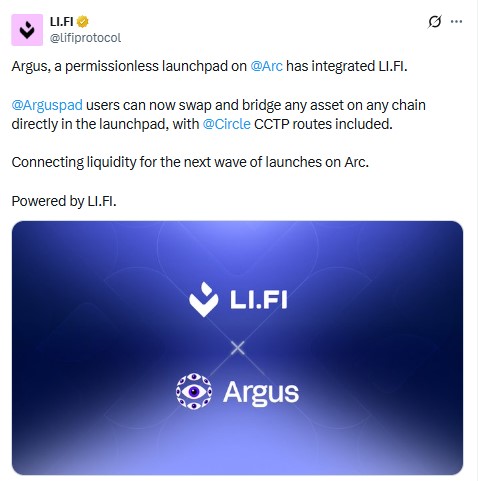
The official LI.FI post on X says the setup includes Circle CCTP routes. The team framed the aim as connecting liquidity for the next wave of token launches.
Users swap and bridge without leaving the launchpad
CCTP routes cover native USDC transfers
The router handles pricing and execution in the background
What the LI.FI Argus Integration Changes for Users
Before this update, funding a purchase meant leaving the app. Traders had to use a separate bridge. Now a trader holding assets elsewhere can start from the launchpad itself. Cross-chain bridges still run underneath, but the user sees one flow.
The aggregator is a routing layer for on-chain finance. According to its documentation, one API, SDK, or widget gives apps several tools. These include same-chain swaps, cross-chain swaps, and multi-step flows, such as bridge then swap. It compares routes on price, speed, gas, and reliability.
How Circle CCTP Routes Move Native USDC Between Networks
CCTP stands for Cross-Chain Transfer Protocol. Circle’s CCTP burns USDC on the source network and mints the same amount on the destination. No wrapped copy is created. Newer versions add a faster transfer option and programmable hooks.
That suits this network well, because gas fees are paid in USDC. A user who arrives with USDC stablecoin can cover fees and buy tokens with one asset.
Detail | Confirmed information |
Announced | November 2, 2026 |
Source | Official LI.FI post on X |
New feature | In-app swaps and bridging |
Included routes | Circle CCTP |
Network | Arc, the mainnet, has been live since September 16, 2026. |
Where Arc and the Launchpad Fit in the Bigger Picture
Arc is an open Layer-1 blockchain from Circle. Its mainnet opened on September 16, 2026, according to Circle’s press release. It is EVM-compatible and targets sub-second finality.
Argus lets anyone launch a token. Per its official docs, launches carry configurable buy and sell taxes. Liquidity sits in locked Uniswap v4-style pools, and prices show in USDC.
According to the docs, the platform keeps a share of fees. A large part of that revenue funds buybacks of its own $ARGUS token.
The platform is among the launchpads active on the network. No dated volume or user figures came with this update, though. Plugging into a router also lets a small team offer many routes without building each bridge. That makes this crypto update a useful signal for the wider ecosystem.
Risks Traders Should Weigh After the Launchpad Update
Moving funds between networks is never risk-free. Bridges can stall. Swaps may fill at a worse price than quoted, and smart contract bugs are always possible. New launchpad tokens may also trade thin and swing hard, and each token sets its own tax, so the real cost of a trade can differ.
The LI.FI Argus integration widens access, not token quality. Easier inflows may help new launches find buyers, but that depends on real demand. Neither side shared usage data, so the effect on liquidity remains unmeasured.
Fresh Arc network news will show whether volumes follow. Until then, the LI.FI Argus integration is a user-experience upgrade, not proof of growth.
Disclaimer: This article is for educational and informational purposes only and should not be considered financial or investment advice. Always conduct your own research before making investment decisions.






