Lightning Network Balance Discovery: Can Attackers Infer BTC?

How Lightning Network Balance Discovery Reveals Hidden Channel Funds
Lightning Network balance discovery lets an observer guess how much Bitcoin sits on each side of a channel. It does not expose a whole wallet or private keys. Studies now show how well the attack works and how to blunt it.
Glossary
Payment channel: A shared Bitcoin balance between two users.
Probing: Sending payments built to fail so the errors reveal information.
Information gain: How much an attacker learns about a hidden balance.
Onion routing: A method that hides the full route from middle nodes.
What Is Lightning Network Balance Discovery?
Lightning Network balance discovery is a way to guess the hidden split of funds inside a channel. The network shows a channel's total size. It does not show how much each side holds. Attackers use test payments to narrow that gap.
A payment channel is a shared Bitcoin balance between two users on a layer 2 network. Each payment moves funds from one side to the other. So the split keeps changing.
Why Are Lightning Channel Balances Hidden?
Hidden balances protect privacy. Nodes share channel size and routing data so senders can find a path. The Lightning rulebook, called BOLTs, says what is public. BOLT #7 covers that public channel data.
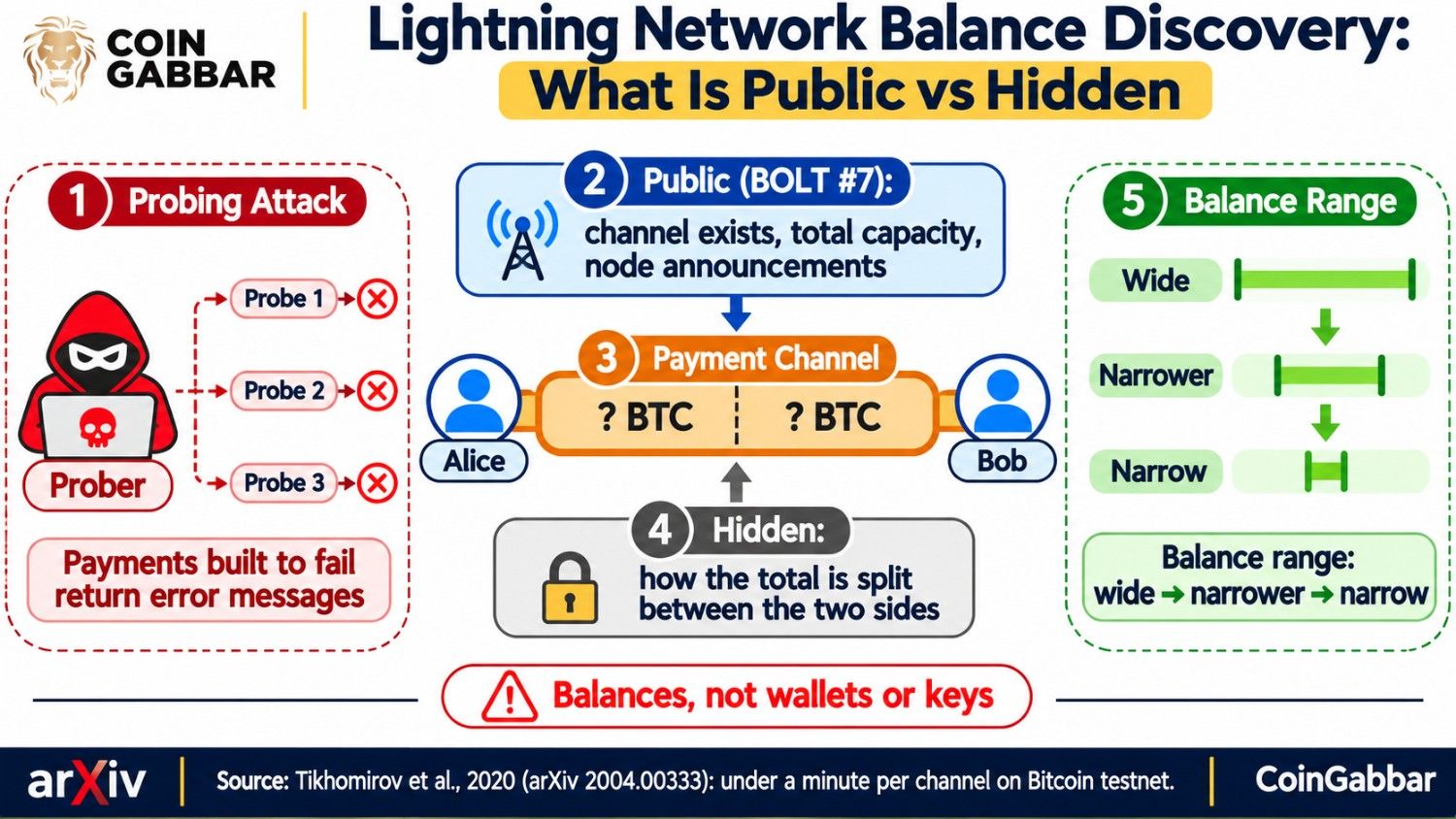
Onion routing adds cover. Under BOLT #4, a relay node learns only the node before it and the node after it. It never sees the full route.
Hiding balances has a cost. A payment fails if one hop lacks funds on the right side. The sender must try again. Experts call this the privacy versus routing trade-off.
How Does Lightning Network Balance Discovery Work?
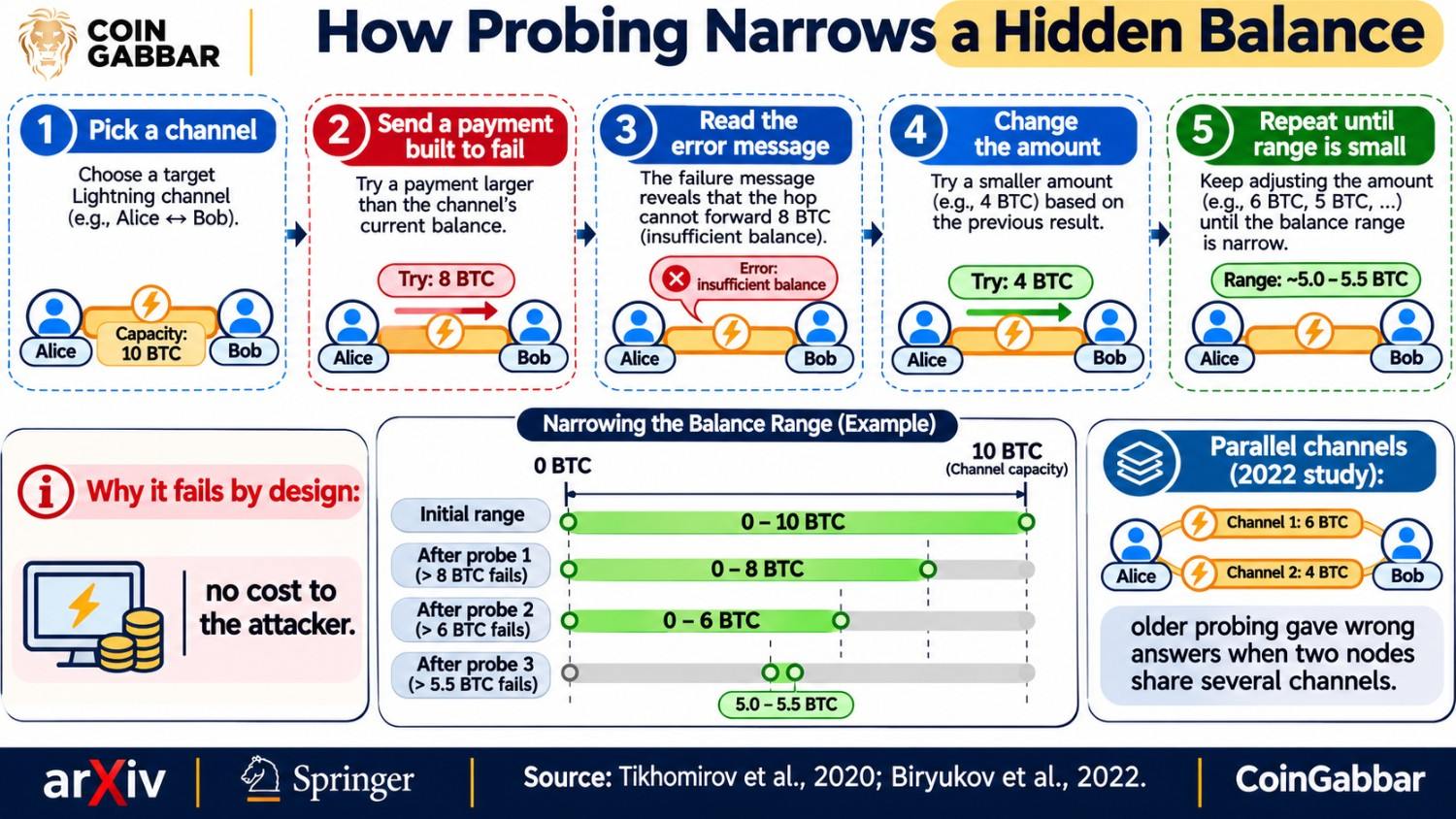
The classic method is probing. The attacker sends payments that are built to fail. Each failure returns an error message. That message shows whether a hop could have passed the amount along.
Repeat with new amounts, and the balance range shrinks. A 2020 study tested this on Bitcoin's testnet. It reported under a minute per channel. It needed moderate capital and no spending, since the payments fail by design.
Later work added detail. Two nodes can share several parallel channels. Older probing gave wrong answers there, so a 2022 study built a model that handles it.
Does Lightning Network Balance Discovery Work on Today's Network?
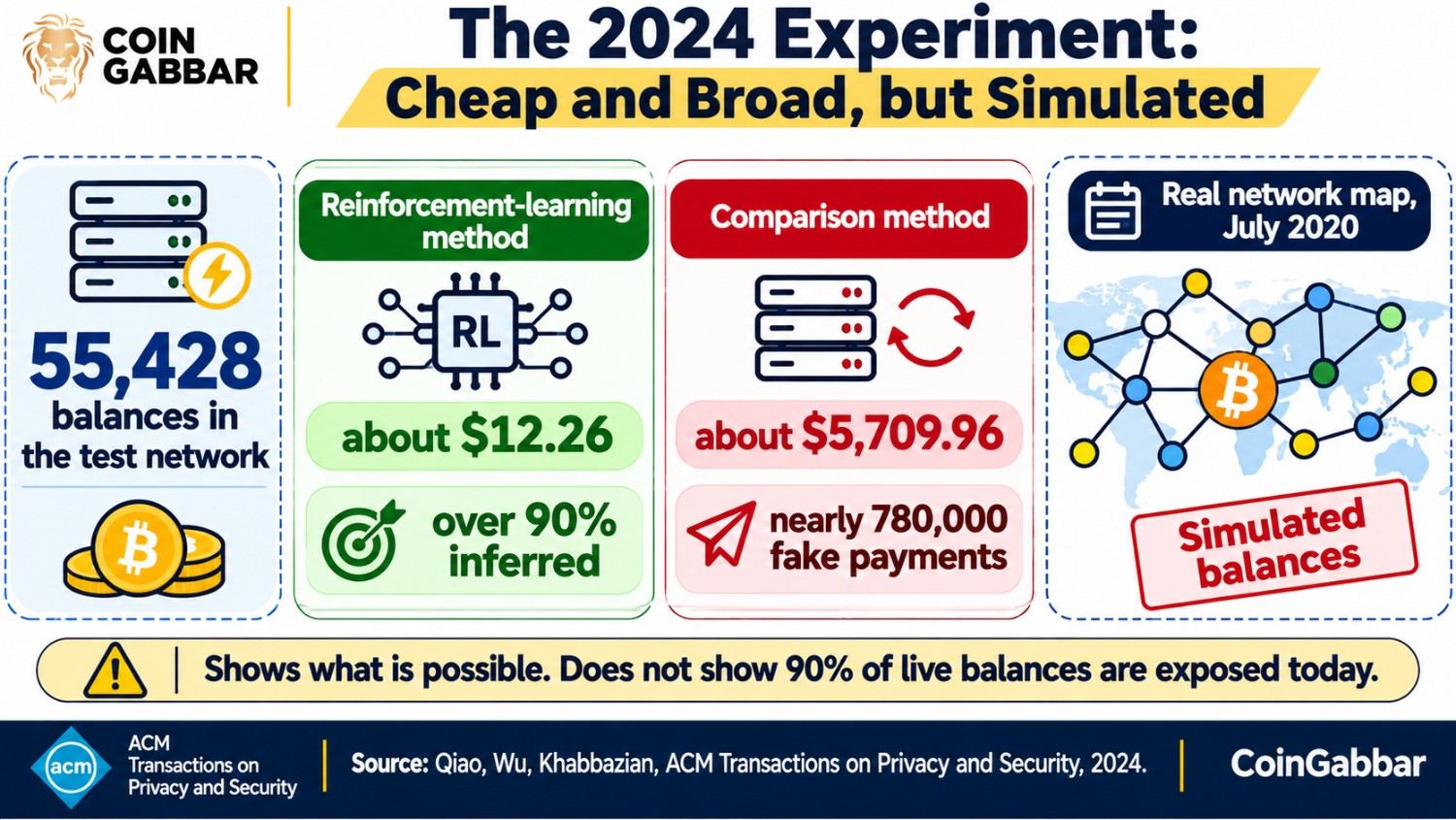
Not proven. The strongest numbers come from experiments. A 2024 study in ACM Transactions on Privacy and Security used reinforcement learning to choose the best test paths. That is a method where software learns by trial and error.
In that test, the method inferred over 90% of 55,428 balances. It cost about $12.26. A comparison method cost about $5,709.96 and used nearly 780,000 fake payments.
There is a key limit. The team used made-up balances on a real network map from July 2020. The result shows what is possible. It does not show that 90% of live balance are exposed today.
How Does Payment Splitting Protect Channel Privacy?
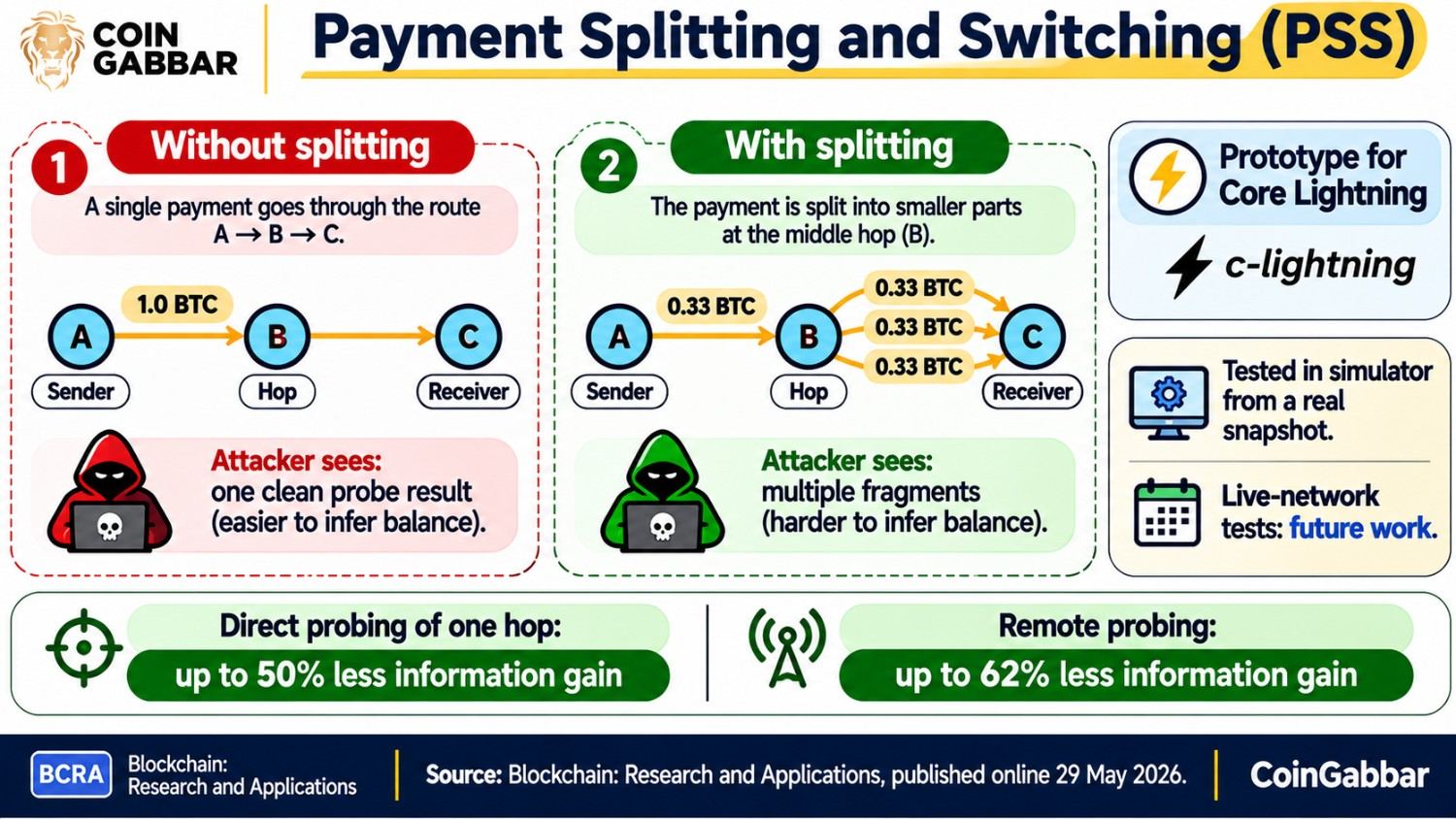
Payment Splitting and Switching (PSS) is a defense against Lightning Network balance discovery. It breaks a payment into parts at the middle hops. The attacker then learns less from each probe. A 2026 paper in Blockchain: Research and Applications tested the idea in simulation.
It reported up to 50% less information gain for direct probing of one hop. For remote probing, the cut was up to 62%. The authors also built a prototype for Core Lightning.
Two cautions apply. The tests ran on a simulator built from a real network snapshot. The authors list large live-network tests as future work.
Does Onion Routing Guarantee Privacy?
No. Onion routing hides the route from middle nodes. BOLT #4 itself notes that traffic analysis can still create privacy risks.
A 2021 study took a wider view. It looked at what outsiders can infer from public data, including balances and payment paths. A 2022 paper proposed differential privacy as a defense. It adds controlled noise to hide payment amounts. It has costs and works only under set assumptions.
CoinGabbar Expert Analysis
The studies fit a clear pattern. Early work showed the leak. Later work made it cheaper and faster. The newest work tries to close it without breaking routing.
Study | Year | Setting | Main result |
Probing channel balances | 2020 | Bitcoin testnet | Under a minute per channel |
Balance tomography | 2024 | Simulated balances, 2020 map | Over 90% of balances inferred |
Payment splitting | 2026 | Simulator, real snapshot | Up to 62% less information gain |
Our view of Lightning Network balance discovery is a reading of the research, not a new measurement. The open question is whether the live network can hide funds and still route payments well. Until splitting is tested at scale, treat channel balances as partly guessable. See also the guide on running a Lightning node.
Key Takeaways
Lightning Network balance discovery targets channel balances, not wallets or keys.
One study inferred over 90% of balances, but only in a simulation.
A 2026 study found that splitting payments cut the attacker's gain by up to 62%.
Disclaimer: This article explains published research. It is not financial, legal, or security advice. Results come from experiments and simulations, and no outcome can be promised. Check your node software's current documentation before making changes.