Luxor Commander Hijack: 12+ Mining Accounts Hit by a Two-Hour Attack


Luxor Commander Hijack: How 12+ Mining Accounts Were Hit in Two Hours?
A security incident at a well-known Bitcoin mining software provider is drawing attention across the industry.
The Luxor Commander Hijack saw the computing power of just over a dozen client accounts sent to a different mining pool without permission.
The firm says it fixed the problem within two hours and will pay every affected client in full.
This article explains what was confirmed, how this kind of redirection works, and what is still unknown.
What the Provider Confirmed
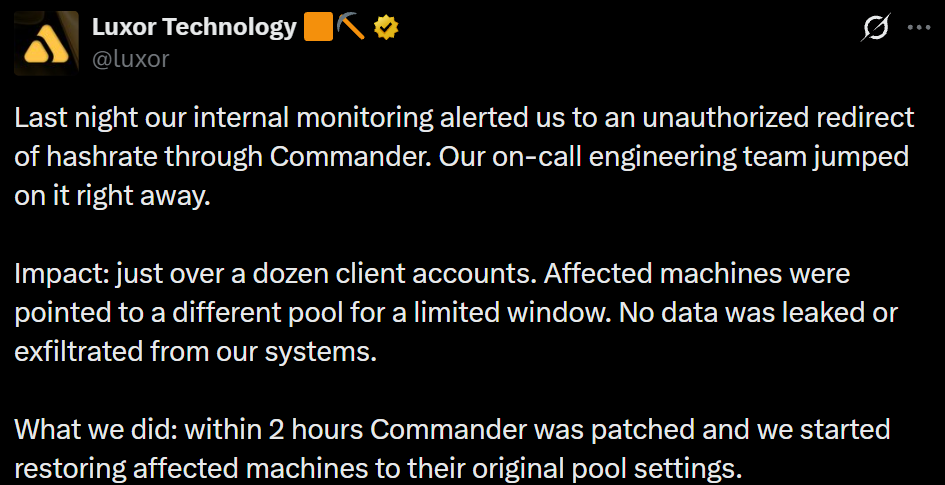
In its official statement on X, the provider said its internal monitoring flagged an unauthorized redirect of hashrate through its Commander tool the night before.
Source: Luxor Technology
Its on-call engineers acted right away. Hashrate is the computing power that miners contribute to the Bitcoin network.
The machines of the affected clients were pointed to a different pool for a limited window.
The statement also says no data was leaked or taken from its systems. Anyone looking for facts about the Luxor Commander Hijack should start with this statement, because it is the firm’s own account.
| Detail | What the statement says |
| Accounts affected | Just over a dozen client accounts |
| What happened | Machines were pointed to a different pool for a limited window |
| Time to fix | Within 2 hours |
| Data | None leaked or exfiltrated |
| Compensation | Paid in full, as if the hashrate had mined normally |
| User action | None needed |
| Next step | A full post-mortem will be shared |
How Hashrate Redirection Works
Bitcoin miners run powerful machines that compete to add new blocks to the blockchain.
Most miners join a mining pool, which is a group that combines its computing power and shares the rewards.
Each machine is told which pool to work for. If that setting is changed without the owner’s knowledge, the machine keeps running and keeps using electricity, but its work counts for a different pool. I
n general, the rewards from that work go to whoever controls the receiving account. This is why the provider promised to pay clients “as if it had mined normally.”
The tool at the center of this case is cloud-based software for managing mining fleets, as the official documentation explains.
Its product page lists real-time monitoring, bulk remote commands and automated profitability tools among its features.
The launch announcement from April 2026 says it works with the firm’s own firmware as well as stock firmware from Bitmain, MicroBT, and Canaan. Because one dashboard can send commands to many machines at once, a weak point in such a tool can affect several miners together.
How the Response Unfolded
The official statement describes these steps:
-
Detection: internal monitoring raised the alert, and the on-call engineering team jumped on it right away.
-
Fix: the tool was patched within two hours.
-
Recovery: the team started restoring affected machines to their original pool settings.
-
Payment: every affected client will be paid in full for the redirected hashrate.
-
Current status: the tool is operating normally, and no action is needed from users.
The wording matters here. The statement says the team started restoring machines within that window, and it gives no final restoration time.
The provider is also working with the teams involved and will share a full post-mortem, which is a detailed report on what went wrong and how it was fixed.
What Is Still Unknown
Several important questions remain open:
-
How the attackers gained access
-
Which pool received the redirected power
-
How many machines were affected, since the statement counts accounts and not machines
-
The total value of the lost mining revenue
The statement does not cover these points. Until the promised report is out, any figure or claim about the Luxor Commander Hijack beyond the official statement should be treated as unconfirmed.
Why It Matters for Miners
For mining businesses, the lesson is about control. Software that manages a whole fleet from one place saves time, but it also becomes an attractive target, so fast detection is critical.
In this case the provider reports that its own monitoring caught the problem. It responded with a patch, a restoration effort and a pledge of full payment.
Miners using any management tool can use this moment to review who has access to their accounts and pool settings, even though the provider says no action is needed from its users.
Conclusion
The Luxor Commander Hijack affected just over a dozen client accounts for a limited time.
The provider says the tool was patched within two hours and that full compensation is coming. The key questions about the cause and the size of the loss stay open until the post-mortem arrives.
For now, the official statement is the most reliable source, so readers should wait for the full report before drawing conclusions.
Disclaimer
This article is for educational and informational purposes only and is not financial or investment advice. Crypto assets are high risk, their prices can be very volatile, and you can lose some or all of your money. Always do your own research and consider speaking with a licensed financial advisor before making investment decisions.






