MEET48 IDOL: How Fan Rewards Influence Token Demand

MEET48 IDOL Utility and Liquidity Risks in the Fan Economy
MEET48 IDOL is the utility token of an idol fan platform. The platform mixes AI tools, Web3 games, and fan voting. Fans use the token to vote, join events, and meet virtual idols.
That raises a question about demand. Fans buy tokens to vote, then get rewards back. Does that build steady demand or only short spikes?
What Is MEET48, and What Does the IDOL Token Do?
MEET48 calls itself an immersive social platform that joins AI with Web3. Its content covers idol shows, AI-made media, and blockchain games, per the official MEET48 platform.
The project says it targets over 30 million idol fans through its partner SNH48. That number is a project claim, and independent checks are limited.
The MEET48 IDOL token runs on BNB Smart Chain as a BEP-20 token. BEP-20 is a standard format that lets tokens work with wallets and exchanges on that network.
Per the project's documents, the token pays for idol votes, live streams, virtual meet-and-greets, and staking. It also covers metaverse costs, such as renting virtual land.
MARS Protocol is a launchpad, meaning a platform where new tokens first reach the market. Virtual idols can issue their own meme coins there. A meme coin is a token driven mostly by community attention.
The MEET48.ai platform lets users build idol AI agents. These agents can chat, stream, and perform.
Other AI agent tokens on the BNB Chain work the same way. The token pays for activity inside an app, so demand follows app use.
Its games sit close to Web3 gaming presales, where in-game spending drives token use.
How Does Vote-to-Earn Create Demand for MEET48 IDOL?
Vote-to-earn rewards fans for joining votes and community programs. Each vote on the platform needs IDOL, so it means a token bought or kept off the market.
Annual events show the scale. In the 2025 idol election, votes used over 1.6% of the total supply. About 0.45% of supply was burned, based on published figures.
This is the core demand loop. Fans buy tokens, cast votes, and watch part of the spent tokens burn. Rewards then flow back to fans.
Can Fan Rewards Also Increase Selling Pressure?
Yes, and that is the second side of the loop. Rewards paid in IDOL reach fan wallets. Any holder who sells them adds supply back to the market.
The available data suggests demand comes in bursts. Voting seasons bring heavy activity, while quiet weeks bring less need for the token. MEET48 IDOL demand grows only when new spending beats reward selling.
What Does the MEET48 IDOL Tokenomics Model Show?
Tokenomics is simply how a token is built: how many exist, who gets them, and when they come out. According to the project's published tokenomics, the maximum supply is fixed at 4.8 billion IDOL.
Allocation | Share | Purpose |
Community incentives | 45.2% | Fan rewards, voting, and activity programs |
Ecosystem development | 20% | Product growth and partnerships |
Team and advisors | 17% | Project builders and advisers |
Backers | 7% | Early investors |
Marketing | 5.8% | Promotion and user growth |
Liquidity | 3% | Trading depth on markets |
IDO participation | 2% | Public token sale |
Community incentives take the top share at 45.2%, so fan rewards sit at the core of the design. The backer share is only 7%, which may limit early selling on paper.
Vesting is a release plan for locked tokens. It sets the dates when each batch can reach the market and be sold. The project's documents say about 902 million IDOL, or 18.8% of supply, was liquid at launch in June 2025.
Bigger parts stay under cliffs and linear vesting. A cliff is a waiting period before unlocking starts. Linear vesting then frees tokens in equal parts over time.
Teams often hire token launch marketing services before a launch like this.
How Do Token Burns and Staking Change the Supply Picture?
A token burn sends tokens to an address no one controls. That removes them from supply for good. The project's documents say tokens from voting pools are set for burning, and fees can fund periodic burns.
One confirmed burn came in January 2026. About 8.7 million IDOL were destroyed, equal to 30% of voting income from the second MEET48 Best7 event. That is roughly 0.181% of total supply.
Staking means locking tokens to earn rewards. It can cut the supply open for trading for a while. Rewards paid from new emissions may add supply later, so MEET48 IDOL staking can cut both ways.
The net effect is the real test. A 0.181% burn looks small beside the roughly 78% of supply still outside circulation.
What Do Current Market Numbers Say About MEET48 IDOL?
As of November 2, 2026, IDOL traded near $0.0226, with about 315,000 holders. The table lists the main figures from one market data page.
Metric | Value |
Price | About $0.0235 |
Market cap | About $24.6 million |
Fully diluted valuation (FDV) | About $112.86 million |
Circulating supply | About 1.046 billion IDOL (21.8%) |
Maximum supply | 4.8 billion IDOL |
24-hour trading volume | About $33.5 million |
Market cap equals price times circulating supply. FDV, or fully diluted valuation, multiplies price by maximum supply. It shows the value if every token already existed.
The FDV is about 4.6 times the market cap. That gap comes from locked supply. Future unlocks can pressure the MEET48 IDOL price.
Daily volume topped the market cap, which points to heavy trading. Heavy trading does not prove fan usage, since traders can lift volume without ever voting.
The price rose about 24% in a day. It still sits roughly 46% below its all-time high and 230% above its recent low. That swing shows how fast mood can turn.
IDOL is listed on several centralized exchanges, and it also trades through on-chain swaps on BNB Smart Chain.
Each venue applies its own exchange listing requirements before a token goes live. Circulating supply also differs by data provider, so the latest figure needs a check.
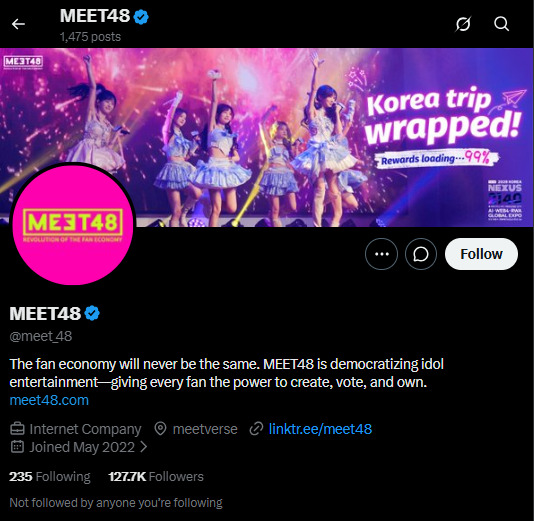
Voting and burn updates appear on the project's official X channel.
What Are the Main Risks Around MEET48 IDOL Demand?
Close to 78% of the supply is still locked, so every unlock date could bring fresh tokens to the market, even if fans stay just as active.
Much of the buying comes from voting seasons. Between campaigns, MEET48 IDOL has less to do, and demand can cool until the next event starts.
Fans who receive reward tokens are free to sell them. If that happens faster than burns remove supply, the rewards end up working against the token.
The price jumped about 24% in one day and sits roughly 240% above its recent low. Moves like that can reverse just as fast, and MEET48 IDOL is no exception.
A 4.6 security score shows on its market page, but it only tracks on-chain activity. It is not an audit, and it does not prove the contracts are safe.
The 30 million fan figure comes from the project itself. Until independent data backs it up, the real reach stays uncertain.
Conclusion: What Fan Rewards Can and Cannot Do
MEET48 IDOL links token demand to real fan actions such as voting, staking, and in-app spending. Burns from voting income add a supply-side effect, so the model is more than a simple reward scheme.
Still, only 21.8% of supply circulates, the FDV sits far above the market cap, and demand looks tied to event calendars. The open question for MEET48 IDOL is whether fan activity can outrun scheduled unlocks. Burn notices, vote counts, and vesting data can track it.
Disclaimer:
This article is for information only and is not financial advice. Crypto assets are volatile and can lose value fast. Independent checks matter before any decision.