Meteora MET: How Do DLMM Liquidity Pools Generate Fees?


How Meteora MET Uses DLMM Pools to Manage Liquidity and Fees
Meteora MET draws plenty of attention, but the token and the fee engine are two separate things. Swap fees come from trading inside DLMM pools on Solana (SOL). Meteora MET sits beside that system, and its role is narrower than many first-time readers assume.
DLMM stands for Dynamic Liquidity Market Maker. It splits liquidity into small price slots called bins. Traders swap against those bins and pay a fee. Liquidity providers (LPs), the people who deposit tokens into a pool, collect most of it.
What Is a DLMM Pool and How Does It Work?
Meteora is a Solana liquidity protocol. On its official website, it describes the aim as a secure, optimized, and composable yield layer. That is the project's claim.
In a DLMM pool, each bin holds liquidity for one fixed price. The gap between neighboring bins is the bin step, measured in basis points. The documentation's example: a 25-basis-point step puts bins about 0.25% apart.
Only one bin is active at any moment. It holds both tokens in the pair. Bins on one side hold only one token, and bins on the other side hold only the other.
Trades inside the active bin settle at that bin's fixed price. The documentation calls this zero slippage within a bin. Price moves only after a bin runs out of liquidity.
One consequence matters for income. Only the active bin earns trading fees. Where an LP places liquidity decides whether it earns anything.
Readers new to pooled liquidity can compare it with how market makers work on order books.
Pool design also shapes risk across DeFi, as the DeFi lending architecture comparison shows for lenders.
How Is a DLMM Swap Fee Built?
Every swap pays one total fee. Two parts make it up, and a small cut goes to the protocol.
The Base Fee: A Fixed Floor
The pool creator sets the base fee. It depends on the base factor and the bin step. The DLMM formulas documentation shows the base fee rate as base factor × bin step × 10, scaled by a power factor. Larger bin steps often pair with higher base fees because each bin covers a wider price move.
Creators can't change either setting after launch.
The Variable Fee: A Volatility Surcharge
On top sits a variable cost that reacts to price movement. The documentation measures volatility by counting how many bins' prices cross over time. More crossings raise the fee. The formula squares the movement, so sharp swings add cost quickly.
The documented formula caps the combined fee at 10%. Fees are calculated bin by bin and split among the LPs in each bin by share of liquidity.
The Protocol Share
Before LPs are paid, the protocol takes a slice. The documentation lists 5% of the total fee for standard pools. One page lists 20% for launch pools, so the share may vary by pool type.
A hypothetical example shows the flow. Assume a 0.30% total fee. A $10,000 swap through the active bin would generate $30. The 5% protocol share takes $1.50. LPs in that bin split the remaining $28.50. This illustrates the math and isn't a figure from any real pool.
Fee Part | Who Sets It | Who Receives It |
Base fee | Pool creator, at launch | LPs in the crossed bins |
Variable fee | Volatility formula | LPs in the crossed bins |
Protocol share | Protocol settings | The protocol |
What Decides How Much an LP Actually Earns?
Fees follow position, not just deposits. Three mechanics shape the result:
Range placement: Once a price leaves an LP's range, the position stops earning.
Bin step trade-off: A smaller bin step can capture more volume, but each position covers a narrower range.
Manual claims: Fees don't auto-compound. LPs have to claim them.
The Dynamic Terminal also shows a 24-hour fee-to-TVL ratio. TVL means total value locked, the funds sitting in the pool. It doesn't predict future income.
The project says dynamic fees are meant to offset impermanent loss. That term describes the value gap that appears when pool token prices move after a deposit. The documentation offers no guarantee it works.
How Does Meteora MET Connect to Pool Fees?
Only indirectly, if at all. Swap fees go to LPs and the protocol share, not automatically to token holders.
The official MET white paper is direct about this. It describes Meteora MET as an access and coordination asset. It says holders receive no ownership, voting, governance, or profit-sharing rights. Listed uses include priority in launches and liquidity programs, plus staking later to earn non-transferable engagement points.
That paper dates from October 2025, and the pages reviewed didn't confirm whether staking has gone live.
So Meteora MET holders shouldn't treat DLMM fee volume as a payout. Any link between pool activity and token demand is analyst interpretation, not a documented mechanism.
What Does the Meteora MET Supply Look Like?
Per the published MET tokenomics, Meteora MET launched on Solana on 23 October 2025. Total supply is 1,000,000,000 MET. Circulating supply at launch was 480,000,000, or 48%.
Allocation | Share of Supply | Status at Launch |
Mercurial holders and reserve | 20% | Unlocked |
LP Stimulus Plan | 15% | Unlocked |
Launchpads, contributors, partner stakers, M3M3 plan | 10% | Unlocked |
Exchange and market-maker reserve | 3% | Unlocked |
Team | 18% | 1-month cliff, 72-month vest |
Meteora Reserve | 34% | 1-month cliff, 72-month vest |
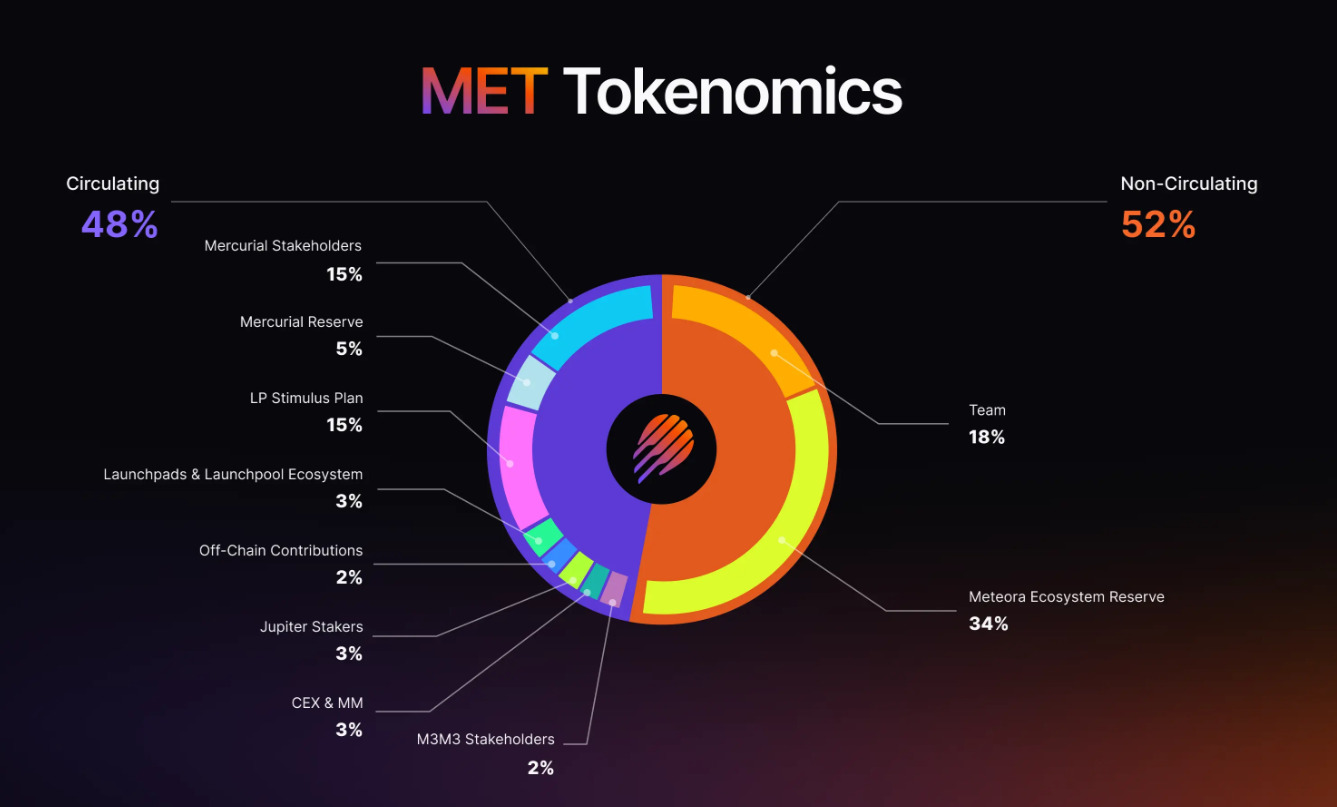
The other 52% of Meteora MET supply belongs to the team and reserve. A cliff is a waiting period before any tokens unlock. Dividing 520 million by 72 months gives roughly 7.2 million Meteora MET a month. That is a rough estimate, not an official schedule.
Market cap uses circulating supply. Fully diluted valuation (FDV) assumes all 1 billion tokens are in the market. The gap narrows as vesting continues. Anyone checking Meteora MET numbers should confirm which one a data page shows.
Official sources also differ slightly. The white paper lists 470 million circulating at launch, a 12-month cliff, and a 35% treasury. The live tokenomics page lists 480 million, a one-month cliff, and 34%. The live page is likely the better reference, since a white paper is fixed at filing.
What Are the Main Risks of Meteora MET?
Position risk: LPs can drift out of range and earn nothing. Impermanent loss can also outweigh fees.
Volume risk: Higher volatility fees raise trader costs. That may push volume elsewhere, which is an interpretation.
Token value risk: The white paper warns that Meteora MET may lose value in part or in full.
Supply risk: Vesting keeps adding Meteora MET supply through October 2031, per the published schedule.
Smart contract risk: The white paper says an audit found no critical vulnerabilities. That is a project claim, and an audit isn't a guarantee of safety.
Protocol-level pauses have happened elsewhere on Solana too, as the Solana borrowing pause analysis explains.
Is Meteora MET Worth Watching Right Now?
Meteora's DLMM pools earn fees in layers. A base fee is set at launch, a variable fee reacts to volatility, and the protocol takes a share before LPs split the rest. The design rewards careful range placement and punishes drifting out of range.
What stands out is that Meteora MET sits outside that fee stream. The white paper rules out profit rights. What remains uncertain is how Meteora MET utility develops, whether staking has launched, and how vesting supply meets demand.
Readers should check the live documentation for current fee settings and unlock data before drawing conclusions.
Disclaimer:
This article is for information only and isn't financial advice. Crypto assets are volatile and can lose value in full. Readers should research independently and consult a qualified adviser before making decisions.