Minotaurus Tokenomics: MTAUR Supply, and Allocation Explained

Minotaurus Tokenomics: MTAUR Supply and Vesting Explained
Minotaurus Tokenomics describes how the MTAUR token is supplied, split between groups, and released over time. The project publishes a maximum supply of one hundred billion MTAUR, with sixty percent set aside for presale and early access.
Reported vesting terms release part of the presale share at the token generation event and the rest after a cliff. None of the supply should be treated as immediately tradable, and every term should be checked against the latest official document.
What Is Minotaurus Tokenomics?
Minotaurus is a blockchain gaming-project , and MTAUR is its native token on the BNB Smart Chain. Tokenomics means the economic design of a token: how much exists, who receives it, when it is released, and what it is used for.
A broader overview of the project's game, price outlook, and token appears in the game, price, and tokenomics overview.
For a gaming project, these choices decide how much of the token can reach players and traders and how fast. Minotaurus tokenomics matters to holders because supply, allocation, and vesting shape liquidity and selling pressure long after a sale ends. This guide stays on the design itself and does not promote the sale.
What Is the Total Supply of MTAUR Tokens?
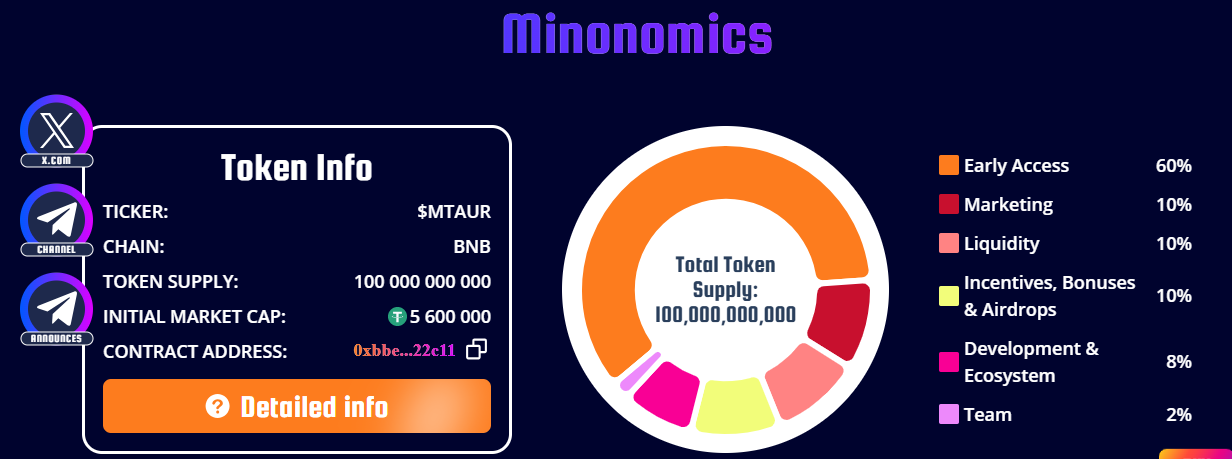
The project publishes a maximum supply of one hundred billion MTAUR. In Minotaurus Tokenomics, total supply and circulating supply are different things. Total supply is the full amount that can exist, while circulating supply is the amount actually available to trade at a given time.
That gap is why the full supply should not be treated as immediately available. Most of it is allocated to groups and released later through cliffs and vesting.
Anyone reading Minotaurus Tokenomics should therefore ask how much is circulating today, not only how much exists on paper. The official token contract is not printed here.
It should be taken from the project's official website and checked on a block explorer for BNB Smart Chain, whose network documentation explains the basics.
How Are MTAUR Tokens Allocated?
The published split gives most of the supply to presale and early access.
| Allocation | Share | Purpose |
| Presale and early access | Sixty percent | Tokens offered to early buyers |
| Marketing | Ten percent | Promotion and community growth |
| Liquidity | Ten percent | Trading pools after launch |
| Incentives, bonuses, and airdrops | Ten percent | Rewards and vesting bonuses |
| Development and ecosystem | Eight percent | Building the game and its tools |
| Team | Two percent | Founders and contributors |
| Total | One hundred percent | |
Allocated tokens have not necessarily been distributed or spent. A line in the table is a plan for a future holder, and it says nothing about whether those tokens have moved.
Each line also carries a different incentive. Marketing and liquidity support visibility and trading, development funds the product, and the team share aligns founders with the long term only if its cliff is respected.
The small team share is a notable feature, but a split on paper is not proof of fairness. For a wider look at how such splits are judged, the notes on crypto presale tokenomics give context. Reading Minotaurus Tokenomics well means pairing the split with the release schedule.
How Does the MTAUR Vesting Schedule Work?
Three terms explain the schedule:
-
Vesting: tokens are released over time instead of all at once.
-
Cliff: a waiting period before scheduled releases begin.
-
Linear release: equal portions released gradually after the cliff.
The reported terms for each allocation are below.
| Allocation | Reported release terms |
| Presale | Thirty percent at TGE, a one-month cliff, then eight months of linear release |
| Marketing | A one-month cliff, then twelve months |
| Liquidity | A one-month cliff, then twelve months |
| Incentives, bonuses, and airdrops | Fully unlocked at TGE |
| Development and ecosystem | A two-month cliff, then ten months |
| Team | A six-month cliff, then twelve months |
These terms come from earlier coverage and have not been independently confirmed here. The project's own allocation, vesting, and unlocks page is the place to compare. There is also a caution.
The project confirms a base eight-month vesting option and a feature to extend it, but its FAQ also describes varying vesting periods, so the applicable terms depend on the purchase conditions. Conflicting wording should not be treated as settled.
In Minotaurus Tokenomics, locked tokens and tradable tokens are not the same. A locked token cannot be moved until its release date, while an unlocked token can be moved but may never be sold.
The existing page on token vesting and the unlock schedule covers the presale side in more detail, and Minotaurus Tokenomics depends on reading both.
How Does the MTAUR Token Unlock at TGE?
In Minotaurus Tokenomics, the token generation event, or TGE, is the moment tokens are created and the first releases become possible. Under the reported terms, thirty percent of the presale allocation unlocks then.
On a presale allocation of sixty billion tokens, that is eighteen billion. The incentives allocation, reported as fully unlocked at TGE, adds another ten billion, for a theoretical initial release of twenty-eight billion.
Those figures follow from published percentages and are not confirmed counts. Unlocked at TGE is also different from tradable. A token may be claimable before any market exists for it, and a large early release can affect circulating supply and liquidity once trading starts. The guide on token unlocks explains why that timing matters.
A planned listing price is not a guaranteed market price, and no TGE date should be assumed without an official announcement. This is a basic rule when studying Minotaurus Tokenomics.
What Is the Utility of the MTAUR Token?
The last layer is used; the project describes MTAUR as an in-game currency. Its stated roles also include staking and reward-related functions, governance, and access to ecosystem features. Those are the project's own descriptions, found on its official website.
Announced utility is not the same as live utility. A feature described in plans may not yet be available to users, so each function should be checked as live or proposed before it is counted as a reason for demand.
Utilities that depend on game launches and adoption can take time or may not arrive. Judging Minotaurus tokenomics fairly means separating what exists today from what is promised.
What Should Readers Check Before Judging Minotaurus Tokenomics?
A short routine helps when applying Minotaurus Tokenomics to a real decision:
-
Verify the official contract address and the blockchain.
-
Review the allocation and vesting documents.
-
Check TGE and distribution announcements.
-
Review audit reports and their scope.
-
Consider liquidity, unlock-related selling pressure, and development risks.
Tokens run on smart contracts, so an audit's scope matters as much as its existence.
Fake token pages and claim links appear around launches, and the guide on crypto phishing protection shows what they look like. Presale tokens are speculative, and a clear schedule does not remove the risk of loss.
Final Thoughts
Minotaurus Tokenomics comes down to three layers: a published maximum supply, an allocation that favors presale and early access, and a vesting schedule that releases tokens over time. Each layer has to be read together, because a large supply split means little without the release terms behind it.
The practical lesson is to check before trusting. Confirm the latest official document, separate the announced utility from live features, and wait for an official TGE announcement before assuming anything about availability.
Understanding minotaurus tokenomics helps readers judge risk, not predict price. For ongoing coverage, the latest crypto news page tracks new developments.
Disclaimer: This article is for educational purposes only and is not financial or investment advice. Presale tokens are speculative and may lose value, and published terms can change. Verify every detail on the project's official pages before buying.