Morph Payments: Eric Cheung on Stablecoin Settlement in APAC

Stablecoins can move money in minutes, so why do most businesses still wait days for a bank transfer? Eric Cheung of Morph says the technology is ready, but the experience is not.
In a written interview with CoinGabbar in November 2026, Cheung explained how Morph Payments aims to make cross-border stablecoin payouts simple for businesses across the Asia-Pacific.
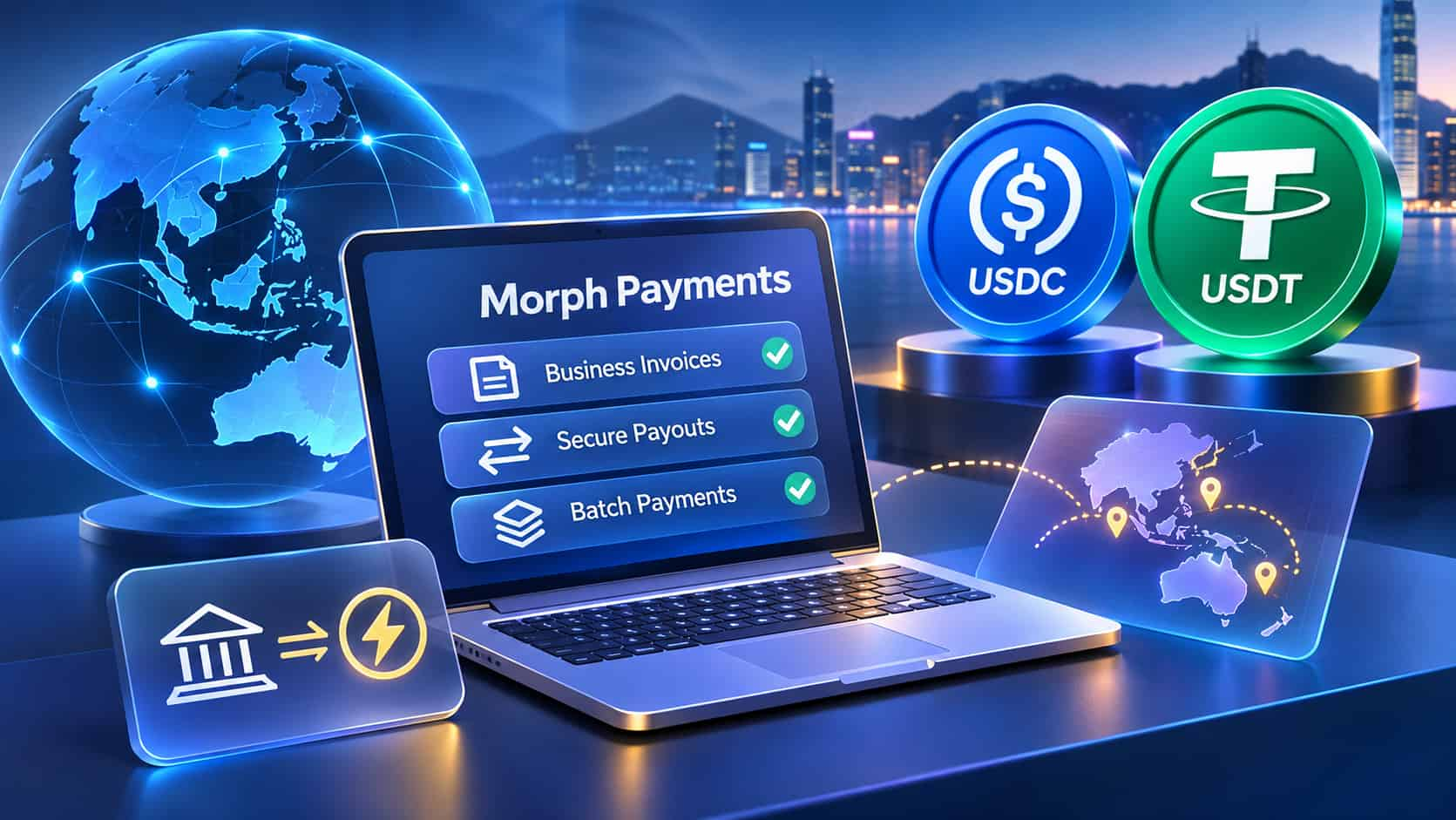
Quick answer: Morph Payments is a non-custodial stablecoin payments platform. Businesses create invoices or payment links, receive USDC or USDT directly into their own wallet, send payouts, and perform batch payments like payroll. Morph never holds the funds, so owners retain full control of their funds.
Key Takeaways
-
Morph Payments lets businesses collect USDC or USDT through stablecoin invoices and payment links.
-
It is non-custodial, so funds land in a wallet only the business controls.
-
Scheduled payouts and stablecoin payroll are next, according to Eric Cheung.
-
Hong Kong and Singapore come first for regulated partners.
-
India shows strong demand, but its compliance path remains narrow.
| Item | Detail (per Cheung and Morph) |
|---|---|
| Product | Morph Payments, non-custodial |
| Assets | USDC and USDT |
| Tools | Invoices, payment links, dashboard |
| Next | Scheduled payouts, basic payroll |
| First markets | Hong Kong, Singapore, and selected Southeast Asia corridors |
Who Is Eric Cheung, and Why Did He Join Morph Network?
Eric Cheung is APAC Head of Market Expansion at Morph Network, according to the company's press brief. He is based in Hong Kong and has worked at American Express, Airwallex, Worldpay, dtcpay, and Cregis.
He told CoinGabbar he joined because stablecoin payments still feel harder than they need to be. His card and payments years taught him that reliability, clear fees, and simple reconciliation matter more than new features.
Crypto roles added a second lesson. Compliance and custody choices decide whether a product can scale. "At Morph I am applying those same standards," Cheung said, so businesses need not become crypto experts.
What Is Morph Payments, and What Problem Does It Solve?
Morph Network is an Ethereum Layer-2 incubated within the Bitget ecosystem, according to Blockhead. It launched Morph Payments in August 2026 for businesses, freelancers, and distributed teams that want USDC payments for business use.
Cheung said the product removes the usual friction of setting up wallets, tracking on-chain payments, and reconciling what was paid. Freelancers and small teams with overseas clients can get paid in stablecoins without handing funds to a third party.
Why Does Morph Payments Rely on Non-Custodial Stablecoin Payments?
Cheung said Morph chose non-custodial stablecoin payments, so it never holds a merchant's money. Funds land in a wallet that only the business controls. Users can also add any wallets they hold on another platform, e.g Coinbase, to receive a supported stablecoin.
For a non-technical owner, that means no balance sitting with Morph, no withdrawal request, and no risk of frozen or delayed access. Users sign up with an email, receive a secure wallet, and use links, invoices, and a dashboard. "The blockchain part stays in the background," he said.
Where Do Cross-Border Stablecoin Payouts Work Today?
Cheung said stablecoins already work well for cross-border business payouts and for collecting from crypto-native clients. A company can pay contractors or suppliers in USDC or USDT within minutes instead of waiting days for a bank transfer.
Merchant settlement and treasury use are growing but remain early for most traditional businesses. He said the gap is rarely the stablecoin itself. It is the missing on-ramp or off-ramp or a finance team's comfort with reconciliation.
The market is large. Blockhead cited Visa's Onchain Analytics, which put adjusted stablecoin volume at $10.2 trillion over twelve months.
What Do Compliance, Infrastructure, and Liquidity Require?
Cheung named three requirements for any merchant or payments company building a stablecoin payments platform. First, a clear compliance path, including know-your-customer checks and sanctions screening.
Second, reliable infrastructure, so collection and payouts do not fail or need manual fixes. Third, enough liquidity on the chosen chain so counterparties can send and receive the stablecoin. "Without those three, most businesses stay in pilot mode," he said.
What Did Eric Cheung Learn Around India Blockchain Week 2026?
India Blockchain Week ran on November 1 and 2 at the Fairmont Mumbai, organized by Hashed Emergent. Cheung said he wanted to show Morph as a settlement layer under existing payment and card flows, not a consumer app.
What stood out was the demand for USDT cards and compliant on-ramps and off-ramps. He also noted caution around KYC data and tax treatment. Informal channels still fill gaps that licensed rails do not cover cleanly.
How Do Stablecoin Payments in India Compare With Hong Kong and Singapore?
Cheung said priority markets are Hong Kong and Singapore for regulated partners, plus selected Southeast Asia corridors where cross-border payouts are already painful. Both hubs offer clearer licensing paths.
For stablecoin payments in India, he sees large remittance and card interest. Tax rules on virtual digital assets and recent enforcement actions make most formal players cautious, he said.
Adoption would move faster in India if licensed ramps can add Morph cleanly. In Southeast Asia, it would move faster if more partners treated Morph as a standard deposit and payout chain.
What Is Next for Morph Payments, From Payroll to Partnerships?
The first release covers collection through invoices and payment links, plus a dashboard. Next, Cheung said Morph is prioritizing scheduled payouts and basic stablecoin payroll because businesses already using stablecoins request them most.
He builds first what removes a real blocker to moving volume and can ship reliably. For bank and fintech deals, he suggests one concrete flow, not a broad memorandum of understanding. Review after 60 or 90 days, he said, and expand only if the numbers fit.
Expert Opinion: What Does This Mean for Stablecoin Payments?
Editor's own view sees a practical strategy. Morph Payments targets recurring business payouts rather than consumer hype, which is where stablecoins hold the clearest advantage over bank transfers.
However, its success will depend on licensed partners and measurable transaction volume. Businesses should review regional regulations, tax implications, and available payment ramps before relying on any stablecoin payment platform.
Conclusion: Can Morph Payments Become a Default Settlement Option?
Cheung wants Morph Payments to be the default settlement option for live partners in Hong Kong, Singapore, and selected Southeast Asia corridors. His test is simple: a handful of partners moving recurring real money, not test transactions.
Disclaimer: This article is for informational purposes only and is not financial, investment, or legal advice. Statements about Morph come from its executive's written answers and were not independently audited by CoinGabbar. Crypto assets are volatile, losses are possible, and rules vary by country. Consult a licensed advisor before investing.