FLOP Foundation: Understanding Flop Labs and Governance

How Do FLOP Labs and the FLOP Foundation Govern the Network?
The FLOP Foundation is the part of the project most readers skip, yet it decides who writes the rules. Anyone searching for the people behind this project usually finds a token and a whitepaper, but very few names or structures. This guide explains the two entities behind the network, what each one controls, and what a famous face at the top does and does not tell readers.
Key Takeaways
Two entities stand behind the network. Flop Labs LLC builds the software, and the Foundation stewards the protocol after launch.
Until the first halving, only the Foundation can submit protocol proposals. Validators still decide every one of them.
The handover that removes the genesis superuser key is specified but not yet executed.
What is FLOP Network ?
FLOP Network is a proof-of-inference blockchain and the native currency for the agentic economy. AI agents pay miners in $FLOP to run inference, so currency turns directly into compute. Blocks arrive about once per second, and the block reward starts at 96 $FLOP, halving every 730 days until it settles at 3. The whitepaper targets a testnet in Q4 2026 and a mainnet in Q1 2027.
Source: official website.
Who is behind FLOP Network
The public face is Arthur Hayes. He co-founded BitMEX in 2014 and served as its CEO until October 2020. On August 18, 2026, he announced that he was coming out of retirement to lead Flop Labs. His X profile, @CryptoHayes, now lists him as CEO of Flop Labs.
One caution is worth stating. Hayes did not describe his exact duties, ownership stake or pay when he announced the role. A name adds attention, not proof, so readers should judge the network by its published rules.
The whitepaper follows a model common in open-source protocols. The company that builds the software is kept separate from the body that stewards the rules, so the party paid for building does not control the rules.
Flop Labs LLC | The Foundation | |
Role | Operating company | Steward of the protocol |
Main job | Designed and built the network | Funds independent core developers |
Paid by | Fixed block emission | Its own fixed block emission |
Other income | None stated | Stake forfeited by dishonest operators |
Flop Labs LLC company structure
Flop Labs LLC designed and built the network. It is organised under the laws of St Vincent and the Grenadines. The company is paid through a fixed block emission, not a token sale. The project advertises no pre-sale, no VCs and a fully fair launch, so this emission is its only stated income from the protocol.
FLOP Foundation role in governance
The Foundation does three things. It funds independent core developers from its own emission. It holds the sole right to submit protocol improvement proposals until governance passes to validators at the first halving. And it receives any stake forfeited by miners or validators who act dishonestly.
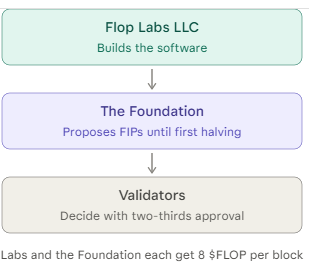
The whitepaper stresses that this is submission control, not vote control. The Foundation cannot change anything alone, and every proposal still needs validator approval. Hayes has described the interim as a constitutional monarchy, in which the Foundation proposes and the validators decide.
One of its stated goals is to bring block times below one second, which would suit fast payments between AI agents. The whitepaper does not yet name the Foundation's board. That detail is promised in a later revision.
The chart below shows who does what.
FLOP Network governance explained
The rules are strict, and they are written so that no single party can act alone.
Rule | Detail |
Approval needed | Two-thirds of the active validator set, plus minimum participation |
Enactment delay | Fourteen days after approval |
Exit protection | No change raising obligations can start faster than the unbonding period |
Governable settings | Economic parameters marked governable in the Yellow Paper |
Fixed at genesis | Block reward and halving schedule |
Emergency tools | Time-locked override and per-module pause, both with a delay and cooldown |
FLOP Improvement Proposals (FIP) and validator voting
Protocol changes travel through FLOP Improvement Proposals, known as FIPs. A FIP is a numbered design document tied to an on-chain referendum. FLOP Network validator voting then decides the result.
Validators are the guardians of the network. The set is capped at 1,000 seats, ranked by bonded stake among operators who pass a service check. Each validator posts a self-stake bond of 1,200,000 $FLOP, and there is no delegated staking into the set. That bond puts real money behind every vote.
FLOP Network team and foundation emission
Both entities are paid the same way. Each receives 8 $FLOP per block, issued on top of the normal block reward. The amount halves on the same schedule and stops after year ten. By year ten, each share adds up to 5.4% of total supply.
Item | Detail |
Block reward | 96 $FLOP per block, halving every 730 days |
Reward split | 75% miners, 10% validators, 10% agents and brokers, 5% stakers |
Labs emission | 8 $FLOP per block, extra |
Foundation emission | 8 $FLOP per block, extra |
End date | After year ten |
The protocol itself takes no fee and burns no tokens. Neither entity earns a cut of inference fees.
FLOP Network superuser key handover
At genesis, the chain carries a superuser key held by a multi-signature wallet, as most new networks do. Whoever controls that wallet can alter the runtime. The handover removes the key and sends every upgrade through the governance track.
The official whitepaper is open about the status. The handover is specified, but it has not been executed. Until it is, governance is best described as designed, not completed.
What changes after the first halving
Block rewards halve every 730 days, so the first halving arrives about two years after launch. At that point the proposal restriction ends. Any party can submit a FIP, and the community selects what validators vote on. The Foundation then becomes one voice among many.
Final thoughts
The FLOP Foundation sits at an unusual point in the plan. It guides the rules for the first two years, then steps back so validators and the wider community can take over. Whether that handover happens cleanly will matter more than any single name on the team. Readers tracking the project should watch for the executed key handover, the final Yellow Paper and the first halving.
Disclaimer: This article is for information only and is not financial, investment or legal advice. Details come from the FLOP Network whitepaper, official website and public reports. The Yellow Paper is the definitive specification and is not final, so plans, parameters and governance rules may change. Crypto carries real risk, including loss of funds, so readers should do their own research and check official channels before acting.