

NEAR AI Cloud encryption has reached E2EE v3, according to an X post published on Nov 27, 2026, at 12:34 PM IST.
The post says the release enforces encryption of all fields and adds cryptographically authenticated reply keys. It also describes added protection for users and agents that rely on intermediate services.
Crypto news often links blockchain themes with AI infrastructure, and privacy for prompts is a recurring concern for developers building agents. The official documentation sets out how the update handles that concern.
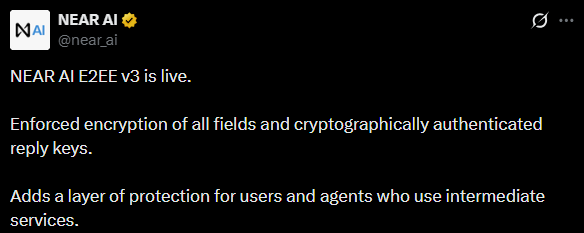
Source: Official X Post, on Nov 27, 2026, at 12:34 PM IST.
NEAR AI Cloud encryption builds on Trusted Execution Environments (TEEs), where both the gateway and model inference run with hardware-level isolation.
E2EE adds a client-side layer: messages are encrypted with the model's public key before leaving the user's machine, and the key is bound to the model's TEE attestation.
Under v3, the client generates a fresh reply key pair for every request. Each field is encrypted with the reply public key and a field label supplied as additional authenticated data, and the proxy checks both before processing the field.
The SDK defaults to Ed25519, and the guide lists ECDSA as a second option.
Detail | Ed25519 (SDK default) | ECDSA |
Suite ID | 0x02 | 0x01 |
Reply public key in AAD | 32 bytes | 65 bytes, uncompressed |
Key exchange | X25519 ECDH with HKDF-SHA256 | secp256k1 ECDH with HKDF-SHA256 |
Cipher | XChaCha20-Poly1305 | AES-256-GCM |
The request AAD joins a version label, the suite ID, the reply public key and the field label. Message content uses the literal label messages[].content for every position.
The guide says v3 encrypts supported function and tool fields whenever they appear. Tool parameter schemas and multimodal content arrays are serialized to JSON and encrypted as one field.
Tool definitions and calls can carry sensitive details, so NEAR AI Cloud encryption extends to them.
Requests: function names, descriptions and parameter schemas, named tool choices, and tool-call names and arguments
Responses: function names and arguments, refusals, tool results, and logprob tokens and bytes
Developers enable the feature by setting e2ee: true in the JavaScript client from the @nearai/inference-sdk package, which requires Node.js 24.22.1 or later.
NEAR AI Cloud encryption is off by default, and with the option on, the SDK verifies the model key, encrypts the request and decrypts the reply automatically. Python, Rust and Go SDKs support the same flow.
verifyResponse() checks the signature against the exact request and response bytes, and streaming replies must be fully consumed first
Response records expire 60 minutes after the full response is read, by default
The default Intel TCB policy accepts UpToDate, OutOfDate and TDRelaunchAdvised, and stricter policies can be set
Optional OHTTP encapsulates chat requests and responses
The SDK page says to leave E2EE disabled for other models and APIs
The release is a technical update, and the source material contains no token or pricing information.
For readers following the crypto market, including BTC and NEAR Protocol, it reads as infrastructure news rather than a price event. The material reviewed lists no partners or rollout schedule.
Practical limits still apply. The browser entry point does not perform Gateway TLS binding, and the guide says both the Gateway and the model endpoint must support protocol v3.
The gateway sends client-E2EE requests only to a compatible serving path, and a request is unsupported when none is available. NEAR AI Cloud encryption therefore depends on a compatible setup from the client through to the model.
Disclaimer: This article is for information only and is not financial, investment or security advice. Details may change, so please check the official NEAR AI documentation and do your own research.
Frequently Asked Questions (FAQ)




Owned by:-
DCG Tech FZCO, UAE
Delivery Partner:-
Gabbar MediaTech Pvt Ltd.
Copyright © 2026 Coin Gabbar. All Rights Reserved


