NEAR Intents Exploit Exposes Deposit Flaw, but $3.8M Is Recovered


The NEAR Intents Exploit was in crypto news today after it was reported that a security flaw in a smart contract caused the generation of $3.8 million in incorrect balances during 23 failed operations on October 1.
Key Takeaways
A NEAR Intents exploit on October 1 exposed a smart contract deposit vulnerability, allowing an attacker to generate approximately $3.8 million in false balances across 23 failed transactions.
The flaw existed in the NEAR Intents contract, not the Omni cross-chain infrastructure, and involved the refund mechanism triggering before deposit records were cleared.
All $3.8M was recovered within 36 hours through on-chain tracking and negotiation. The team applied security fixes and paid a $300,000 bounty to a separate researcher who flagged a related vulnerability on October 7.
NEAR Intents Exploit Postmortem: Alex Shevchenko Explains the Incident
In the latest crypto news, NEAR Intents General Manager Alex Shevchenko (@AlexAuroraDev) published a postmortem on the October 1 security incident.
Source: @AlexAuroraDev on X, captured October 17, 2026
The post was titled "Postmortem: NEAR Intents October 1 Exploit." This is the main source where information about this particular NEAR Intents exploit can be found, an acknowledgement of the existence of a problem, its exploitation, and subsequent fix by the project’s management.
The use of the term "postmortem" shows that the developers viewed this event as already finished by the time of writing the post.
Wu Blockchain Translation: How the Exploit Worked
Crypto News Today outlet @wublockchain12 translated the postmortem details from Chinese sources.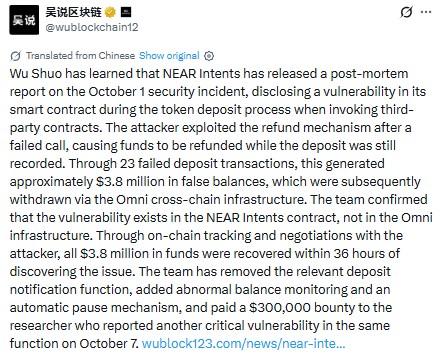
Source: @wublockchain12 on X, captured October 17, 2026
According to this translation, the attacker exploited the refund mechanism in the NEAR Intents smart contract during the token deposit process when invoking third-party contracts.
After a failed call, the refund triggered while the deposit was still recorded as valid, creating a false balance.
Through 23 failed deposit transactions, approximately $3.8 million in false balances was generated and subsequently withdrawn via the Omni cross-chain infrastructure.
The team confirmed the vulnerability was in the NEAR Intents contract, not in Omni.
What Did the Team Do After Discovery?
According to the latest crypto news coverage, NEAR Intents' SHIELD AI security layer flagged the exploit activity.
The team paused services across 11 networks, including BSC and Polygon, within an hour of detection.
Alex Shevchenko publicly identified the suspected exploiter and issued a 48-hour deadline with return addresses across BTC, EVM, and Solana chains. The full $3.8M was returned, and the investigation closed on October 4.
The team also paid a $300,000 bounty to a researcher who independently reported a related critical vulnerability in the same function on October 7.
Three fixes were applied: removal of the relevant deposit notification function, abnormal balance monitoring, and an automatic pause mechanism.
What Is Still Unconfirmed?
The exact identity of the exploiter has not been publicly named. The $300,000 bounty recipient is not identified in sources reviewed.
No breakdown of which of the 23 transactions occurred on which chain is publicly available.
Whether affected users received full compensation as promised has not been independently verified in crypto news today coverage reviewed.
What Should Readers Watch Next?
Two items matter for anyone following this NEAR Intents exploit news. First, whether the full user compensation is confirmed and distributed.
Second, whether NEAR Intents publishes a full on-chain transaction audit from the incident.
YMYL Disclaimer
This article is for informational purposes only and is not financial or investment advice. Details are sourced from social media posts and third-party crypto news outlets. Verify current security status and compensation details through official NEAR Intents channels before making any decisions.






