Onyx Blockchain: XCN Utility, Staking, Bridge and Wallet Features

Onyx Blockchain: How Does Its Layer 1 Network Work With XCN?
Banks want speed. Developers want tools they already know. Regulators want clear records. Few networks try to serve all three at once, and the Onyx blockchain says it was built for exactly that. This guide covers what Onyx is, how XCN powers it, and how users can bridge, stake, and store XCN on it.
Key Takeaways
Onyx is a sovereign Layer 1 chain for payments and financial institutions, live since March 27, 2026.
Onyxcoin (XCN) pays gas, secures the network through staking, and carries DAO votes.
Onyx runs EVM compatible smart contracts on aBFT consensus, with Chain ID 327.
What Is Onyx Blockchain?
Onyx is a Layer 1 network made for banks, payment firms, and other regulated players. The Onyx Protocol pairs familiar Ethereum-style tools with fast, final settlement.
What is Onyx Layer 1? It is a base network with its own validators. Nothing is borrowed from another chain, so every transaction settles on Onyx itself. The official website lists the key numbers below.
Source: official website.
Feature | Detail |
Network type | Sovereign Layer 1 |
Consensus | aBFT with proof of stake |
Block time | About 1 second |
Throughput | Up to 24,000 TPS |
Average fee | Around $0.00036 per transaction |
Chain ID | 327 |
What Is Onyxcoin XCN Used For?
Onyxcoin is the native token of the network. On Ethereum it exists as an ERC-20. On Onyx it works as native gas and as the stake that protects the chain. Every Onyx holder gets three jobs to choose from.
Role | What it does |
Gas | Pays fees for every transaction |
Staking | Gives validators voting weight and earns rewards |
Governance | Votes on Onyx Improvement Proposals |
The official whitepaper caps supply at 68,892,071,757. The website shows more than 39.3 billion in circulation. Fee burns and DAO-approved burns are meant to keep the model deflationary.
How Does Onyx Blockchain Work?
Most chains throw away competing blocks. Onyx keeps them. Events that happen at the same time are merged into the ledger, so no work is wasted and nothing waits for a slow producer.
Order comes from fairness, not from a block builder. Each transaction gets a consensus timestamp, which is the median of the times nodes first saw it. One node cannot set that value alone.
The journey of one transfer looks like this:
Wallet sends it → a node shares it with peers → nodes agree on time and order → finality in under 2 seconds → balances update
Onyx also adds a private layer called Onyx Mesh. Banks can keep sensitive data and business logic off the public ledger while still using Onyx for trusted ordering.
Onyx aBFT Consensus Explained
aBFT stands for asynchronous Byzantine fault tolerance. In plain words, the network still agrees even when attackers delay messages or some nodes lie.
There is no leader to attack and no timer to break. A transaction is final once nodes holding more than two-thirds of the staked tokens validate it. The chain is safe while bad actors control less than one-third. The result is a forkless ledger with no reorganisations.
Is Onyx EVM Compatible?
Yes. Solidity contracts deploy with zero changes, and Hardhat, Foundry, ethers.js, and Wagmi work out of the box. A developer who already ships on Ethereum can move code over without a rewrite.
Onyx Chain ID 327 and Wallet Setup
Chain ID 327 identifies Onyx Mainnet inside any EVM wallet. The Quick Start guide lists the current network settings, so users should copy them from there and not from a third party.
How to Use Onyx Wallet
The Onyx Wallet is non-custodial and gas-free. Users manage, swap, and send tokens from one app.
Download it from the App Store or Google Play links on the official site.
Create a wallet and store the recovery details offline.
Fund it with XCN through a transfer or the bridge.
Use the app to swap, send, or stake.
How to Bridge XCN to Onyx
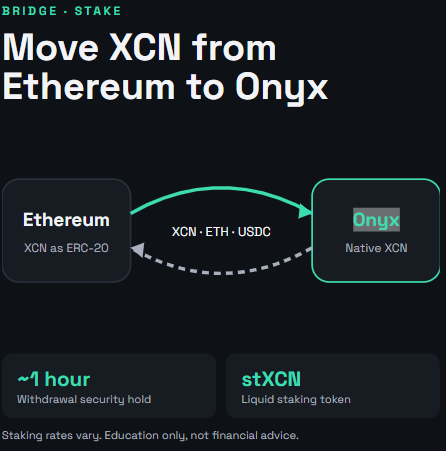
The Onyx Bridge moves XCN, ETH, and USDC between Ethereum and Onyx in both directions. It stays ERC-20 on Ethereum and becomes native XCN on Onyx.
Bridge fees are separate from network gas, and they can change. Users should read the live quote in the app before confirming. Withdrawals from Onyx to Ethereum wait about one hour in a security hold. A finished source transaction does not mean funds have arrived, so the same transfer should never be sent twice.
How to Stake XCN on Onyx
Staking happens in the Onyx App.
Connect a wallet on Onyx Mainnet.
Stake XCN.
Receive stXCN, a liquid token that stands for the staked position.
Hold or use stXCN while rewards build.
The site showed about 30% APR when checked, but the rate is variable. The docs also warn about smart contract risk, and the protocol owner can change rates, change fees, pause staking, or upgrade contracts.
Who Governs Onyx?
The Onyx DAO does, through token holders. A proposal needs an address with at least 100,000,000 of weight. Voting runs three days, and 200,000,000 XCN in favour is needed to pass. A two-day timelock follows before the change executes.
Source: official documentation.
What Risks Should Holders Know?
The whitepaper says decentralisation happens in stages. The network starts with trusted node operators, and the DAO proxy-stakes XCN to DAO-run nodes at first. Open, permissionless operation comes later.
Staking rewards move. Bridges add delay and contract risk. Price can also swing hard. Analysts who follow the Onyx blockchain tend to watch how fast outside operators join the validator set, since that shows whether the open model is working.
Conclusion
Onyx Blockchain is a Layer 1 network designed for payments and financial applications. Powered by XCN, it offers staking, bridging, EVM compatibility and DAO governance. With its own wallet, aBFT consensus and Ethereum asset support, Onyx aims to connect blockchain technology with real-world financial use cases.
Disclaimer: This content is for education only and is not financial, investment, or legal advice. Crypto assets are volatile and carry a risk of loss. Staking and bridging add smart-contract risk. Readers should verify details on the official website and do their own research before acting.