Orbinum Network ZK-NPoS Launch: Private Staking Before Mainnet

Orbinum Network Testnet: Private Staking Features and User Benefits
Orbinum Network has switched on private staking on its public testnet, a rare twist on Polkadot-style proof-of-stake (ZK-NPoS) in which addresses and amounts stay hidden.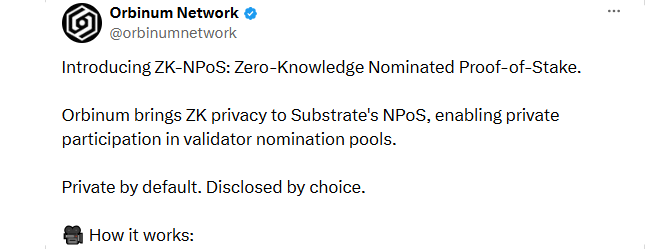
The feature, called ZK-NPoS, was announced on X and builds on a privacy-focused Layer-1. Can a crypto project still on testnet turn that edge into a mainnet debut before year’s end?
Orbinum Network ZK-NPoS Explained: How Private Staking Pools Work
Standard nominated proof-of-stake exposes every participant. Block explorers show who stakes, how much, and for which validators. Orbinum Network keeps the same consensus, with Aura producing blocks and GRANDPA finalizing them, then adds a privacy layer for pool members, per its staking docs. The flow runs in five steps:
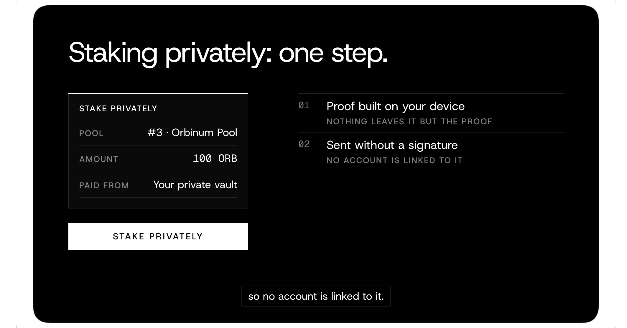
Vault: ORB token sits in a private vault as notes, also called commitments
Proof: the wallet builds a zero-knowledge proof on the device to show the join is valid
Entry: the proof goes in without a signature, so no public account is linked, and the stake joins a shared pool account
Shares: private shares land in the vault, and rewards compound into them every era
Exit: unbonding is confidential as well and takes two eras, about two days
Pools, validators, total amounts and timing stay public. Users can reveal a single note through a disclosure key without exposing the spending key. The chain pairs Groth16 ZK-SNARKs with full EVM compatibility. Runtime updates from spec 21 to 22 delivered NPoS first and shielded staking next. Only validators face slashing today.
Private Staking Benefits and What Orbinum Testnet Users Can Do Today
The pitch rests on four points:
Privacy: who stakes, and how much, stays hidden
Spread: stakers can join several pools without tying activity to one public account
Low entry: confidential pool membership starts at 10 ORB on testnet, while public nominator and pool roles run from roughly 1 to 100 ORB
Hands-off rewards: no claiming, with short unbonding for non-validators
Per the getting-started docs, testers can draw ORB from a faucet, shield balances, send protected transfers and run validators or pools. Season 1 of the Community Program also hands out credits that convert to an airdrop at TGE, under snapshot and vesting rules.
Testnet tokens carry no real value, and the chain can reset, so no ORB price exists yet.
Market Comparison: Orbinum Against Aleo, Aztec and Secret Network
Orbinum Network competes in a crowded privacy field. A comparison of privacy blockchains lists the main rivals:
Aleo: a ZK Layer-1 with shielded apps and privacy-preserving staking
Aztec: an Ethereum Layer-2 built for privacy-preserving smart contracts and DeFi
Secret Network: Cosmos-based, with confidential contracts run in trusted hardware
Penumbra and Namada: ZK shielded pools and private DeFi in the Cosmos ecosystem
Zcash, Monero and Dusk: payment privacy and regulated-finance privacy
Orbinum’s angle is narrower. It joins Substrate NPoS privacy, EVM compatibility and private-by-default pools with selective disclosure on one chain. That niche is still unproven at mainnet scale.
Orbinum Mainnet Launch Date: Token Listing and Roadmap Phases Ahead
The roadmap shows research, community and public testnet phases complete. Phase 4, the mainnet launch targeted for Q4 2026, is under way:
Sale and audits: public sale, genesis and security audits
Network: validator selection and consensus migration
Token: end of Season 1, a credits snapshot, then the TGE
Market: mainnet launch and initial exchange liquidity
No Orbinum launch date, listing venue or sale price has been confirmed, and the network remains on testnet. After ORB mainnet, staking rewards would come from scheduled issuance, 30% of supply over time, plus fees. Later phases point to private DeFi, institutional adoption and cross-chain privacy bridges.
Disclaimer: This article is for informational purposes only and does not constitute financial or investment advice. Crypto markets carry significant risk. Always do your own research before making any investment decisions.






