Orex Network Staking: From Token Locking to Governance Voting


Orex Network Staking: What Are the Lockup and Delegation Plans?
Many crypto projects promise staking and voting before the technology exists. Orex Network staking is one of those planned features, so it helps to separate what is live from what is only described in a document. This guide uses the official website and the whitepaper (v1.2) to show where things stand.
Key Takeaways
The Orex Network lists staking and governance as planned features that depend on a future blockchain.
Staking is meant to reward long-term participation, but rewards are not guaranteed returns.
Governance would let eligible participants propose and vote on selected matters once the technical and legal framework is ready.
What Is Orex Network?
Orex Network is a Web3 project that started with a free Android app. The Orex mobile mining app lets users start a 24-hour session and earn ORX without any hardware. The whitepaper describes a wider goal: one ecosystem that links mobile participation, blockchain infrastructure, digital rewards and gaming.
Source: official website.
Item | Detail |
Mining speed | 0.5 ORX per hour, about 12 ORX per full session |
Referral bonus | +200 ORX per friend who joins |
Cost | Free, supported by ads |
Security | Google Firebase with server-side time checks |
The word “mining” needs a note. The website says it means app-based participation and rewards, not conventional proof-of-work mining. Sessions run on Orex servers, so the app does not drain the phone’s battery.
ORX Tokenomics: Why It Matters for Staking
The ORX token has a stated maximum supply of 500,000,000. Any staking program needs a clear source of rewards and a clear picture of who holds the tokens. The allocation shows where the project plans to place them.
Allocation | Share | ORX |
Community and mobile mining | 50% | 250,000,000 |
Liquidity and listings | 15% | 75,000,000 |
Ecosystem and gaming partners | 15% | 75,000,000 |
Core team and developers | 10% | 50,000,000 |
Marketing and treasury | 10% | 50,000,000 |
Half of the supply is aimed at community distribution and mobile participation. The whitepaper says the model is meant to create utility before emphasizing speculation. It also calls the split a project-level target that may be refined, and says vesting, lockups and release schedules should be documented publicly before they take effect.
What Is Orex Network Staking?
Staking means locking or assigning tokens to help support a network. In return, participants may receive rewards, depending on the rules of that network. It is common on blockchains that use a stake-based consensus model.
The Orex calls staking a way to encourage long-term participation. It sits next to governance and the buyback and burn framework. Staking cannot start until the Orex blockchain exists, because the final model depends on the consensus and economic design of the production network.
Orex Staking and Governance: Quick Snapshot
Feature | What the whitepaper says | Status |
Staking | ORX may be locked or delegated | Planned |
Rewards | Follow published rules | Planned |
Validators | A delegated model is being considered | Under consideration |
Governance | Eligible participants may propose and vote | Planned |
All four items are future plans. None of them has a launch date in the official documents.
How Will ORX Staking Work?
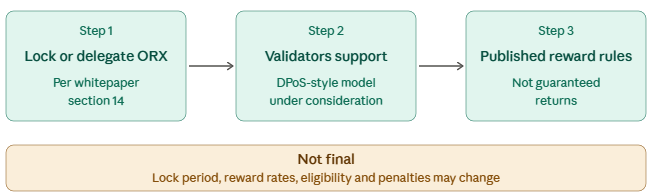
The whitepaper says participants may lock or delegate ORX to support network functions or approved ecosystem programs. The exact rules are not final. The paper states that reward rates, lock periods, eligibility and penalties may change according to network needs.
ORX Staking Lock Period
A lock period holds tokens for a fixed time. During that time, the tokens cannot be spent or moved. It mentions locking as one option but gives no length, so any specific number found elsewhere is not an official figure.
Delegation
Delegation assigns tokens to a validator, usually without giving up ownership. It lets holders take part without running their own node. The whitepaper says participants may “lock or delegate,” which suggests both routes are being considered.
ORX Staking Rewards
The whitepaper says rewards should follow published rules and should not be described as guaranteed investment returns. This is a direct warning against promising fixed yields. Rewards for the mobile app are a separate system, and the paper says those will include participation rules, anti-abuse controls and eligibility requirements.
Penalties
Penalties are listed among the terms that may change. In many staking systems, penalties discourage bad behavior or early exits. Orex has not published its own penalty rules.
Orex Network Delegated Proof of Stake
The whitepaper says a delegated proof of stake style model is being considered. In this kind of system, validators or delegates help run the network. It adds that final details may change after technical testing, security review and community governance.
The planned chain also aims for EVM compatibility. This would let developers who know Ethereum tools adapt existing practices to Orex infrastructure. The goal is fast confirmation and low transaction costs, which matter for games that create many small transactions.
The whitepaper adds two more points. A delegated design would generally avoid the energy model of proof-of-work mining, though actual performance depends on the final build. The network is also meant to be modular, so parts can be improved without redesigning the whole ecosystem.
Orex Network Governance Voting
The whitepaper says the community is meant to have a growing role in ecosystem decisions. A future framework may let eligible participants propose, discuss and vote on selected matters. The paper does not define who counts as eligible.
Orex Network Governance Proposals
The ORX lists several topics that governance could cover.
Possible topic | What it could cover |
Community initiatives | Programs led by users |
Ecosystem grants | Funding for builders |
Gaming priorities | Which games to support |
Treasury programs | Use of project funds |
Parameter changes | Network settings |
Development proposals | Changes to the roadmap |
How Staking and Governance Could Fit Together
The official whitepaper treats both as tools for long-term participation. In many networks, staking shows commitment and governance gives that commitment a voice. Orex has not said whether staking will be required to vote.
Because the paper only says “eligible participants,” readers should treat any claim about voting rights as unconfirmed. The same applies to claims about voting weight or reward sharing. Official rules would need to be published first.
ORX Ecosystem and Token Utility
The whitepaper lists possible uses for ORX across the ORX ecosystem: blockchain transaction fees, gaming economies, digital assets, staking and ecosystem incentives. Within supported games, ORX may be used for purchases, rewards or access. Each game may set its own balance, so gameplay does not depend only on token speculation.
ORX Buyback and Burn
It describes a buyback and burn tool that may be used if adopted and technically built. Eligible funds could buy ORX under published rules, and selected tokens would be removed from circulation. The project should publish the funding source, execution rules, wallet addresses and transaction evidence. The whitepaper says burning does not guarantee a higher price.
What the Whitepaper Says About Risk and Security
The whitepaper says security is a continuous process. Planned controls include multi-signature approval for treasury actions, cold storage for protected assets, contract testing and independent audits where practical. Audit status should be communicated openly rather than implied.
The whitepaper also warns of technical failures, smart-contract vulnerabilities, regulatory changes, market volatility and loss of private keys. It also says ORX is not publicly listed or freely tradable. Users remain responsible for protecting their own seed phrases and private keys.
Is Orex Network Staking Live?
Item | Status |
Live | |
ORX trading | Not publicly listed or freely tradable |
Withdrawals | Planned (Phase 03 on the website) |
Blockchain testnet and validators | Planned |
Staking and governance voting | Planned |
Final Thoughts
Orex Network staking and governance are best read as a plan, not a product. The whitepaper gives a clear direction but leaves key terms open, including lock periods, reward rates and voter eligibility. Readers should rely on orex.network official channel for updates, and treat anything unpublished as unconfirmed.
Disclaimer: This article is for information only and is not financial advice. It reflects the Orex Network whitepaper v1.2, which describes a development roadmap that may change.