Paytaca Backend Attack Created Fake Orders, Keys Not Affected

What the Wallet Team Disclosed About the Two Incidents
Bitcoin Cash wallet Paytaca has disclosed a Paytaca backend attack on two straight days, November 17 and 18, 2026. Attackers used one flaw to create fake P2P Ramp orders. They used another to send payment requests users never made. The team said private keys were not involved.
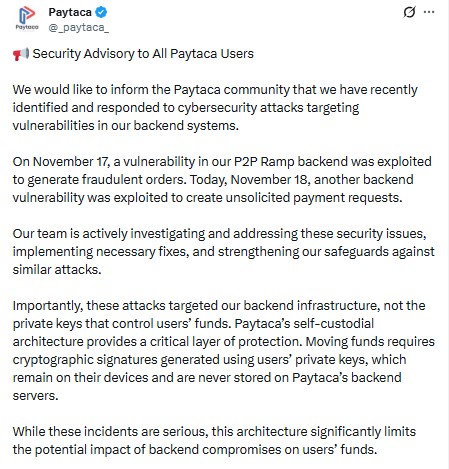
The wallet posted its security advisory on X on November 18. It said engineers are investigating, applying fixes, and adding safeguards. Reports on the advisory say it describes neither flaw in detail.
How the Paytaca Backend Attack Unfolded Over Two Days
The advisory covers two events. The first hit the P2P Ramp, the service where users trade directly with each other.
Date | What was exploited | Result described |
Nov 17, 2026 | A P2P Ramp vulnerability | Fake orders generated |
Nov 18, 2026 | A second vulnerability | Unsolicited payment requests generated |
Nov 18, 2026 | Security advisory posted on X | Investigation and fixes under way |
Why Self-Custody Kept Private Keys Out of the Attack
A self-custodial wallet keeps the private key on the user device. The team said the key is never stored on its servers. Sending funds needs a digital signature made with that key.
So a backend flaw can change what the app shows. By the team’s own account, it cannot sign a transaction for the user.
This moves the remaining risk to the approval step. A fake order or request only costs money if someone signs it. That reading is an analysis based on the wallet’s description. It is not a finding from a technical review.
The Paytaca backend attack therefore points to one habit: check before you sign. The team gave users the same advice. Two separate backend components were hit, according to the advisory, so the fixes may need to cover more than one system.
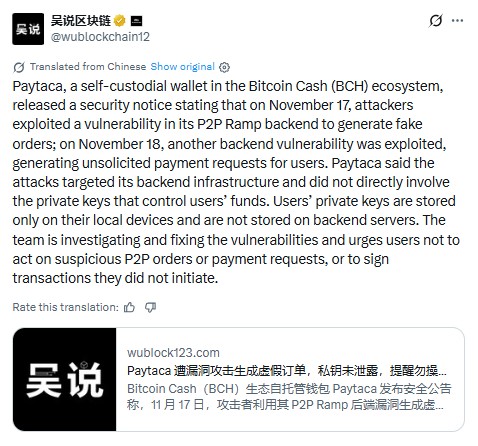
Wu Blockchain also covered the update on X.
What Users Should Do While Fixes Are Under Way
The advisory on the Paytaca backend attack gives three steps:
Ignore suspicious or unsolicited P2P orders and payment requests.
Do not approve or sign transactions you did not start or do not recognize.
Never share a recovery phrase or private key with anyone.
The steps apply to different people in different ways.
Who | What to do |
Users of the P2P Ramp | Ignore orders you did not create. |
Any wallet user | Do not sign requests you did not start. |
Anyone asked for a recovery phrase. | Do not share it. |
Take later instructions only from the official channels, such as the wallet website.
What Remains Unconfirmed After the Security Advisory
The advisory did not say whether any funds were lost, according to The Defiant. It also does not state whether the two incidents are linked or came from one attacker.
No post-mortem was found in the sources reviewed as of November 18, 2026. Readers following this crypto news should watch for updated figures.
The Paytaca backend attack is still under investigation, so details may change.
Disclaimer: This article is for information only and is not financial advice. Crypto assets are volatile, so verify details with official sources before acting.






