Pearl Crypto: Exploring a Blockchain Built Around AI Computing


What Is Pearl Crypto? Proof of Useful Work and AI Mining Explained
What if mining a coin also trained AI? Bitcoin miners burn huge amounts of power on puzzles that help nobody outside the chain. Pearl crypto tries to change that by letting the same GPUs that run AI models also secure a blockchain.
The idea comes from Pearl Research Labs. This guide covers how it works, who built it, how the coin is structured, and what to check before trading it.
Key Takeaways
Pearl uses proof of useful work (PoUW), so one GPU pass can serve an AI request and secure the chain.
Its native coin is PRL, with a stated maximum supply of 2.1 billion.
The open question is demand. Miners can run the math without a paying customer behind it.
The Pearl Network at a Glance
Pearl is a Layer 1 AI blockchain. Its network page calls the system the Pearl Protocol, designed so that every GPU cycle powering AI also produces a native digital currency.
It is not a Bitcoin fork. It runs its own protocol.
Source: official website.
Detail | Pearl |
Network type | Layer 1 blockchain |
Consensus | Proof of useful work |
Native coin | PRL |
Max supply | 2.1 billion |
Builder | Pearl Research Labs |
Product | Pearl Inference Platform |
Who Built It: Pearl Research Labs
Pearl Research Labs shares its engineering work on its official site. One article shows how the team squeezed up to 15% more performance from a core mixture-of-experts kernel on Blackwell GPUs.
Another covers a BLAKE3 kernel that hashes GPU tensors 400x faster without a trip to the CPU. The lab also belongs to the NVIDIA Inception Program.
That shows real engineering depth. It does not say anything about where the coin’s price will go.
How Proof of Useful Work (PoUW) Works
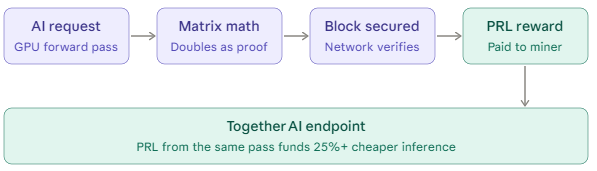
Matrix multiplication sits at the heart of modern AI models. Pearl uses it as the mining task instead of a throwaway puzzle.
A research paper from the team gives a proof of useful work for matrix multiplication with 1 + o(1) overhead. In plain terms, the proof adds almost no extra cost, so GPUs can reuse their AI compute to secure the chain.
Feature | Bitcoin (PoW) | Pearl (PoUW) |
Work done | SHA-256 hashing | Matrix multiplication |
Output | A block only | A block plus an AI result |
Typical hardware | ASIC miners | GPUs |
Energy purpose | Security only | Security and AI work |
One cycle, step by step:
A GPU runs an AI forward pass.
The matrix math doubles as a mining proof.
The network verifies it and secures a block.
The miner earns PRL.
AI Mining Crypto Gets a Real Product: Pearl Inference Platform API
The coin sits next to a working service. The Pearl Inference Platform offers OpenAI-compatible endpoints, so any OpenAI SDK works once it points to Pearl’s base URL.
Users pay per token from a prepaid balance, with no clusters to reserve. The docs list chat completions, function calling, JSON mode, reasoning models and vision.
The catalog covers open-weight models such as DeepSeek V4, Qwen and GLM, with context windows up to 1M tokens. For now, the platform serves chat-model inference only.
Pearl Crypto Together AI Partnership
The first live proof came through Together AI. Gemma-4-31B-it-Pearl runs on Pearl’s proof of useful work as a serverless endpoint.
It is priced 25%+ below the standard rate. The discount is funded by the PRL mined on the same forward pass.
So customers pay less while miners earn from the same computation.
PRL Tokenomics
PRL has a stated maximum supply of 2.1 billion. Supply growth is the part to watch.
About 1.01 million PRL is mined each day, and roughly 305 million new tokens were slated to enter circulation over the following year, nearly doubling the supply at that time. That figure comes from CoinMarketCap data in early November 2026.
Metric | Detail |
Max supply | 2.1 billion PRL |
Daily mining | About 1.01 million PRL |
Main use | Mining rewards and transfers |
Ticker note | Docs say PRL, listings may show PEARL |
New supply needs matching demand to hold value. Always confirm the ticker and contract before buying.
Pearl Crypto Vision
The stated goal is simple: make AI compute pay twice. One run should produce intelligence and network security together.
The team backs this with research. One paper models the economics of proof of useful work, and a public list covers open problems in math, cryptography and consensus. CoinMarketCap’s overview describes the same aim.
Expert Opinion: Innovation vs Doubt
Supporters like the link between AI compute and mining. It gives GPU power a second job that Bitcoin never offered.
Critics raise a fair point. A September 2026 report noted that miners could run matrix calculations without serving any real AI request. If that happens, the “useful” part exists only on paper.
The real test is whether customer demand grows alongside mining activity.
Source: official documentation.
Why Pearl Is Trending: Coinbase Listing and Where to Buy
Interest picked up after Coinbase moved on the coin. Coinbase announced that Pearl (PEARL) spot and perpetual contract trading will launch on November 13, no earlier than 20:00 Beijing time.
The Pearl crypto Coinbase listing follows its addition to the exchange’s roadmap in October 2026. Perpetual futures also trade on several other venues.
Spot access differs by country, so Indian readers should check their own exchange’s official announcements. Avoid random decentralized exchange links, and use the contract address published on the official site.
Risks to Know Before Investing
Supply inflation: Daily mining adds steady sell pressure.
Unproven demand: Customer usage must grow with the network.
Narrow product: The platform serves chat-model inference only today.
Ticker confusion: PRL and PEARL labels appear in different places.
Volatility: New listings often swing sharply.
Conclusion
Pearl’s idea is clear and technically serious. It gives mining a second job, and the Together AI endpoint shows an early working example.
Whether it lasts depends on real AI demand. Read the whitepaper, verify the contract, and size any position with care.
Disclaimer: This article is for information only and is not financial advice. Crypto is volatile, so do your own research.
















