Pepeto Launch: Will a Tier 1 Listing Set the First Trade Level?


Pepeto Launch Outlook as the Sale Round Nears Its Cap
This price prediction for the Pepeto launch works without a confirmed opening level, so it measures five outcomes against the current cost of $0.0000001905.
They range from a 40% dip to a 300% gain, and each one shows what a $1,000 position would be worth.
Supply, staking rewards, and the unannounced Tier 1 listing decide where trading could settle within that range. The sale page and the project’s November 3 post supply the starting facts below.
What the Sale Page and Official Post Confirm
Item | Status on November 4, 2026 |
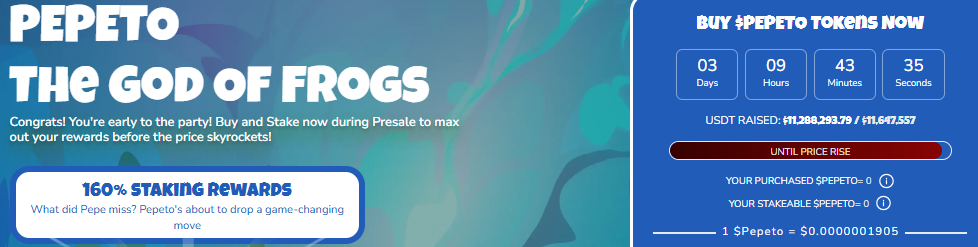
USDT raised | $11,288,293.79 |
Round target | $11,647,557 |
Amount remaining | $359,263.21, about 3.1% |
Timer | 03 days, 09 hours, 43 minutes, 35 seconds |
Staking rewards | 160%, as stated by the project |
Giveaway | $700,000, tied to the period before a Tier 1 listing |
Exchange name | Not given |
Listing date | Not given |
The timer counts down to a step change inside the sale, and the bar beneath it reads “Until Price Rise”.
It does not count down to trading. Until the project confirms an exchange and a date, any reading of the Pepeto launch rests on the sale cost alone.
Source: Official Dashboard
Note: Prices can change quickly, so figures may not reflect the latest value. Readers should check a live price tracker for current data.
Tier 1 Listing: What It Could Mean for the Opening Value
The term Tier 1 usually points to large exchanges with deep order books and wide retail reach, though it has no fixed definition, and the project has not defined it. Deep books tend to narrow the gap between a first trade and later ones. Thin books let a few orders move the value sharply.
Supply arithmetic adds scale. At the current cost, the remaining $359,263.21 buys about 1.886 trillion tokens, roughly 0.45% of the 420.69 trillion maximum supply shown on Etherscan.
The unsold slice is small next to the full supply, so staking claims and other reserves may shape trading more than the last sale tranche. How those reserves unlock around the Pepeto launch will therefore matter.
Price Prediction: Scenario Values After a Tier 1 Listing
These five scenarios test outcomes for the Pepeto launch against the $0.0000001905 sale cost. A $1,000 purchase buys about 5.25 million tokens, which the last column uses to show position value.
Scenario | Multiple | Token value | Change | $1,000 position becomes |
Sharp dip | 0.6x | $0.0000001143 | -40% | $600 |
Slight dip | 0.85x | $0.0000001619 | -15% | $850 |
Parity | 1x | $0.0000001905 | 0% | $1,000 |
Moderate gain | 1.8x | $0.0000003429 | +80% | $1,800 |
Strong gain | 4x | $0.000000762 | +300% | $4,000 |
Each row is a straight multiple of the entry cost, so the table shows how far the opening could sit from that anchor and what a holder would see in dollars.
What would push each outcome:
Sharp dip: early holders and giveaway recipients sell into thin books.
Slight dip: opening orders outweigh buyers briefly, then trading steadies.
Parity: buyers accept the current cost as fair.
Moderate gain: a named Tier 1 listing draws wider demand.
Strong gain: deep liquidity and heavy first-day volume arrive together.
Staking Rewards and Their Effect on Supply
The reward schedule is among the largest unknowns around the Pepeto launch. The project states 160% staking rewards, yet the sources reviewed give no payout schedule. Timing decides whether the rewards pressure the market or not.
Reward timing | Possible effect on trading |
Claimable at listing | Extra tokens may reach the market within hours, adding sell orders |
Locked or vested | Fewer tokens trade at the start, which narrows supply |
Terms unpublished | Impact cannot be modeled yet |
Until the terms appear, both the dip and gain cases stay open.
Key Levels to Watch and Closing Outlook
Several confirmations would narrow the range above:
An exchange name and a listing date from the project
The size of the opening liquidity pool
Volume during the first hour of trading
The reward payout schedule
Any security audit, since the contract page shows none submitted
The only confirmed reference today is the $0.0000001905 sale cost. Every other figure here is arithmetic, and the Pepeto launch stays open until an exchange date and opening level are published.
YMYL Disclaimer: This article is for informational and educational purposes only and should not be taken as financial or investment advice. Crypto markets are volatile, and details such as roles, plans, or figures mentioned here can change over time. Readers should do their own research before making any decision based on this content.