PLX Network Tokenomics: Supply, Allocation and Utility Explained

How Does PLX Network Tokenomics Work? Supply, Rewards and Utility
Most people open a mining app, tap start and never ask where the coins come from. They also don’t ask how many will ever exist. That habit can cost you, because supply and sharing rules decide whether a token can hold its value over time.
This guide walks through PLX Network tokenomics using only the official whitepaper. There is no hype and no price talk, just what the project has published.
Key Takeaways
Total supply is fixed at 1,000,000,000 PLX, and no more can ever be minted.
55% of all tokens go to mining rewards, released over four years from 1 May 2026, with each year paying out less.
Most utility is planned, not live. Transfers and exchange listings are future goals, not promises.
A Quick Look at PLX Network
PLX Network is a free mobile cloud mining app for Android. You start a 24-hour session, the project’s cloud servers run it, and PLX is credited to your balance. You don’t need hardware or money to begin.
It runs on a model called Proof-of-Participation. The project says it is in Phase 2: Mining Phase and Ecosystem Setup.
Source: official website.
PLX Token Supply: A Hard Cap
The PLX token supply is capped at 1,000,000,000 PLX. The whitepaper states that no tokens will be minted beyond this cap.
Think of a hall with a fixed number of seats. More people can arrive, but the seat count never grows. The team says this keeps issuance controlled and supports long-term sustainability.
PLX Token Allocation: Who Gets What
The full supply is split across six buckets, grouped into miners and public, and core and development.
Bucket | Share | PLX Amount | Purpose |
Mining Rewards | 55% | 550,000,000 | Paid to users through mining sessions |
Referral & Community | 15% | 150,000,000 | Referral bonuses, badges, community incentives |
Exchange Liquidity | 12% | 120,000,000 | Held for liquidity if PLX is ever listed |
Team & Development | 10% | 100,000,000 | Core team building the platform |
Marketing | 6% | 60,000,000 | Partnerships and campaigns |
Reserve | 4% | 40,000,000 | Future development, audits, contingencies |
Source: official PLX tokenomics documentation.
Here is the same split as a simple visual:
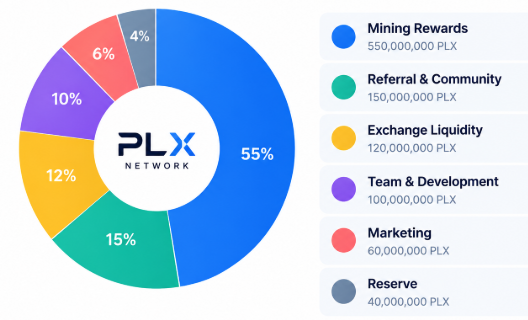
Notice that 82% of supply sits in the miners and public groups (crypto mining, referrals, and exchange liquidity). Only 20% goes to team, marketing and reserve combined.
Also note that the exchange liquidity share exists “if PLX is ever listed.” The whitepaper clearly says a listing is not guaranteed.
PLX Token Distribution: How Coins Reach Users
Mining is the main road. Your earnings depend on three things:
Factor | How it works |
Base rate | Set when you create your account and stays yours permanently. The entry rate for new users steps down as the network grows. |
Referral bonus | Each active referral adds +0.03 PLX/hr, with no cap. |
Team boost | 1.2× with 3 active members, 1.5× with 5. |
This is why early joiners lock in higher base rates. The pool is shared out under rules that are published openly, not decided case by case.
How Does PLX Tokenomics Work?
Here is the short version. A fixed pool of 550,000,000 PLX is released over a four-year mining phase. The release follows a halving curve, so each year gives out less than the year before.
The official whitepaper shares example figures to show the shape of that curve:
Year | PLX Released (example) |
Year 1 | 250,000,000 |
Year 2 | 175,000,000 |
Year 3 | 125,000,000 |
Treat these as illustrations. The final yearly amounts will be known when the mining phase ends.
One more point matters here. The curve controls the total released across the whole network, not your personal rate. Whatever the final numbers are, mining rewards will never go past 550,000,000 PLX.
PLX Vesting Schedule and Token Unlock Schedule
Many readers search for a PLX vesting schedule, usually because of the 10% team share. The whitepaper doesn’t publish a separate lock-up or cliff for the team or any other bucket.
What it does publish is the mining release timeline above. For now, that halving curve is the closest thing to a token unlock schedule. If the project adds vesting details later, the whitepaper is where they should appear. It was last updated in October 2026.
PLX Token Burn: What the Whitepaper Says
The whitepaper doesn’t describe a PLX token burn. Supply control comes from two things instead: the hard cap and the declining release curve.
So if you see a burn claim somewhere online, check it against the official page first.
PLX Token Utility and Staking Rewards
The whitepaper lists what PLX is intended to be used for as the project grows:
Gifting and rewards inside PLX Social and PLX Gift
Payments in PLX Market and other apps
Rewards for creators and for watching ads
Staking and validator participation on PLX Chain
That brings in staking rewards, which are only planned for now. PLX Chain and the PLX-20 token standard are still in development, with public testing planned for Phase 3 of the roadmap. No staking rates have been published.
The wider PLX Network ecosystem includes apps such as PLX Wallet, PLX Chain, PLX Drive and PLX VPN. Most of them are marked Pending or Development on the official site. Each card shows its own status, so check there before assuming anything is live.
Today, PLX in the app is simply a balance recorded by PLX Network. Transfers and exchange listings are goals for later phases.
What to Keep in Mind
Here are three points worth remembering:
Plans and dates in the whitepaper are goals and may change.
The halving numbers are examples, not final figures.
The whitepaper is for information only and is not financial, investment, legal or tax advice.
Read the numbers, then decide for yourself.
Final Thoughts
PLX Network tokenomics comes down to a few clear rules: a 1 billion cap, a 55% mining pool, a halving curve and a utility plan that is still being built. What’s published is simple and easy to check.
What isn’t published yet, like a team vesting schedule or a burn, is just as useful to know. It tells you where the project’s details are still open. Read the full details on the official PLX Network whitepaper before you make any decision.
Disclaimer: This article is for information only and is not financial advice. Crypto participation involves risk.