Polkadot News: DOT Price Rises as Network Tops Decentralization List

Decentralization Ranking and Price Update
This Polkadot News report covers two separate updates recorded on September 17, 2026. A new ranking placed the network at the top of global decentralization metrics, and the DOT price rose over the past 24 hours.
Both developments come from separate sources published on the same day, offering a fuller picture of network activity alongside market movement.
Network Tops Global Decentralization Rankings
According to data platform Chainspect, cited in a report from BSCN on September 17, 2026, Polkadot-now holds the highest Nakamoto Coefficient among tracked Layer One networks.
This Polkadot News update explains what that figure means and how it compares to other major chains.
A Nakamoto coefficient measures how many independent validators or miners would need to cooperate to disrupt a network.
A higher score points to power spread across more independent participants, while a lower score means fewer parties control the network.
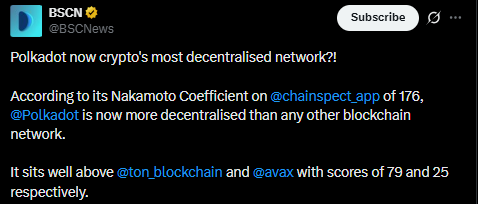
Source: BSCN X Post
Two Data Snapshots Show Consistent Lead
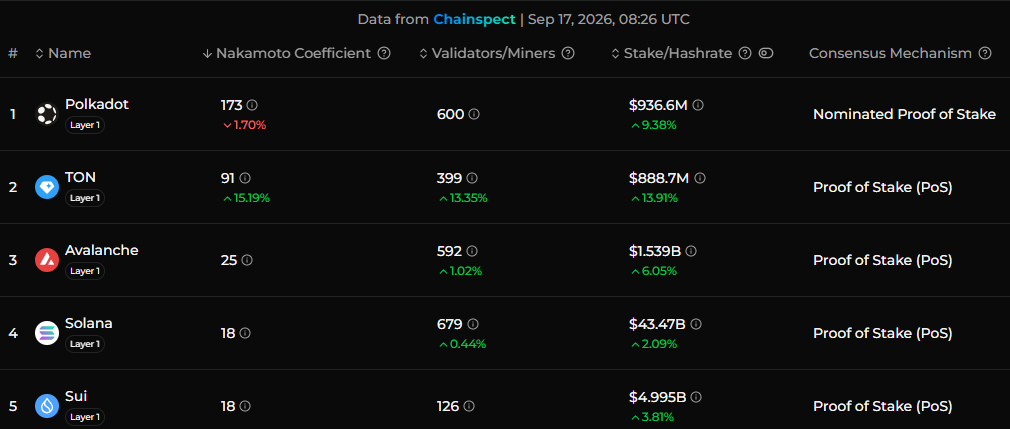
Chainspect data from September 17, 2026, placed the coefficient at 173, ahead of every other layer one chain tracked on its live table. The table below sums up today's coefficient data for this Polkadot News report.
Network | Nakamoto Coefficient | Validators/Miners | Consensus Mechanism |
Polkadot | 173 | 600 | Nominated Proof of Stake |
TON | 91 | 399 | Proof of Stake |
Avalanche | 25 | 592 | Proof of Stake |
Solana | 18 | 679 | Proof of Stake |
Sui | 18 | 126 | Proof of Stake |
This Polkadot News piece notes the figures moved slightly within hours, which is common for metrics pulled from live tracking tools.
Both readings placed the network well ahead of every other chain in the comparison, with more than 600 validators contributing to its stake, according to Chainspect data from the same date.
Source: Chainspect Data
How the Networks Validator Set Compares
The Chainspect table also lists stake-value and consensus mechanism for each chain. Polkadot-uses Nominated Proof of Stake, a system where token holders nominate validators to secure the network rather than running a node directly.
Other details from the same dataset:
Polkadot: 600 validators, $936.6 million in stake, up 9.38 percent
TON: 399 validators, $888.7 million in stake, up 13.91 percent
Avalanche: 592 validators, $1.539 billion in stake, up 6.05 percent
Solana: 679 validators, $43.47 billion in stake, up 2.09 percent
Sui: 126 validators, $4.995 billion in stake, up 3.81 percent
A larger stake-value does not always mean a higher Nakamoto coefficient, since the coefficient depends on how evenly that stake is spread across independent validators rather than the total amount staked.
DOT Price Rises Alongside Ranking News
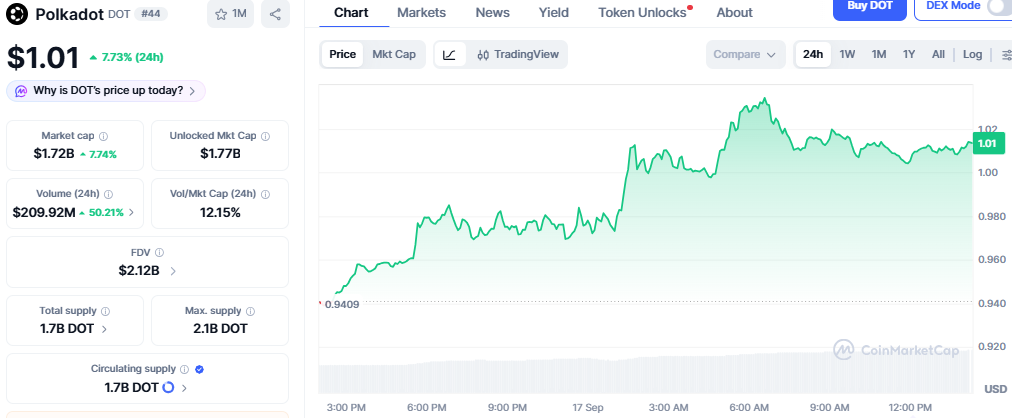
DOT trades near $1.01, up 7.73 percent over the past 24 hours, according to CoinMarketCap data from September 17, 2026.
This Polkadot News price snapshot shows the token holding gains through the latest session.
Metric | Value |
Price | $1.01 |
24h Change | +7.73% |
Market Cap | $1.72B |
Unlocked Market Cap | $1.77B |
24h Volume | $209.92M |
Volume/Market Cap | 12.15% |
FDV | $2.12B |
Total Supply | 1.7B DOT |
Max Supply | 2.1B DOT |
Circulating Supply | 1.7B DOT |
Trading volume rose more than 50 percent in the same period, based on the same dataset.
Source: CoinMarketCap Chart
Note: Prices can change quickly, so figures may not reflect the latest value. Readers should check a live price tracker for current data.
Expert Take
Today's Polkadot News combines a strong decentralization ranking with a notable price gain, two developments that do not appear directly linked.
A high Nakamoto coefficient reflects how validator power is spread across the network, not short-term trading activity, so the ranking should not be read as a direct price driver.
The gap between the network and the next closest chain on the list remains wide, with TON's coefficient sitting well below half of the current figure.
Conclusion
This kind of spread suggests the ranking is unlikely to shift quickly, barring a major change in validator participation.
The price gain lines up with a sharp rise in trading volume over the same 24-hour window, which often points to renewed short-term trading interest rather than a shift tied to any single announcement.
This Polkadot News piece will continue tracking both metrics, since decentralization data and price levels each shift independently over time.
YMYL Disclaimer: This article is for informational purposes only and does not constitute financial advice. Cryptocurrency prices are volatile, and past performance does not guarantee future results. Readers should conduct their own research before making any investment decisions.










