Polygon News: Solana Now Supported in Open Money Stack


Polygon and Solana Share the Spotlight
This Polygon News report covers a payments update that is making waves in crypto news today. The sections below explain it in plain words and point to the official pages worth a look.
Polygon Solana Support at a Glance: What Is Confirmed
Polygon’s Open Money Stack, or OMS, is a set of tools for moving money across blockchains. Polygon’s update from August 3, 2026 says OMS now sends stablecoins to and from Solana.
Co-founder Sandeep Nailwal and the official Polygon account on X also spoke about the link-up in public posts.
Confirmed by Polygon: stablecoin routing to and from Solana, plus more than 20 EVM chains.
Stated by Polygon only: Polygon and SOL carry most USDC payment use around the world.
Not shown in the reviewed update: fees, transfer volumes, and a full list of supported networks.
Polygon Open Money Stack Now Routes Stablecoins to and From Solana
The official Polygon blog post says OMS joins one-click payments with shared funds across the SOL and Ethereum worlds.
It adds that money can move between Solana and more than 20 EVM chains, which are networks built like Ethereum. Examples are Polygon, Ethereum, and Base, and all of them run through one API.
Polygon Trails is the part of OMS that handles the routing. A user can pay with a credit card, Apple Pay, or an exchange balance. The money then moves across chains in one click, though the blog notes that terms apply.
Sandeep Nailwal and Polygon Address the Chain Wars on X
Polygon News also includes public words from the team. Nailwal wrote on X that he would have argued against Solana for payments six years ago.
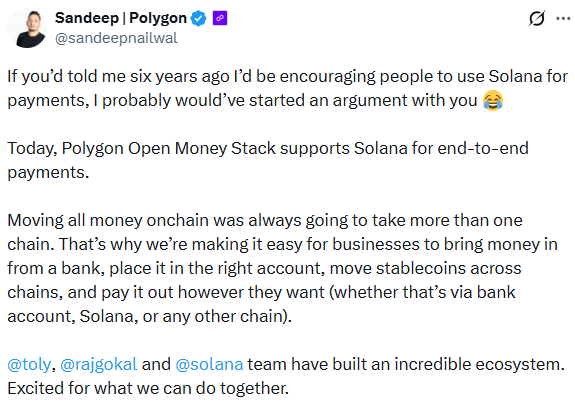
He says OMS now backs Solana for payments from start to end. He added that moving all money on-chain was always going to need more than one chain, and he thanked the Solana team for its work.
The official Polygon account on X then posted a joke titled “Dear Everyone.” It says the network is no longer at war with Solana and that both teams work together.
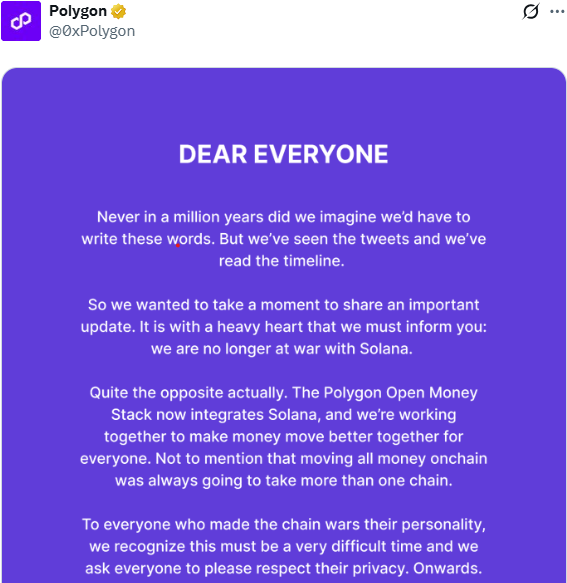
The joke nods to a rivalry that the crypto crowd has teased for years. It also confirms the tie-up in a tone that fits social media.
How the Payment Flow Works From Bank to Blockchain Payout
Nailwal described a simple path in his post. A business brings in money from a bank, puts it in the right account, moves stablecoins across chains, and pays it out the way it prefers. That gives a company one route to fund, move, and pay out money.
Fund: money comes in from a bank account, card, or exchange balance.
Route: stablecoins move across supported chains through Polygon Trails.
Pay out: funds leave by bank account, Solana, or another supported chain.
Meta Payouts Show Why Polygon and Solana Appear Together
Polygon’s post on Meta from April 29, 2026 says some Facebook creators in Colombia and the Philippines can get USDC payouts. Polygon and Solana are the two networks in use.
Polygon adds that the pair carries most USDC payment use around the world, which is the firm’s own claim and is best read that way. This real payout plan helps show why a link between the two chains is useful for stablecoin payments.
What Polygon News Means for Builders and Users
For builders, the update means fewer moving parts. One setup can reach many chains without extra work for each one. For payment teams, the key question is how well stablecoin payments fit with current bank and rule checks.
For everyday users, Polygon’s posts describe a goal where money gets to the right place in fewer steps.
Users would not need to know which chain holds the funds. This Polygon News item also shows two roles, since the blog carries the tech claims while the X posts carry the public message. A joke about a rivalry is not a data point, so the real test will be volume and named business users.
Polygon News Timeline and Open Questions
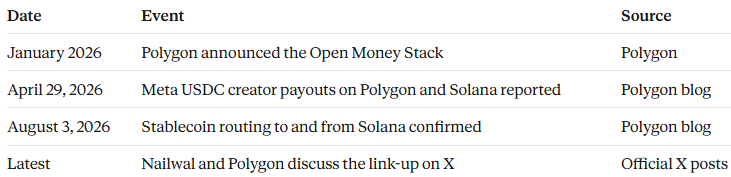
As of October 30, 2026, the reviewed posts do not list fees, volumes, or the full set of supported networks, so those facts are still open. Cross-chain transfers also carry risks, such as network downtime and delays before a transfer is final. A cross-chain transfer safety guide makes a useful companion read.
Conclusion: Key Dates and Open Questions
The confirmed facts are the August 3, 2026 blog update and the public words from Nailwal and Polygon. Before using any route, readers can check three things on official pages: the supported chain list, the contract addresses, and the fees shown at the time of transfer.
Future Polygon News will matter most once Polygon shares routed volume and named business users.
YMYL Disclaimer: This article is for informational purposes only. It is not financial advice, a price prediction, or a guarantee of returns. Crypto carries high risk, so readers should do their own research.






