Polygon Crypto News: Banks Get Connected Chains, but Is It Safe Yet?


Polygon Crypto News: Can Banks Trust This New Private Blockchain Link?
Banks have run private blockchains for years, but most of those networks sit alone.
This is the polygon crypto news that targets that gap. On October 19, 2026, Polygon announced CDK Besu, a tool that lets a bank launch a private network connected to other chains from its first block.
Here is what changed, how the safety checks work, and what to keep in mind.
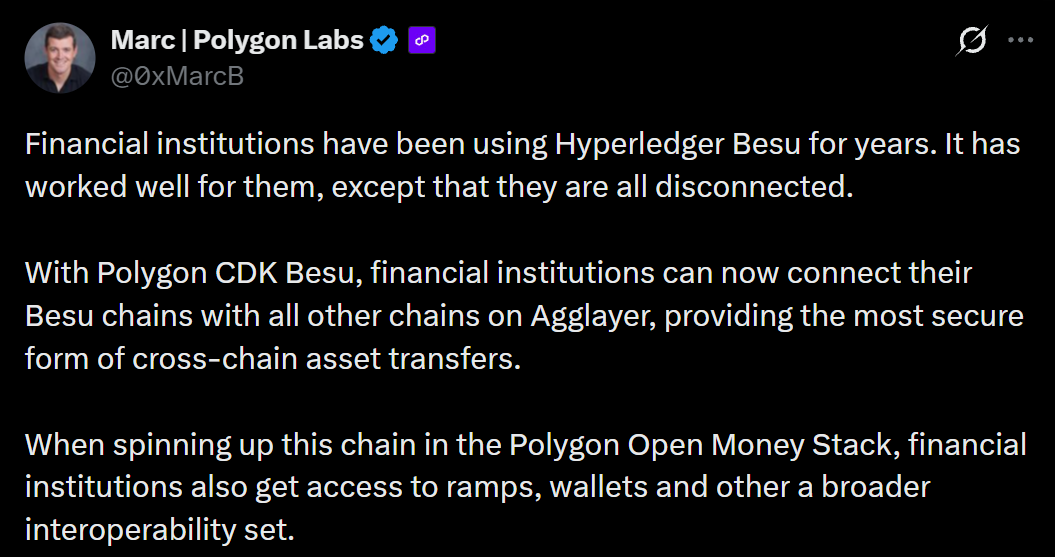
Source: summary post on X.
Why Were Bank Networks Stuck Alone?
Hyperledger Besu is open-source software that banks often pick first because enterprise security teams know it and a known group of institutions runs the validators.
The catch, according to the blog post, is that a private network of this kind starts on its own.
Reaching a partner or another chain’s liquidity has usually meant a separate integration project for each link, often through a bridge that relies on a committee of signers and brings its own risk review.
What Did the Company Launch?
Polygon CDK now supports Besu as a configuration. According to the CDK Besu documentation, a bank can launch a private network that uses QBFT consensus and connects to Agglayer from its first block.
The main points:
-
It runs the standard client, so there is no fork to maintain
-
Assets can move to and from any chain on Agglayer, and each transfer settles on Ethereum with a zero-knowledge proof
-
The bank or consortium runs its own validators and decides who can transact
-
Transaction data stays private and is not posted to Ethereum
-
No revenue share is owed on the network’s activity
-
A token moved this way keeps one canonical version on every connected chain
The company says the product is live and ready for production on the Ethereum mainnet, with test setups for teams that want to evaluate first.
How Does the Safety Check Work?
Agglayer uses what Polygon calls a pessimistic proof, which the post compares to an accountant that trusts nobody.
Each connected network keeps a running balance of what it has received and sent. Before a withdrawal settles, the numbers must add up.
If a network tries to take out more than was deposited into it, the check fails and nothing moves.
The argument is that a compromised chain can lose only its own deposits and that no committee of signers exists to approve a transfer that does not balance.
Two limits appear in the same post. The check covers bridge accounting, not every transaction inside a network.
And institutions that want every state change proven can use the CDK OP Stack option instead, which supports full execution proofs.
These security claims come from the company, and the post does not mention an independent audit of this specific setup.
What Would This Look Like for a Bank?
The post offers an example. A bank issues tokenized deposits to corporate treasury clients.
Later, a client wants to move part of that balance into a tokenized money market fund on another chain.
On an isolated network, that means redeeming for cash, using traditional rails, and buying back in, which can take business days.
Connected through Agglayer, the deposit token moves directly, arrives as the same canonical asset, and can come back the same way.
Here is how the two CDK options compare:
| | CDK Besu | CDK OP Stack |
| Best fit | Private ledgers with known validators | Chains wanting the OP Stack ecosystem and optional full execution proofs |
| Engine | Standard client, QBFT, immediate finality | op-reth with op-node |
| Data on Ethereum | None | Posted to Ethereum |
| Security | Pessimistic proof | Pessimistic proof or full execution proofs |
| Consortium setup | Supported | Supported |
How Is It Built, and Who Controls It?
Per the public runbook on GitHub, a network built this way is a standard Besu network with Agglayer’s bridge contracts written into its first block.
Agglayer then requests a check, generated on the Succinct Prover Network, that every connected chain’s accounting balances.
Once verified, the update settles on Ethereum, and the receiving side claims the asset. For consortiums, two controls apply:
-
Shared block production: each member runs its own validator and key, and membership changes by vote
-
Shared approval: M of N members must sign before anything settles to Agglayer
The post also names DTCC’s collateral platform, Clearstream, Citi Token Services, Project Agorá, and Swift’s shared ledger as networks running on Besu.
What Else Is Happening in Polygon Crypto News?
The same blog lists other recent items, which this article does not cover in detail:
-
October 14:Open Money Stack becomes a U.S.-regulated paymentsplatform with the Coinme acquisition completed
-
October 8:Open Money Stack adds TRON support
-
September 29:Polygon passes $3 trillion in stablecoin transfer volume
The post adds that such a network can also use the Open Money Stack, which offers ramps, wallets, and cross-chain routing.
What Should Readers Watch Next?
For anyone following polygon crypto news, four items matter:
-
Which banks or consortiums announce launches, since the post names none
-
Whether existing Besu networks connect, a path the company says needs a conversation with its team
-
Any independent security review of the setup
-
How the consortium controls work in real deployments
Conclusion
CDK Besu tackles a real problem: private bank networks that cannot reach each other.
The design is clear and the safety model is easy to explain, but it is the company’s own description, and no bank launch has been named. This polygon crypto news is best read as a promising tool, not yet a proven one.
Disclaimer
This article is for educational and informational purposes only and is not financial or investment advice. Crypto assets are high risk, their prices can be very volatile, and you can lose some or all of your money. Always do your own research and consider speaking with a licensed financial advisor before making investment decisions.






