Ethereum Price Prediction: Whales Buy Dip as ETH Slips Below $1,850


Ethereum is trading near $1,832 today, down about 2.2% over the last 24 hours. The drop comes even as some big wallets are stepping back in to buy.
Trader and Bitmex founder Arthur Hayes sent 2.5 million USDC to Galaxy Digital and picked up 1,337 ETH at around $1,869 per coin. This happened just two days after he sold ETH, according to on-chain tracker Lookonchain.
That kind of back-and-forth buying and selling from a known whale often gets traders asking where Ethereum price prediction models see the coin heading next.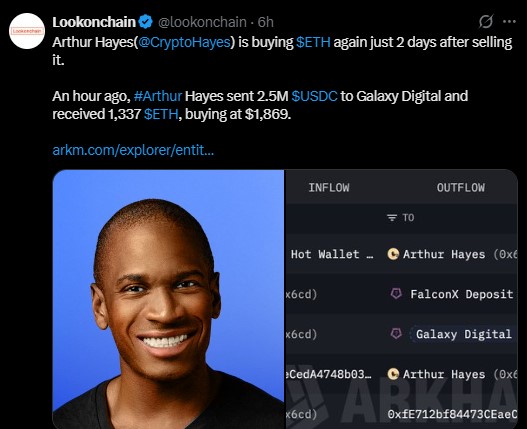
What is Ethereum's price today?
As of this writing, the altcoin sits at $1,832.28. The coin has a market cap of $220.96 billion and a circulating supply of 120.68 million tokens.
Total supply matches circulating supply, meaning there is no locked or unreleased ETH sitting on the sidelines.
Why is Ethereum price down today?
Futures volume over the past 24 hours hit $28.14 billion, up over 23%. Open interest also rose slightly to $26.41 billion.
Long positions took the bigger hit in liquidations. Over the past 24 hours, long traders lost $27.97 million compared to $15.95 million in short liquidations. That means people betting on higher prices got squeezed the hardest.
The long/short ratio on Binance sits at 2.53, and on OKX it is 2.1. This shows more traders are still leaning long, even during the pullback.
Ethereum price chart: key levels to watch
The 4-hour chart shows the altcoin is trading inside a falling channel, with resistance near $1,896 and the 20-period moving average around $1,864.
The Relative Strength Index sits at 38.20, which is close to oversold territory but not quite there yet.
Below is a quick look at where ETH stands technically:
Metric | Value |
Current Price | $1,832.28 |
24h Change | -2.22% |
Resistance | $1,896.44 |
20 SMA | $1,864.63 |
Support (Lower Band) | $1,831.73 |
RSI (14) | 38.20 |
If ETH breaks below the lower band near $1,831, the next stop could be the trendline support drawn from July lows, somewhere close to $1,775 to $1,800.
A bounce back above $1,896 would be needed to shift short-term momentum back to buyers.
Are ETH exchange reserves shrinking?
Analyst Crypto Patel pointed out that Ethereum is trading below its realized price while exchange supply keeps dropping. This is often read as a sign that fewer coins are available for immediate selling.
Historically, low exchange supply combined with price below realized value has come before larger rallies, though Patel notes most investors wait for confirmation before the biggest moves happen.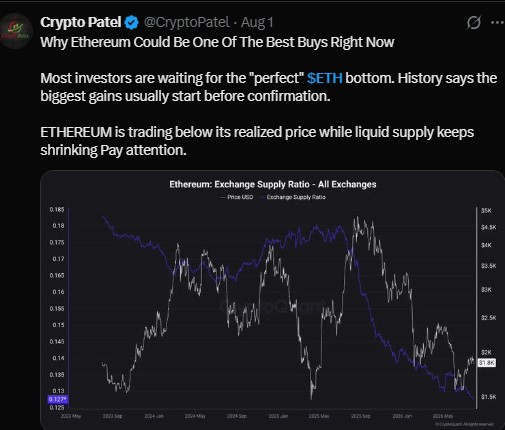
Are Ethereum ETFs still seeing inflows?
Spot Ethereum ETF data shows mixed flows this year. July 2026 brought in $365.17 million in net inflows, a turnaround from May and June, which both saw over $500 million in outflows.
Cumulative net inflow across all $ETH ETFs now stands at $11.21 billion, with total net assets around $10.23 billion.
Why isn't Coinbase holding more Ethereum?
Analyst Ted Pillows raised a question that's been floating around trading circles: why doesn't Coinbase add more ETH to its own balance sheet?
According to filings, Coinbase held 150,279 coins worth $448,484 in fair value as of June 30, 2026. That's down from 151,175 ETH at the end of 2025.
Meanwhile, Coinbase increased its Bitcoin holdings from 15,389 BTC to 17,311 BTC over the same period. This gap has led some in the community to ask why $ETH isn't getting the same treatment from exchanges that build directly on its network.
Ethereum price prediction: what could happen next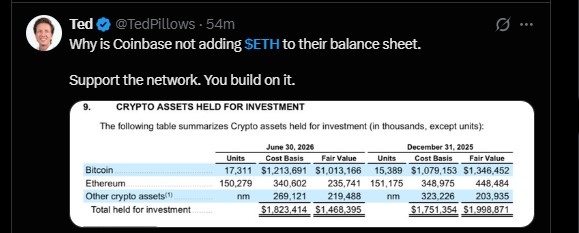
Short term, ETH looks stuck between $1,830 support and $1,896 resistance. A clean break in either direction will likely set the tone for the next few weeks.
Whale accumulation, like Hayes's recent buy, and shrinking exchange reserves offer some support for bulls. But heavy long liquidations and choppy ETF flows show the market is still undecided.
Traders watching Ethereum price prediction charts should keep an eye on the $1,800 zone. A drop below that could open the door to deeper losses, while reclaiming $1,900 might bring buyers back with more confidence.
Disclaimer
This article is for informational purposes only and does not constitute financial, investment, or trading advice. Cryptocurrency markets are highly volatile and carry significant risk. Prices mentioned are subject to change and should not be treated as guaranteed outcomes. Always do your own research and consult a licensed financial advisor before making investment decisions.