SpaceX Stock: Another 319 Million Shares Unlock, What's Next for SPCX?


SpaceX stock is heading into another test this week. About 319 million shares held by early employees and investors become free to trade on August 20. This is the second big unlock since the company's June IPO.
The stock closed at $143.34 on Tuesday, down 1.98%. That drop came right before the new batch of shares became eligible for sale.
Why Is SpaceX Stock Dropping Before the Unlock?
Traders often sell early when they expect more shares to hit the market. More shares can mean more supply, and more supply can push a price down.
But the last unlock tells a different story. On August 6, about 912 million shares became eligible to trade. Instead of a crash, the shares jumped 6% that day. They then rose almost 16% the next day.
So the fear around this new 319 million share release may not match what actually happens on August 20. This share lockup event is part of a staggered schedule that will keep unfolding through 2026 and 2027.
Who Owns the Most Shares in the Company?
New filings show which big investors are holding shares in the company. More than 1,500 investors reported positions, but just 23 of them hold over 80% of the total.
Investor | Shares Held |
Alphabet | 551.2 million |
Fidelity | 302.6 million |
Gigafund | 171.8 million |
Saudi Arabia's PIF | 154.1 million |
Nvidia | 122.8 million |
Together, these five holders control more than 1.3 billion shares. Baillie Gifford, an early backer, holds over 51 million shares. Harvard Management Co. reported nearly 13 million shares, making it Harvard's biggest single U.S. equity position.
Elon Musk's own stake, close to 6.4 billion shares, stays locked until June 2027.
SPCX Price Prediction: Key Levels to Watch
On the daily chart, the stock keeps getting turned away near $150. That price lines up with the 0.382 Fibonacci retracement of the move from the $225.59 high down to the $104.87 low.
Fibonacci Level | Price |
0.236 (support) | $133.36 |
0.382 (resistance) | $150.98 |
0.5 | $165.23 |
0.618 | $179.48 |
0.786 | $199.76 |
The 14-day RSI sits near 48.06. This is close to the neutral 50 mark, showing momentum is balanced, with the stock neither overbought nor oversold.
If the stock closes above $151, the path could open toward $165 and then $179. If it gets rejected near $150 again, it may slide back to test $133.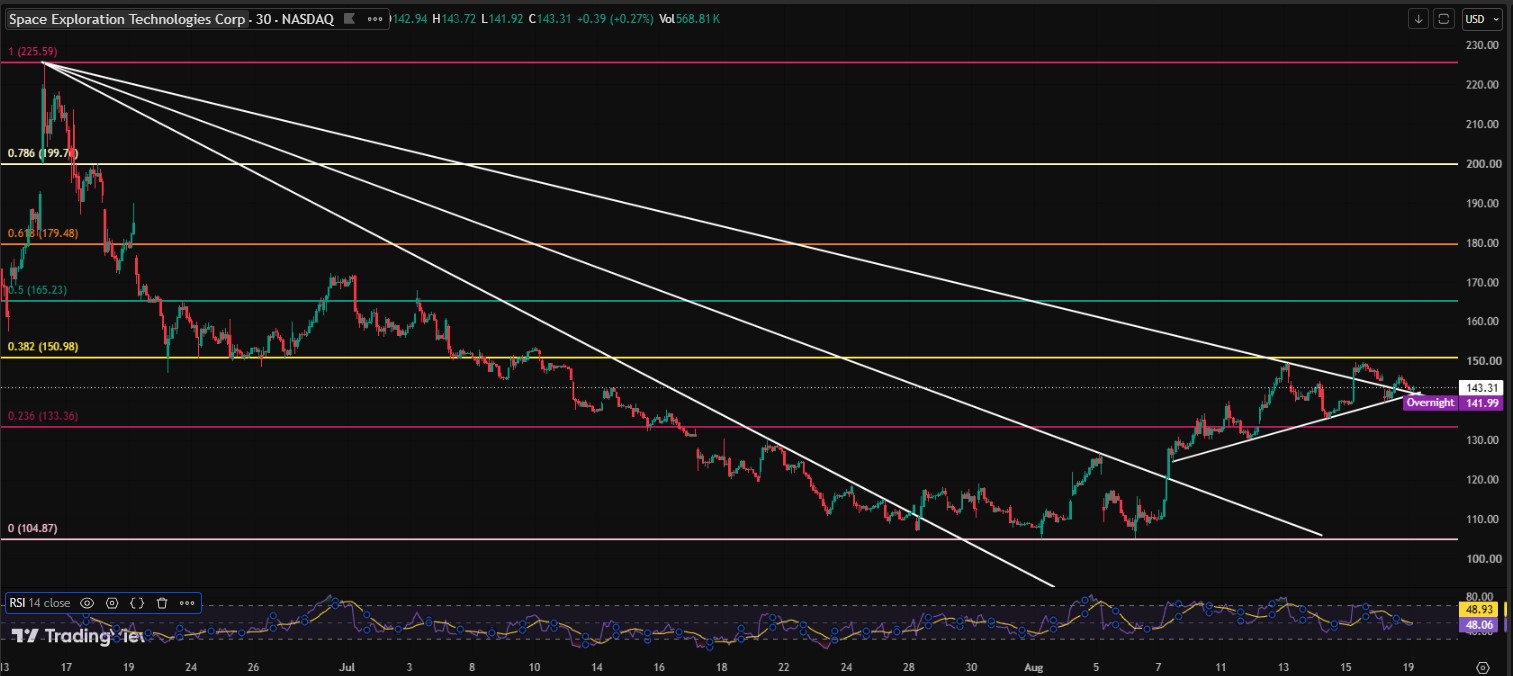
What Does the Bull Case Say?
Some analysts argue the sell-off fear is overdone. SpaceX's Starlink unit brought in $4.29 billion in the second quarter, up 66% from a year earlier. Subscribers doubled to 12 million.
The company's AI and data business also grew fast, with revenue up 247% and its first adjusted EBITDA profit of $1.1 billion. SpaceX put $15.83 billion into AI infrastructure last quarter alone.
Backers of this view point out that big holders like Nvidia and Harvard rarely dump large stakes once they're built, since these positions often support pensions and long-term funds.
What Do the Bears Say?
Not everyone agrees the shares are cheap. Some well-known market voices have called the company overvalued, with fair value estimates as low as $10 to $30 a share.
Their argument rests on comparing it to older-style valuation models that may not fit a company mixing rockets, satellites, and AI in one balance sheet.
Both sides agree on one thing, though. The August 20 unlock is a real event that could add short-term volatility, even if it does not decide the longer path on its own.
This is the question most traders are asking right now. Last time, on August 6, the market braced for a drop and got the opposite. The shares jumped 6% on unlock day and another 15.8% the day after.
That reaction came from a bigger unlock too, 912 million shares versus this week's 319 million. A smaller float release could mean an even smaller impact on price, at least in theory.
But there are differences worth noting. The stock is already sitting closer to resistance this time. Back on August 6, shares were coming off a low near $105, so there was more room to run.
Right now the price is parked just under $150, a level it has failed to clear more than once on the daily chart.
That makes this unlock a bit different. It is not just a supply test; it is a supply test happening right at a technical wall.
If buyers show up the way they did on August 6, a close above $151 is possible and could open the door toward $165.
If sellers use the unlock as an excuse to take profit near resistance, the stock could stall or drift back toward $133 instead.
History does not repeat exactly, and one calm unlock does not guarantee another. RSI near 48.06 sits close to neutral, so the chart is not sending a strong signal either way right now.
Still, this is an open question the market will answer on its own, not something a chart alone can promise.
SpaceX Stock Forecast: What Next For SPCX?
Price action into this week will likely hinge on the $150 to $151 zone. A clean break above could shift momentum toward the next resistance levels. A failure there keeps the shares inside their recent range.
With more staggered unlocks expected through 2026 and 2027, supply pressure is not going away soon. Traders will be watching closely to see if history repeats from the August 6 unlock or if this time plays out differently.
Anyone tracking these moves should keep an eye on SpaceX news in the days around August 20, since headlines about large holders or fresh contracts can shift sentiment fast.
For readers who trade internationally, some search using slightly different phrasing like SpaceX stock price or SPCX stock price, but the ticker and the underlying data stay the same.
Staying updated with SPCX news around each unlock date remains one of the simplest ways to stay ahead of sudden swings.
For SpaceX price prediction 2026-2030, click on the link
Disclaimer
This article is for informational purposes only and does not constitute financial, investment, or trading advice. Technical levels and analyst opinions discussed here are not guarantees of future performance. Always do your own research and consult a licensed financial advisor before making any investment decisions.







.webp)