SpaceX Stock Price Prediction: SPCX Forecast Ahead of 9 Sept Unlock


SpaceX stock is sitting at a crossroads this week. Shares of Space Exploration Technologies Corp. (SPCX) closed at $140.71, down 1.07% from the prior session, as traders brace for a major share unlock on September 9.
The stock has cooled off after a strong summer run. Now the question on every trader's mind is simple. Does the upcoming unlock trigger a sharp drop, or does it push toward the bullish targets some analysts are calling for?
Here is what the charts, the unlock schedule, and the latest analyst notes are saying right now.
What Is the SpaceX Share Unlock Date?
The next unlock lands on September 9, 2026, the 90th trading day since the IPO.
Unlike most companies, SpaceX did not use a single 180-day lockup. Its S-1 filing laid out a staggered release schedule instead.
Roughly 319 million shares become eligible for sale on September 9. A smaller 59 million share block tied to affiliates follows on September 10.
That two-day split explains why some sources argue the real date is the 9th, others say the 10th. Both are technically correct, but the 9th carries more than five times the supply.
SpaceX Share Unlock Schedule Explained
Here is the full early-release schedule from the company's S-1 filing, based on Bloomberg Intelligence data.
Trigger / Date | Portion Unlocked | Cumulative Unlock |
IPO pricing begins | 0% | 0% |
2nd trading day after Q1 earnings (Aug) | 20% | 20% |
Stock hurdle (~30% above IPO price) | 10% | 30% |
Day 70 after IPO | 7% | 37% |
Day 90 after IPO (Sept 9) | 7% | 44% |
Day 105 after IPO | 7% | 51% |
Day 120 after IPO | 7% | 58% |
Day 135 after IPO | 7% | 65% |
2nd day after Q2 earnings (Nov) | 28% | 93% |
Day 180 after IPO | 7% | 100% |
After the September 24 tranche, the total shares released in September alone add up to roughly 707 million. The cadence then continues with about 328 million shares each on October 9 and October 24, before the full 180-day lockup ends on December 8, 2026.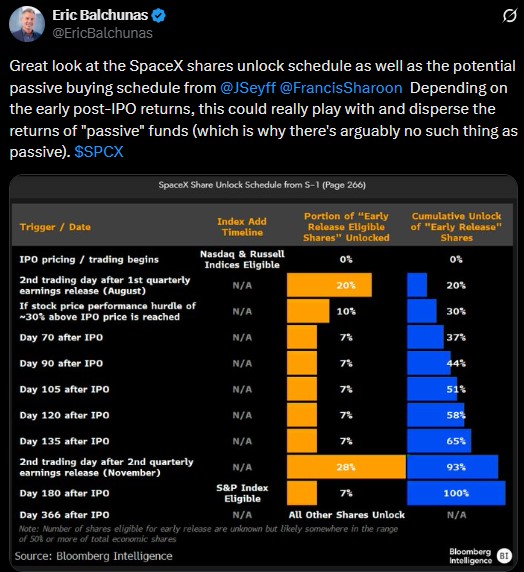
How Did SPCX React to Past Unlocks?
Traders watching the price action have two recent data points to lean on.
The first unlock hit on August 6, releasing about 911.5 million shares, the largest single tranche in the whole schedule. SPCX actually rose 6.1% that day after bottoming near $108 the session before.
The second tranche came August 20, with 319 million shares released. This time the stock slipped 4% to 5% heading into the date, then found buyers and stabilized.
So the pattern so far has been mixed. One unlock triggered a rally, the other a pullback followed by a bounce. That is worth keeping in mind before assuming September 9 automatically means a crash.
SPCX Technical Analysis: Key Support and Resistance
On the daily chart, SPCX has been trading inside a bullish flag while also respecting a wider descending channel.
Price recently broke below the ascending channel that formed off the August 20 low. That is a short-term bearish signal. At the same time, the stock tested the upper edge of the larger flag and got rejected there too.
Key levels to watch:
Resistance: $149 to $150
Support: $140, then $135
Major downside target: around $130
Catalyst: September 9 share unlock
If $140 fails to hold, the next stops on the way down are $135 and then the $130 zone. A close back above $149 to $150 would weaken the bearish case and could open the door toward the upper channel again.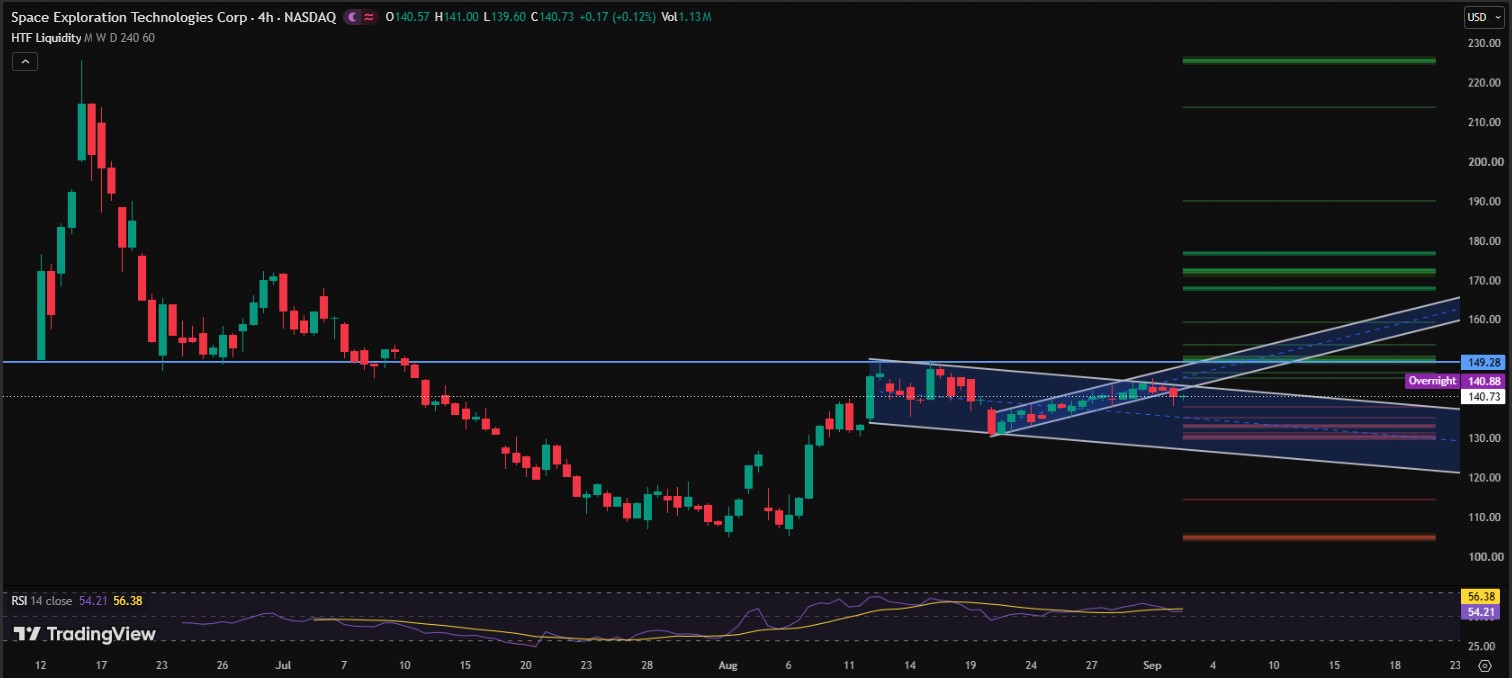
What Are Analysts Saying About SpaceX Stock?
Not everyone is bearish heading into the unlock.
Oppenheimer raised its SpaceX price target to $280 from $250, keeping an Outperform rating. Analyst Tim Horan pointed to the company's AI infrastructure, its access to Nvidia GPUs, and rapid data center expansion as reasons for the higher target.
He also flagged strong usage growth from Grok and Cursor, along with expectations for better AI compute pricing once Nvidia's next-generation Rubin chips roll out.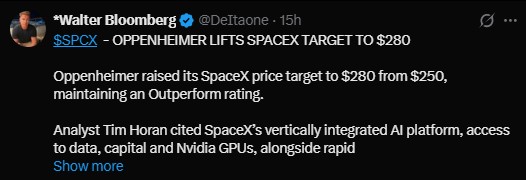
JPMorgan is more measured but still bullish. Analyst Doug Anmuth kept an Overweight rating with a $240 price target, reaffirming confidence in the AI side of the business, which now makes up most of SpaceX's overall valuation.
SPCX Price Prediction: What Comes Next
The setup into September 9 is genuinely two-sided.
On one hand, roughly 319 million newly unlocked shares hitting the market could add real selling pressure, especially if insiders rush to cash out early like they did in prior tranches.
On the other hand, analyst targets of $240 to $280 suggest institutions see a much higher ceiling once the unlock overhang clears, similar to how the stock recovered after the August tranches.
A break below $140 opens the path to $135 and then $130. A hold above $140, followed by a reclaim of $149 to $150, would support the case for a longer-term move toward the higher analyst targets.
Either way, expect volatility to pick up as the date approaches. This is not a moment to assume a guaranteed outcome in either direction.
Disclaimer
This article is for informational purposes only and does not constitute financial, investment, or trading advice. Past performance does not guarantee future results. Always do your own research and consult a licensed financial advisor before making investment decisions.
Also read: