TikCoin's 80% Mining Supply: Biggest Strength or Future Price Risk?


TikCoin Mining Supply sits at 80% of TIK's entire 3.33 billion token cap, by far the largest community allocation this analysis has covered for any recurring token.
That number cuts two ways at once: it's a genuinely rare, decentralization-forward structure, and it's also the single biggest variable determining what happens to TIK's price once more of that supply becomes tradable.
TikCoin's Token Economy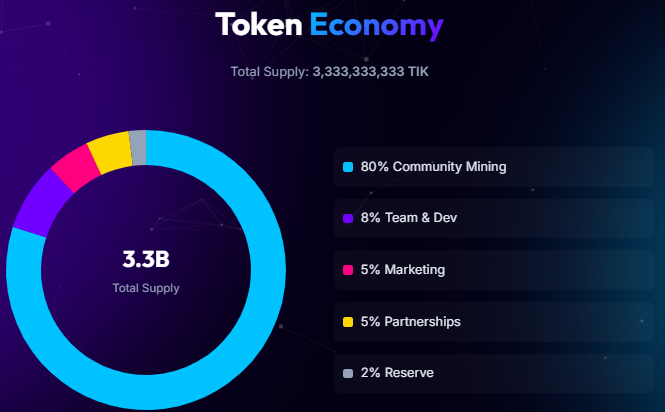
Source: TikCoin Network official tokenomics materials, captured September 1, 2026
Allocation | Share | Approximate TIK |
Community Mining | 80% | ~2.66 billion |
Team & Dev | 8% | ~266.7 million |
Marketing | 5% | ~166.7 million |
Partnerships | 5% | ~166.7 million |
Reserve | 2% | ~66.7 million |
Total-Supply | 100% | 3,333,333,333 TIK |
Why 80% Community Mining Is Unusually Large
Most crypto projects allocate somewhere between 40% and 60% of supply to community-facing rewards, reserving meaningfully larger shares for the team and early investors.
TikCoin's structure inverts that pattern almost entirely: TikCoin Tokenomics puts 80% directly in the hands of users who mined it through daily engagement, with the team holding just 8%, a genuinely small share by industry norms.
That's a real, verifiable signal against insider-heavy token design, not a marketing claim.
The 2.66 Billion TIK Question
Being generous to the community and being exposed to selling pressure from that same community aren't mutually exclusive.
TikCoin's 80% mining supply impact on price comes down to a simple mechanical fact: roughly 2.66 billion TIK, distributed gradually to miners over more than two years of app activity, represents the largest single pool of tokens that could eventually reach an open market.
Unlike a presale allocation with a single cost basis, this pool includes early miners who accumulated large balances at effectively zero direct cost, which changes the incentive calculus around holding versus selling once trading opens.
Can Gradual Unlocks Actually Reduce Selling Pressure?
Is TikCoin's community mining supply a price risk, or can gradual unlocks manage it? This is the central tension the project's own design tries to address.
TikCoin has described an anti-dump mechanism giving the community a vote on how many tokens stay temporarily locked at launch, specifically aimed at reducing day-one selling pressure from the 80% float.
This analysis has previously tracked a related, evolving detail: the project's stated transferable-limit ramp, which appeared to shift from an originally reported 30%-in-month-one-plus-10%-monthly plan toward a more conservative 5%-starting-point ramp toward the same 30% ceiling.
Whichever version proves accurate, the underlying logic is the same: release less of the float at once and give demand more time to catch up before the full pool is liquid.
Why the Halving Mechanism Matters for Future-Supply
TikCoin's mining rate steps down through a halving-style mechanism every time the platform's globally mined total crosses a 100 million TIK threshold, meaning early miners earned at meaningfully higher rates than those joining later.
TikCoin halving's impact on TIK supply works in TIK's favor over time in one specific way: as halvings continue, the pace at which new supply enters the 2.66 billion mining pool slows, which should, in theory, moderate how quickly additional selling-eligible-supply accumulates going forward, separate from the unlock-pacing question covering tokens already mined.
Decentralized Supply Structure vs. Actual Market Demand
This is the distinction worth holding onto above all the individual mechanics: a large, broadly distributed community float is a structural characteristic, evidence against concentrated insider control, not a guarantee of price stability.
The TIK community supply vs. market demand will ultimately be decided by whether buying interest from new users, from exchange access, and from broader market conditions grows fast enough to absorb whatever portion of that 2.66 billion pool becomes liquid at any given stage.
No tokenomics structure, however community-friendly, substitutes for that demand actually showing up.
TIK: If Anti-Dump Locking and Adoption Hold Up
No official TIK market price exists yet, so these TikCoin price predictions reflect third-party analyst scenario estimates based on tokenomics structure and comparable mobile-mining launches, not a project-stated target or confirmed trading data.
Scenario | Price Range | Key Driver | Invalidation |
Bear Case | $0.15–$0.35 | Heavy day-one selling from the unlocked portion of the 80% float outweighs demand even with anti-dump locking partially in place | A sustained recovery above $0.35 would challenge this |
Base Case | $0.35–$0.65 | The community-voted lock and at least one confirmed exchange absorb early selling, and the price settles near mid-range analyst estimates | Price holding in this range through the first weeks of trading |
Bull Case | $0.70–$1.00+ | A Tier-1 exchange confirms and strong post-listing engagement keeps demand ahead of newly unlocked mining-supply | Requires sustained volume and retention well beyond a single listing-day spike |
TikCoin Price Prediction: Mid-Term Outcomes as More Supply Unlocks
Outcome | Key Driver | Invalidation |
Manageable Drawdown (Up to ~30%) | Third-party analysts flag a possible mid-term pullback as more of the 80% float becomes tradable over the following months, absorbed by continued social-mining engagement | Engagement dropping sharply post-listing would deepen this beyond the typical range |
Halving-Assisted Stabilization | Slowing new-supply growth from the halving mechanism reduces additional selling-eligible-supply over time, helping price find a floor | A halving threshold not being reached on schedule would delay this effect |
Demand Fails to Scale With Float | New user growth and exchange liquidity don't keep pace with the mining pool's gradual release, sustaining downward pressure beyond the typical mid-term range | A confirmed Tier-1 exchange listing or major utility catalyst could reverse this |
Disclaimer
Informational purposes only, not financial advice. TikCoin's 80% community mining allocation and 3,333,333,333 total supply are drawn from the project's own tokenomics materials. Unlock pacing and anti-dump mechanism details referenced reflect the project's stated plans, which have shown some revision over time and are not independently confirmed beyond official updates. No official TIK market price exists; price figures above are third-party analyst estimates, not guaranteed outcomes. Cryptocurrency carries significant risk of loss.
Also read: