Reboot (REBOOT) Tokenomics: How to Verify Supply and Liquidity

Reboot (REBOOT) Tokenomics: How to Verify Supply and Liquidity
Reboot (REBOOT) Tokenomics research starts with a problem that comes before any supply figure: REBOOT is an ambiguous ticker. Market-data pages show more than one REBOOT listing, and on-chain trackers show REBOOT-labelled pools on both Base and Solana, each with its own contract and its own supply reporting.
A ticker match proves nothing, and a Solana token with a similar name, shown on a wallet price page, is a clear example of the confusion. These records cannot safely be merged into one tokenomics profile.
This guide therefore answers four practical questions. Which exact REBOOT token is being researched? What do official sources confirm about its supply and allocation? Can circulating and total supply be checked independently? And does reported volume reflect enough liquidity to trade without a large price impact?
A brief supplied for this article mentioned a sharp one-day gain and notable turnover for REBOOT in early November 2026.
Those figures are unverified until the exact market-data asset page and historical snapshot are matched, so they are not used here. A price-gainer ranking is a list of movers, not proof of which token is which.
The same caution applies to any price prediction, since a forecast for one token says nothing reliable about another that shares the ticker.
What the Official Sources Confirm
Only the project’s own materials can settle identity. The checklist of official sources is short:
-
The project website and documentation.
-
The contract address and blockchain network.
-
Total supply and maximum supply.
-
Circulating supply and unlocked supply.
-
Allocation and vesting, if officially published.
-
Token utility, if the primary documentation supports it.
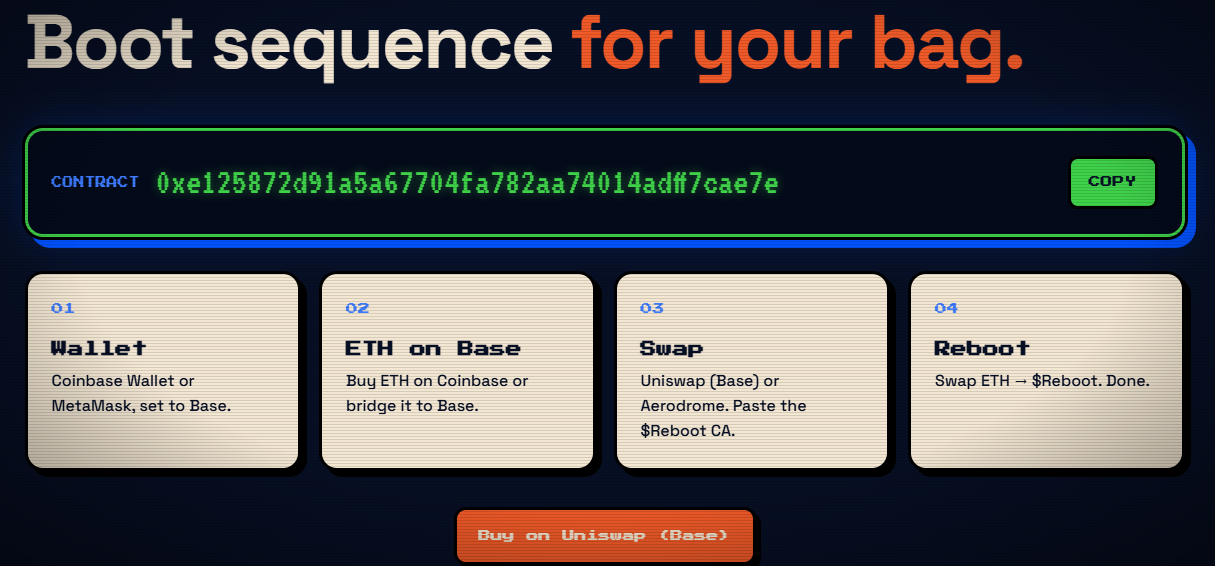
One market-data listing for a Base token called Reboot reports a fixed supply with the full amount circulating, while another REBOOT listing uses a different contract and reports no supply at all.
The first listing names a project website, but a website field on a listing is not confirmation of ownership, so it must be checked against the project’s own social profile and explorer links.
Who Is Affected and Why
-
Existing holders checking whether the supply they read about matches the token they own.
-
Traders judging liquidity and the price move that an order might cause.
-
New buyers who must confirm they are buying the correct token before sending funds.
-
Researchers comparing market-data providers that may be describing different assets.
Each group reads Reboot (REBOOT) Tokenomics differently, but all of them need the same starting point: a confirmed contract.
Buyers carry the most risk. A look-alike token with the same ticker can sit beside the real one in search results, and scam pages exploit that, as the guide on crypto phishing protection explains.
Step-by-Step Verification
A contract-first routine works in this order:
-
Open the project’s official website.
-
Follow its official explorer or contract link.
-
Match that contract with the relevant market-data listing, not the other way around.
-
Check the network and the token decimals.
-
Read the total supply from the block explorer.
-
Check circulating supply separately, using a transparent methodology.
-
Review holder distribution and large wallet balances.
-
Locate the main trading pools.
-
Compare pool liquidity with trading volume.
-
Look at recent buys and sells instead of relying on percentage gains alone.
Reading the contract itself is the most reliable step, and the entry on smart contracts explains what an explorer page shows.
For a deeper check of the code, the guide to verifying a smart contract audit covers what an audit claim does and does not prove.
Worked Verification Example
An illustrative checklist is safer than printing unverified REBOOT figures.
| Metric | What to verify | Why it matters |
| Contract address | The exact explorer address | Identifies the asset |
| Network | Base, Solana or another chain | Prevents network confusion |
| Total supply | Explorer or token contract | Shows issued supply |
| Circulating supply | Provider methodology | Estimates freely circulating tokens |
| Holder distribution | Top wallet balances | Shows concentration |
| Pool liquidity | Available liquidity on both sides | Helps assess trade execution |
| Trading volume | Actual buys and sells | Shows recent activity |
| Slippage | Price impact for different order sizes | Estimates execution cost |
A token can report high daily volume and still have a shallow pool. Volume measures activity over a period, while liquidity measures how much can be bought or sold without moving the price significantly.
Historical volume pages are useful for context, but they need to be matched to the exact asset first. For this reason, Reboot (REBOOT) tokenomics checks should always end with a look at pool depth.
Dates, Costs, Limits, or Token Mechanics
Only mechanisms that are documented or independently verified belong in a tokenomics profile. The usual items to check are:
-
Supply and allocation breakdowns.
-
Vesting and unlock dates, which the explainer on the token unlock schedule covers in depth.
-
Minting and burning permissions.
-
Transaction taxes or transfer restrictions.
-
Liquidity-pool depth and trading fees.
-
Slippage and price impact.
If the documentation is silent on any of these, the accurate statement is that it is unverified, not that it does not exist. A missing tax or restriction should never be assumed from silence, because some small tokens do carry hidden transfer rules.
Common Mistakes and Risks
Most errors in Reboot (REBOOT) tokenomics research come from skipping the identity step. Others follow from trusting one convenient number.
-
Confusing tokens that share the same ticker.
-
Treating total supply as circulating supply.
-
Assuming market volume equals liquidity.
-
Using a price-gainer ranking as proof of token identity.
-
Treating a project website’s claims as independently verified.
-
Ignoring concentrated holders or liquidity withdrawals.
-
Assuming a token is safe because a scanner shows no warnings.
Fast-moving small tokens are especially prone to sudden swings, a pattern described in the memecoin guide. A scanner result is a screening tool, not a safety certificate.
Practical Checklist
This short Reboot (REBOOT) Tokenomics checklist can be repeated before every trade.
-
Identify the exact REBOOT token and its official project.
-
Confirm the contract address and blockchain network from official pages.
-
Read total supply from the explorer.
-
Check circulating supply and note the provider and time.
-
Review holder distribution and large wallets.
-
Locate the main liquidity pools and compare depth with volume.
-
Check recent buys and sells, not only the percentage move.
-
Treat anything the project has not documented as unverified.
Final Thoughts
Reboot (REBOOT) Tokenomics is less about any single number than about the order of operations: identity first, contract second, supply third, and liquidity last.
If the official project and contract cannot be established, the honest conclusion is a ticker-confusion warning, not a tokenomics profile.
Verified supply and liquidity data come first, and only then do the latest news and any price prediction add useful context.
Disclaimer: This article is for educational purposes only and is not financial or investment advice. Token data differs between sources and changes quickly. Verify every detail with official project sources and the blockchain explorer before buying or trading any token.