Remittix Long-Term Vision: What Comes After RTX 2026 Launch?

Remittix Long-Term Vision: Roadmap, Utility, and Ecosystem Growth
Most presale roadmaps end at the launch. The harder question is what follows it. For Remittix crypto, the official documents already describe a path that runs well past the RTX coin debut.
Remittix is a PayFi project built to connect crypto holders with ordinary bank payments. Its whitepaper treats Level 7, the public launch stage, as a starting point instead of a finish line.
Level 7 covers the launch itself, the Beyond Level 7 section outlines expansion, and the long-term vision explains the bigger goal. The same documents also set out supply, vesting schedules, and the main risks that could slow progress.
What Is Remittix and How Does It Work?
The project runs on a model called PayFi. In simple terms, a sender pays with crypto while the recipient receives regular money in a bank account.
The whitepaper shows the flow simply: digital asset, PayFi, conversion and routing, fiat, then the recipient's bank account. The official Remittix website describes the same idea as paying fiat into any bank account by connecting a wallet.
The ecosystem has four products: $RTX PayFi for payments, Wallet for non-custodial access, Markets for perpetual futures, and Earn for yield. RTX is the native token, with a fixed maximum supply of 1.5 billion.
Remittix Roadmap: What Does Level 7 Actually Deliver at Launch?
The Remittix whitepaper outlines the planned steps for Level 7, titled Remittix and Public Ecosystem Launch, as shown in the table below.
| Level 7 item | Stated plan |
| Presale close | Ends at the hard cap or on a confirmed closing date |
| Decentralized exchange | RTX trading begins, and the initial liquidity pool is locked. |
| Centralized exchanges | RTX launches on confirmed centralized platforms. |
| Public platform | Full launch of the crypto-to-fiat service |
A locked liquidity pool limits how quickly early trading funds can be pulled out. It is a safeguard, not a guarantee of price stability. Earlier updates on the RTX launch timeline described the launch as milestone-based rather than date-based.
The whitepaper says Level 7 does not end Remittix development, and the presale roadmap level updates show how earlier stages unfolded.
Remettix Crypto: What Could Come After Level 7?
The Beyond Level 7 roadmap section is short and careful. Later work is expected to focus on scale, coverage, and features. New milestones appear only once confirmed.
Payment Corridors and Asset Support
More payment corridors and wider digital-asset support lead the list. A payment corridor is a route between two currencies, such as stablecoins in and a local bank transfer out.
Coverage can vary by market. The documents say availability depends on local rules and can change.
Deeper Product Links
The same list points to deeper links between the four products. Many platforms split trading, custody, payments, and yield across separate apps, while Remittix aims for fewer manual transfers.
Business Payments and APIs
Business payment tools and API access also appear. The whitepaper describes an embedded model where payment features could sit inside apps people already use.
If that works, Remittix could shift from a customer-facing app into a wider payment layer. The document ties that outcome to execution, infrastructure quality, regulatory access, and steady demand.
Wider RTX Utility
The full RTX utility framework has not been released yet. Staking is part of the current model and stays separate from Earn, while utility across PayFi, Markets, and Earn arrives in stages.
Remettix Ecosystem: How Does the Long-Term Vision Fit Together?
The long-term vision section makes one point clearly. The goal is not to replace banks or fiat money with crypto. Both systems already exist, and the link between them remains fragmented.
Its examples are simple: a sender holding BTC while the recipient needs euros, or a business holding stablecoins while suppliers want bank transfers. The stated role of Remittix is to manage that crossing, and the July ecosystem update lists products built toward it.
Analyst view: the framing is practical. Rather than promising to replace banks, the project positions itself as a connector, which lowers the bar for the idea but raises it for execution.
What Does the RTX Supply Structure Look Like?
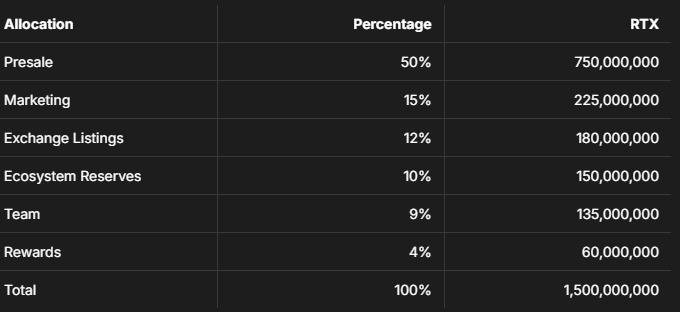
RTX has a fixed maximum supply of 1.5 billion tokens. The Remittix white paper splits it across six token allocations.
| Allocation | Share | RTX tokens |
| Presale | 50% | 750,000,000 |
| Marketing | 15% | 225,000,000 |
| Exchange listings | 12% | 180,000,000 |
| Ecosystem reserves | 10% | 150,000,000 |
| Team | 9% | 135,000,000 |
| Rewards | 4% | 60,000,000 |
| Total | 100% | 1,500,000,000 |
Half the supply sits in the presale allocation, the largest public-facing slice.
The team's 135 million tokens stay locked for two years. After that, 25% unlocks each year across years three to six, so the full amount arrives after six years. The vesting start date sits in the official token documentation.
Maximum supply and circulating supply are not the same. Vesting schedules decide how much of an allocation is available at a given time.
What Risks Could Slow the Remittix-Roadmap?
-
Roadmap changes: Features may be changed, delayed, or withdrawn because of technical, regulatory, or market conditions, so the roadmap shows a direction rather than a guarantee.
-
Regulatory access: Availability depends on local rules, and regulated activity relies on authorized third-party providers with their own compliance duties.
-
Unfinished utility: The full RTX utility model remains unreleased, so any demand tied to future features stays unconfirmed.
-
Audit limits: An independent review covers the RTX token contract, yet the whitepaper itself says audits reduce certain risks without removing every blockchain-related risk.
Conclusion: Launch Is the Start, Not the Finish
Remittix aims to link crypto holders with bank-based recipients through PayFi, supported by Wallet, Markets, Earn, and RTX. Level 7 brings the public launch, and Beyond Level 7 names corridors, asset support, integration, business tools, and wider RTX utility.
What stands out is the cautious wording: the documents avoid fixed post-launch dates and add plans only once confirmed. What remains uncertain is the full RTX utility model, corridor growth, and regulatory access.
Official roadmap updates and token documentation remain the main places to check any change, while crypto presale news tracks the project's launch progress.
Disclaimer:
This content is for general information only and is not financial or legal advice. Crypto assets carry a high risk of loss, and project plans can change. Independent research is essential before any decision.
















