Remittix Presale: Will RTX Hit $0.46 or Drop After Launch? What's Next

Remittix Presale has already pulled in around $33 million, and now 300 million RTX are set to be burned at launch, wiping 20% off the 1.5 billion supply. With November 24 close and a $0.28 reference price on the table, the big question is whether RTX can run toward $0.46 or early sellers will cool it down first.
Remittix Launch Countdown: Will RTX Face a Sell-Off?
Launch day is November 24, and early buyers will be watching the screen closely. Some of them may sell the moment tokens become tradable. If that happens, RTX could feel short-term pressure even with the planned 300 million token burn. So the first question is simple: is there enough demand on the other side to take that selling?
Remittix Presale Buyers: The First Price Test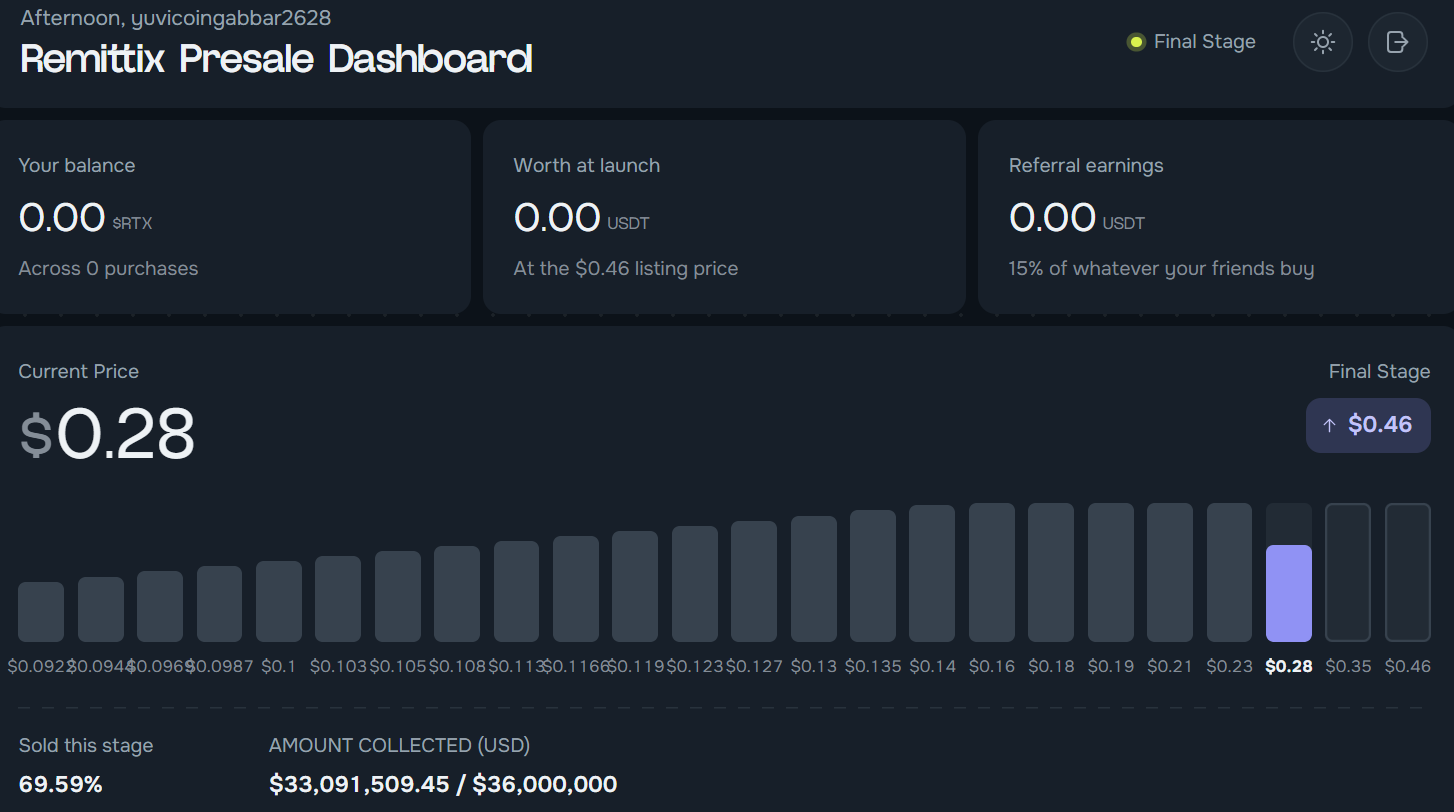
The reported presale price is $0.28. That's a handy number to compare against, but the market is under no obligation to open above it.
Check the opening price, the liquidity, and the token-claim details. If RTX can't hold its opening range, those early price targets deserve another look.
Remittix Presale: Why the 300M RTX Burn Matters
The project plans to go live on November 24, 2026, and it's bringing a big tokenomics announcement along. At launch, it says, 300 million RTX will be burned for good. Against the original supply of 1.5 billion, that's a 20% cut.
It gives the Remittix Presale a new talking point. Will a smaller supply help demand once public trading begins? Maybe.
Burning tokens shrinks the supply, yet the price won't rise just because of that. Demand, circulating supply and liquidity all play a part, and so does whether the payment product actually works as promised.
Remittix Presale Update: Key Figures to Know
Here are the figures from recent project-related reports:
Metric | Reported details |
Token | Remittix (RTX) |
Planned launch | November 24, 2026 |
Original maximum supply | 1.5 billion RTX |
Planned token burn | 300 million RTX |
Supply after planned burn | 1.2 billion RTX |
Reported fundraising | Around $33 million |
Fundraising target | $36 million |
Reported presale price | $0.28 in recent coverage |
Reported final presale tier | $0.46 |
Everything above comes from project announcements and recent coverage. None of it is independently verified exchange data. Pages have also shown different presale prices, so open the official dashboard and check the current one before you rely on any quote.
The burn needs the same treatment. Once it's done, there should be an official transaction or an on-chain record you can look up.
Can Remittix PayFi Utility Support RTX Demand?
Remittix wants to connect crypto with traditional banking through its PayFi platform. The idea is crypto-to-fiat payments and cross-border transfers, where the person on the receiving end gets ordinary currency without much fuss.
The team says it has tested payment routes with a few selected users. That's a start. It's a long way from broad adoption, and it says nothing yet about payment volume or revenue.
Scarcity can only do so much for RTX. For lasting demand, traders will want to see real platform usage, a list of supported payment routes, a transparent token distribution, and confirmed exchange liquidity.
Remittix Price Prediction: Key RTX Target Levels
$RTX has no public exchange history yet. That rules out the usual chart-based support and resistance analysis.
The levels below are illustrative scenarios built around reported presale figures. They're reference points, and nobody should read them as confirmed forecasts.
Scenario | RTX price | Interpretation |
Bearish scenario | $0.20 | Price falls below the $0.28 reference |
Presale reference | $0.28 | Reported presale price in recent coverage |
Moderate upside scenario | $0.35 | Separately reported launch-price reference |
Higher upside scenario | $0.46 | Reported final presale tier |
Extended upside scenario | $0.56 | Hypothetical level requiring stronger demand |
These aren't confirmed exchange targets and they aren't technical levels. Some coverage reported $0.35 as a launch-price reference, while $0.46 has been described as the final presale tier. Neither tells you where trading will actually open.
On paper, $0.28 to $0.35 is a 25% gain, and $0.46 sits about 64.3% above $0.28. Fees, liquidity, restrictions, and the chance that $RTX opens below either level aren't part of that math.
What matters most is whether enough buyers turn up to absorb the tokens available after launch. If selling is heavy or liquidity is thin, the price can slide even after the burn goes through.
What Should Presale Buyers Check Before Launch?
Three checks are worth doing before you make a call:
Burn confirmation: Find an official announcement and a verifiable transaction that shows whether the 300 million $RTX burn really happened.
Launch and exchange details: Check the token contract, trading pairs, exchange announcements and launch timing on official sources.
Token claims and distribution: Read the official claim schedule and work out when presale tokens can be moved.
Final Outlook: Can $RTX Deliver After the Presale?
The planned 300 million $RTX burn gives the Remittix Presale a clear milestone before the November 24 launch. Still, supply is just one side of the price story.
The bigger signals are confirmed launch arrangements, a transparent token distribution, real PayFi adoption and enough market liquidity. Until public trading sets a price, read the targets above as hypothetical scenarios and nothing more. They aren't promises of returns.
Disclaimer: This article is for informational purposes only and is not financial advice. Presale figures and launch plans should be verified through official sources. Cryptocurrency investments are highly volatile, and investors can lose their entire investment.