Shiba Inu Staking Guide: SHIB Rewards, BONE and Ecosystem Impact

What Are the Rewards and Risks of Shiba Inu Staking in 2026?
Staking sounds simple: lock a token, earn a reward. For Shiba Inu holders, the real picture has a few more layers.
There is more than one staking route, more than one token, and a few recent changes that matter. This Shiba Inu staking guide uses official Shib.io pages, the project's documentation and its public status page to sort it all out.
Key Takeaways
SHIB can be staked on ShibaSwap through a feature called Bury. BONE can also be staked with validators on Shibarium.
As of early October 2026, the official status page lists validator staking as under maintenance since April 17, 2026, with no end date.
Rewards depend on the route, the amount staked and the platform's own rules. No single fixed rate applies.
What Is Shiba Inu?
Shiba Inu is a crypto project built around the SHIB token. SHIB was created in August 2020 by a person using the name Ryoshi, and it began as a Dogecoin-inspired meme coin. Its supply is huge, roughly 589.5 trillion tokens according to an August 2026 analysis, which is why one SHIB has a very small price.
What set it apart was the community. Its supporters call themselves the SHIB Army, and they pushed the project well beyond a joke.
Over time, the team built real tools on top of the token. ShibaSwap, a decentralized exchange, launched in 2021 on Ethereum. Shibarium, a layer-2 network, followed to offer faster and cheaper transactions.
Today the project runs under the Shib Doggy DAO Foundation. Its official site describes the shift from a meme coin to a wider utility ecosystem. Staking is one of the ways holders take part in that ecosystem.
Source: official website
The Shiba Inu Ecosystem
The official ecosystem page groups the project into several parts.
Part | What it does |
SHIB | Primary ecosystem token and community asset |
BONE | Shibarium gas token, governance and staking rewards |
LEASH | Scarce ecosystem token with staking and access uses |
TREAT | Governance, rewards and ecosystem services |
ShibaSwap | The ecosystem's decentralized exchange |
Shibarium | The layer-2 network, secured by validators |
Other areas | Shib DAO, ShibIdentity, NFTs, ShibTheMetaverse, DappStore |
BONE matters most for staking. The docs name it the native staking token of Shibarium.
What Is Shiba Inu Staking?
Staking means locking tokens for a set purpose and earning rewards in return. The lock can support a network, or it can simply reward long-term holders.
In this ecosystem, staking comes in two forms:
Platform staking: On ShibaSwap, holders "bury" their tokens in a pool and earn rewards.
Network staking: On Shibarium, BONE holders back validators that secure the chain.
So, does Shiba Inu have staking rewards? Yes. Rewards are paid mostly in BONE, whichever route is used.
Can users stake SHIB? Yes, through ShibaSwap's Bury. Validator staking is different, because it accepts only BONE.
Both routes have run into delays this year, which the status section below covers.
How Does Shiba Inu Staking Work?
How does Shiba Inu staking work in practice? There are two routes, and they work differently.
ShibaSwap Bury | Shibarium validator staking | |
Token staked | SHIB, LEASH or BONE | BONE only |
What the holder gets | An x-token as proof, such as xSHIB | A share of validator rewards |
Rewards paid in | BONE | BONE |
Where | ShibaSwap | shibarium.shib.io |
In Bury, a holder stakes tokens and receives a token that represents the stake. Older guides say rewards are paid weekly in BONE, with one-third claimable at once and the rest locked for six months. These rules may have changed, so ShibaSwap should be checked directly.
In validator staking, BONE holders delegate to a validator instead of running a node. Per the docs, rewards come at each checkpoint, and validators set their own commission. A validator must stake at least 10,000 BONE.
Shiba Inu Staking Rewards
Shiba Inu staking rewards come mostly in BONE. The Shibarium FAQ says rewards vary with the network's reward rate, the amount staked and the validator's performance.
That is the honest answer on the SHIB staking rewards rate: no fixed number applies. Any percentage seen elsewhere should be treated as a snapshot, not a promise.
SHIB Staking Rewards 2026: Current Status
Both routes have had problems this year, shown below.
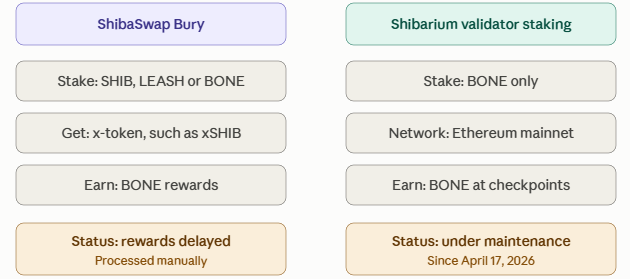
According to the official SHIB ecosystem status page, Shibarium validator staking is unavailable because of an infrastructure migration that began on April 17, 2026. Users are told not to attempt staking transactions until service returns.
The same page notes a delay in staking reward distribution that needs manual processing. The team says it is working on a new tokenomics model for automated payouts. It adds that past stakers stay eligible for rewards under the initial tokenomics.
For SHIB staking rewards 2026, that means expectations should stay low until the status page shows a fix.
Where to Stake Shiba Inu
Where to stake Shiba Inu depends on the token:
SHIB, LEASH or BONE: ShibaSwap, through Bury.
BONE: The Shibarium staking dashboard at shibarium.shib.io, once service is restored.
Both should be reached only through links from Shib.io and its validator page.
How to Stake Shiba Inu
This SHIB staking guide 2026 follows the steps in the official docs for validator staking. Because the service is paused, the steps are for reference until it reopens.
Connect a wallet and select the Ethereum network.
Open shibarium.shib.io and click Stake BONE.
Pick a validator and check its uptime and commission.
Enter the BONE amount, approve in the wallet and confirm.
Use Withdraw Rewards or Restake Rewards under the staked validator.
Unstaking is called unbonding. The docs say it takes one checkpoint, about 45 minutes, before tokens can be claimed.
What Staking Means for the Ecosystem
Staking does more than pay holders. Validator staking helps secure Shibarium, since validators lock BONE to take part in consensus. BONE also pays gas on the network, so it ties staking to everyday use.
The flip side shows now. When staking stops, a core part of the BONE reward loop pauses too. An earlier bridge exploit, which involved validator keys, also led developers to pause staking functions and move funds to a 6-of-9 multisignature wallet. Security of the wider setup matters as much as the staking design.
Key Risks to Keep in Mind
Service downtime: Validator staking has been paused for months, with no end date.
Delayed rewards: Bury payouts need manual processing right now.
Rule changes: A new tokenomics model is planned, so reward terms may change.
Technical risk: Bridges, validators and smart contracts can fail.
Market risk: SHIB and BONE prices can drop, and rewards do not cover losses.
Final Verdict
Shiba Inu Staking is real, but it is not working at full strength. SHIB holders can use Bury, BONE holders have the validator route, and the docs explain both clearly.
Right now the sensible step is to follow the status page, move slowly, and rely on official links only. The Shiba Inu ecosystem has a lot to offer, but readers should treat staking income as uncertain until service is fully back.
Disclaimer: This article is for information only and is not financial, tax or legal advice. Crypto carries high risk, including total loss. Details change often, so readers should check Shib.io and the status page before acting.









.webp)




