Sirius Network Listing: Will KYC and CEX Plans Shape SRT's Value?

Sirius Network KYC Step Moves SST Holders Closer to SRT
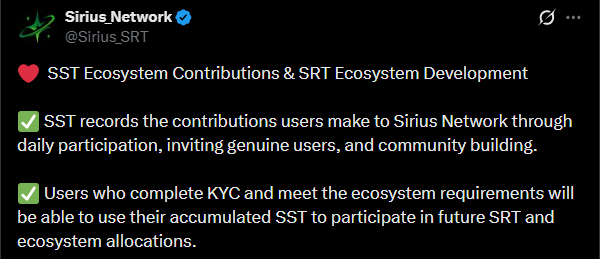
The official X account for the project said on 23 November that users who complete KYC and meet ecosystem requirements can use accumulated SST to join future SRT and ecosystem allocations.
It added that the platform will refine how SST and SRT connect, widen SRT's use cases and keep developing CEX and DEX trading ecosystems. No date, exchange or trading pair was named.
This Sirius Network listing outlook treats that gap as the main variable behind any value forecast.
Source: Official X Post
Sirius Network Listing Scenarios Start With the Venue
A DEX route would sit on BNB Smart Chain, where SRT is planned as a BEP-20 token. A CEX route would need an exchange to accept the token and set its own terms.
The post names neither path. The whitepaper also states that no listing, liquidity or specific level is guaranteed. Any Sirius Network listing forecast therefore stays conditional until a venue publishes a pair.
Combined KYC and Venue Scenarios for SRT Value
The matrix pairs the likely venue with how many holders clear verification. A Sirius Network listing forecast needs both inputs. Directions are reasoned bias, not targets, and no figure here is a confirmed value.
Scenario | Venue | KYC clearance | Value bias |
1 | DEX first | Broad | Fast swings, thin depth |
2 | DEX first | Narrow | Sharp drops if few holders sell together |
3 | CEX first | Broad | Deeper order books, steadier open |
4 | CEX first | Narrow | Tight float, supportive early, fragile later |
5 | Both together | Broad | Gaps between venues close through arbitrage |
Demand matters too. The post ties SST to daily participation, inviting genuine users and community building. Verified holders may lift sentiment, yet value still needs buyers once trading opens.
KYC Clearance Rate and Allocation Size per Holder
Assume a fixed seasonal pool, equal weights, and that SST from uncleared users drops out of the calculation. The table shows allocation per cleared holder, with full clearance as the 1.0x baseline.
Holders clearing KYC | Allocation per cleared holder | Reading |
100% | 1.0x | Widest distribution |
50% | 2.0x | Larger average positions |
25% | 4.0x | Concentrated, higher selling risk |
10% | 10.0x | Few large holders, volatile moves |
Lower clearance does not shrink the pool. It concentrates the pool in fewer wallets, so the verification step shapes early selling pressure as much as eligibility, which matters for any Sirius Network listing.
The effect is arithmetic only. Real weights differ by identity, reputation and quality, so actual shares will vary.
Roadmap Timing Sets the Earliest Realistic Windows
The roadmap lists contract development and audits for 2027 and the on-chain ecosystem for 2028, all as planning targets. The table maps those dates to trading windows.
Window | Condition | Value outlook |
Before 2027 | Venue named early, contract deployed | Unlikely on the stated plan |
During 2027 | Audits done, eligibility rules published | Possible DEX debut, volatile |
2028 | On-chain ecosystem opens | Deeper liquidity, steadier outlook |
Signals That Could Move SRT Before Trading Opens
Several markers would sharpen a Sirius Network listing forecast.
Supportive:
A named venue, trading pair and start date
Published KYC deadlines and eligibility rules
Detail on how SST maps to SRT, which the post promises to refine
Pressure:
Silence on dates after the 23 November post
Narrow clearance that leaves tokens in few wallets
A contract address still unpublished, since the whitepaper ties it to mainnet deployment and audit
Where the SRT Outlook Stands After the Post
The post confirms direction, not delivery. On the sources available, a tradable value cannot be set yet, so the forecast splits into three cases:
Base case: no live trading and no measurable value, with the next official update setting the pace.
Upside case: a CEX or dual route with broad clearance supports deeper books and calmer early moves.
Downside case: a DEX-first debut with narrow clearance risks thin depth and sharp sell-offs.
Regional rules may also limit access, since the whitepaper says feature availability depends on legal requirements.
For any price prediction, the rule is simple: without a named pair there is no tradable price to measure, only scenario ranges.
A Sirius Network listing would turn these scenarios into data. Until then, readers should treat each case as a conditional range.
Disclaimer: This article is for informational purposes only and is not financial or investment advice. Crypto assets are volatile and carry risk, so readers should do their own research before making any decision.