Sirius Network Passport P0 to P5: Identity Levels and Key Benefits

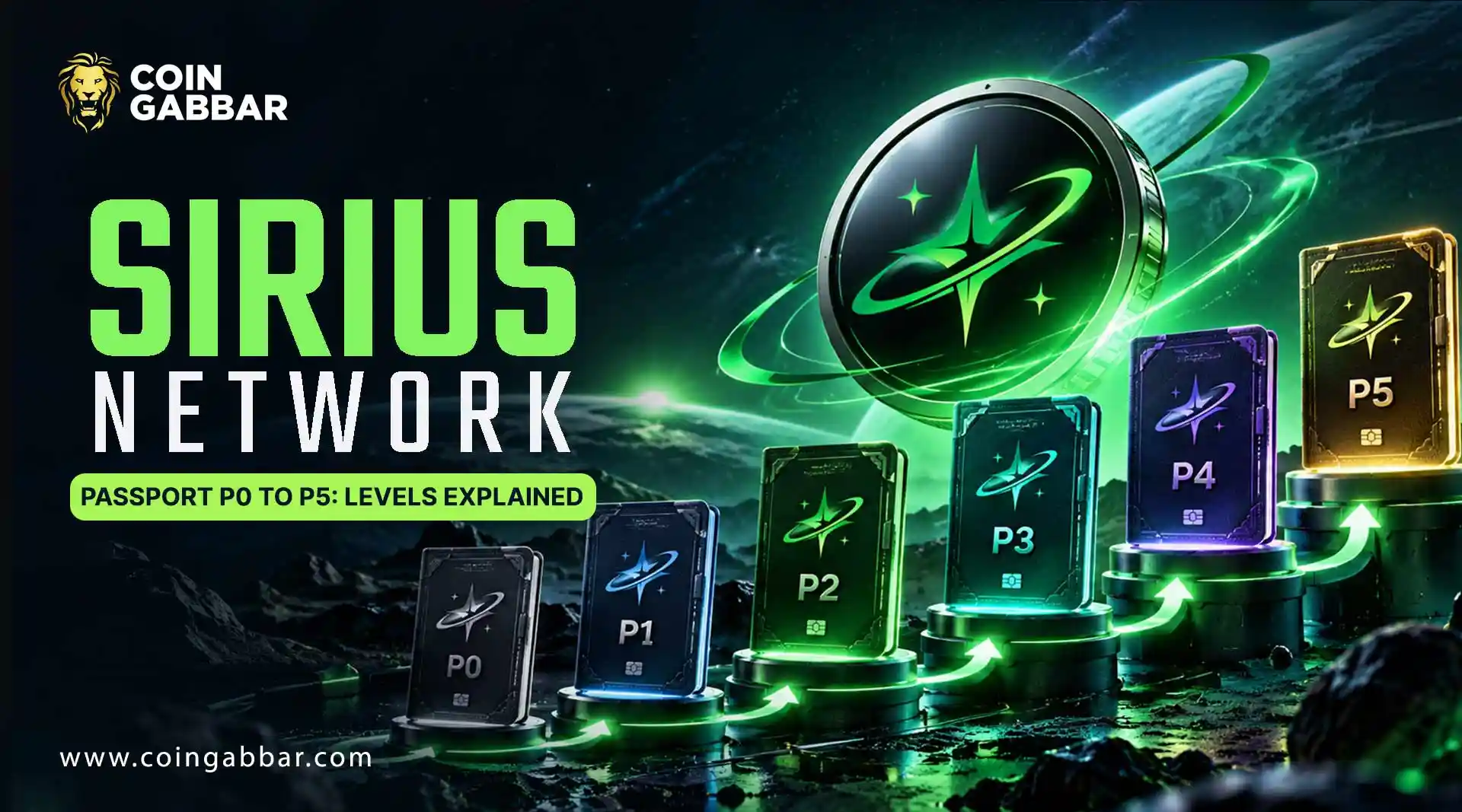
Sirius Network Passport P0 to P5: What Does Each Identity Level Mean?
Most crypto apps ask for an email or a phone number. Sirius Network does not. Every account starts with a Sirius ID, and a Sirius Passport shows how far that account has been verified. This guide explains the Sirius Network Passport P0 to P5 ladder, what each level involves and how it connects to points and tokens, using the whitepaper and the official website.
Key Takeaways
The Passport has six levels, from P0 (account created) to P5 (developer, merchant, node or institutional certification).
Accounts start with a 64-character Sirius ID made on the user’s own device, with no email or phone number.
The Sirius ID is not a wallet private key, and nobody official should ever ask for it.
A Quick Look at Sirius Network
Sirius Network is a mobile-first contribution mining project. Instead of hardware-based crypto mining, users take part through an app in 24-hour cycles and collect points. Its tagline reads “Mobile Mining. Powered by Participation.”
Because rewards depend on real participation, the project needs a way to tell real users from fake ones. That is the job of the Passport.
Source: official website.
What Is Sirius Passport?
Sirius Passport is the identity record attached to each account. It works as a ladder of six levels, and each level shows a stronger form of verification.
The whitepaper also lists a planned Sirius Identity module for the wider ecosystem. It covers digital identity, contribution history, reputation, badges and verifiable credentials. The Passport is the part of that idea that users meet first.
It Starts With the Sirius ID
Registration does not use an email address, mobile number or ordinary username. The Sirius ID is a string of letters and numbers, 64 characters long, generated independently and locally on the user’s device.
It is used to import, log in and identify an account. The same ID is tied to the account’s SST points, contribution history, referral relationships and Passport.
Sirius Network servers do not store the complete ID. That means a lost or exposed ID cannot be retrieved, reset or restored by the project.
The Four Identifiers
An account carries more than one identifier, and each has a different privacy rule.
Identifier | Function | Visibility |
Sirius Access ID | Account import and access | Must stay confidential |
Sirius Public UID | Public identity and ecosystem display | May be public |
Referral Code | Binds referral relationships | May be public |
Wallet Address | Receives and manages on-chain SRT | Address may be public, private key must stay confidential |
The Sirius Network Passport P0 to P5 Ladder
Here is the full Sirius Network Passport stages explained in one table.
Level | Identity status |
P0 | Sirius ID created |
P1 | Basic activity and device verification completed |
P2 | Trusted relationships established and behavioral verification passed |
P3 | On-chain wallet connected |
P4 | Proof of unique personhood or applicable KYC completed |
P5 | Developer, merchant, node or institutional certification |
The climb in one line: Account → Activity and device → Trusted relationships → Wallet → Unique person → Certified role
Each step asks for more proof than the one before it.
Sirius Passport P0 to P5, Level by Level
The grouping below is an editorial reading, not the whitepaper’s own wording.
P0 to P2 happen inside the app. The account is created, activity and the device are checked, and behavior and relationships are reviewed. These levels are about showing that an account acts like a real person.
P3 links the account to a blockchain. Connecting an on-chain wallet is what lets SRT be received later. The wallet address can be public, but its private key must not be shared.
P4 checks that one person owns one account. It requires proof of unique personhood, or KYC where that applies. The word “applicable” suggests KYC is not needed in every case.
P5 is about roles, not people. It certifies developers, merchants, nodes or institutions, which matches modules like Developer and Merchant in the planned Sirius Network ecosystem.
How Sirius Passport Works
The Passport does not stand alone. It sits beside the other records tied to a Sirius ID: points, contribution history and referrals.
As an account completes each verification, its status moves up. That status then matters when rewards are shared out. The project’s token plan weights identity, reputation, quality and risk when splitting each Ecosystem Season’s allocation pool.
In short, points record effort, and the Passport records trust.
How to Upgrade Sirius Passport
The official whitepaper lists what each level means, not a click-by-click procedure. The path is still clear from the table.
Generate a Sirius ID in the official app to reach P0.
Complete basic activity and device verification for P1.
Build trusted relationships and pass behavioral checks for P2.
Connect an on-chain wallet for P3.
Complete proof of unique personhood, or KYC if it applies, for P4.
Apply for developer, merchant, node or institutional certification for P5.
Current requirements should always be read in the official app, since the exact checks may change.
Sirius Passport Levels and Requirements at a Glance
Group | Levels | What gets verified |
In-app checks | P0 to P2 | Account, activity, device, behavior, relationships |
Chain link | P3 | Wallet connection |
Real-person proof | P4 | Unique personhood or KYC |
Role certification | P5 | Developer, merchant, node, institution |
Sirius Passport Benefits
The whitepaper does not list a separate reward for each level. What it does show is where identity counts.
Fairer reward sharing: identity is one of the weights used when seasonal allocations are calculated.
Better user quality: the Passport feeds the Trust Circle, described below.
Access to roles: P5 certification is tied to developer, merchant, node and institutional roles.
Ownership of a digital identity: the account’s history stays tied to one Sirius ID.
The Trust Circle
Trust Circle is designed to raise the share of authentic users, generate Trust Power and support mission quality. It also aims to resist Sybil attacks. A Sybil attack is when one person creates many fake accounts to collect extra rewards (general knowledge).
Trust Circle does not take part in BNB Chain consensus. It is an identity layer, not a blockchain security feature.
Security Rules Worth Knowing
The whitepaper draws a hard line around the Sirius ID. It is not a wallet private key, and the two must never be mixed up.
The Foundation, project team, ambassadors and customer support must never ask for a complete Sirius ID, wallet private key, seed phrase, wallet password or verification code.
Anyone who asks for those is not acting for the project.
The ID should be backed up safely, since the project cannot restore it.
The Sirius Access ID and the wallet private key should stay confidential.
Final Thoughts
The Sirius Network Passport P0 to P5 system is a simple ladder with a clear purpose: separate real participants from fake ones, without asking for an email or phone number. Each level adds proof, from an account on a device to a certified role.
What is still unlisted is a reward per level. Updates are best checked on the official website and whitepaper.
Disclaimer: This article is for information only and is not financial advice. Crypto is volatile, and project plans can change. Please do your own research.