

The project's official X account said on 26 November that users who finish KYC will be added automatically to an initial whitelist, with priority access to the SST Ecosystem Contribution Program and eligibility to earn SRT.
Each direct invitee who also clears KYC gives the inviter 5 SST points and a permanent 5% lift to SST mining power, the post said.
This Sirius Network referral rule changes how weight could be shared among holders, so the outlook below models the lift, not the story around it.
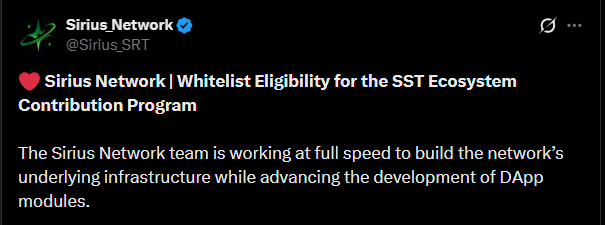
Source: Official X Post, as of 12:35 PM IST, 26 November 2026
The post does not say whether the 5% lifts stack by addition or by compounding. The gap widens with every verified invitee, so both readings are shown.
Any Sirius Network referral forecast has to carry both. The incentive is treated here as a model input, not as a recommendation.
Verified invitees | One-time SST | Additive lift | Compounding lift |
1 | 5 | 1.05x | 1.05x |
3 | 15 | 1.15x | 1.16x |
5 | 25 | 1.25x | 1.28x |
10 | 50 | 1.50x | 1.63x |
20 | 100 | 2.00x | 2.65x |
At 20 verified invitees the two readings differ by about 0.65x. Neither changes total supply. The whitepaper says each season draws on a fixed pool, so a higher multiplier moves weight between holders instead of creating tokens.
Time adds to the lift. Mining runs in 24-hour cycles and the whitepaper's SST formula multiplies power by valid time. If mining power maps to Contribution Power, a 1.5x holder would record 150 SST for every 100 at baseline over the same cycles.
The flat 5 SST points are small beside that, so the permanent lift carries more weight than the one-time points.
Assume a fixed season pool and allocation that follows SST weight, with quality factors held equal. The table compares one holder's portion with the average holder's, at three average multipliers across the whole base.
Holder multiplier | Average 1.00x | Average 1.25x | Average 1.50x |
1.25x | 1.25 | 1.00 | 0.83 |
1.50x | 1.50 | 1.20 | 1.00 |
2.00x | 2.00 | 1.60 | 1.33 |
2.65x | 2.65 | 2.12 | 1.77 |
As more holders collect lifts, the edge fades, which is why a Sirius Network referral advantage is not fixed. A 2.0x holder keeps twice the average only if almost nobody else has a lift.
The whitepaper also weights allocations by identity, reputation, quality and risk, so real outcomes would differ from this simplified view.
Concentration matters more for price than the multiplier itself. The next table assumes a boosted group holds the higher multiplier while everyone else stays at 1.0x.
A Sirius Network referral edge turns into a selling risk only if that group becomes large.
Boosted holders | Pool held at 2.0x | Pool held at 2.65x |
1% | 2.0% | 2.6% |
5% | 9.5% | 12.2% |
10% | 18.2% | 22.7% |
20% | 33.3% | 39.8% |
At 10% of holders, the boosted group would hold close to a fifth of the pool. At 20%, it would hold over a third. A concentrated group can move thin early order books if it sells together.
The post says stringent KYC aims to intercept Sybil attacks and multi-account cheating, which is the main brake on that outcome.
Three directional cases follow from the tables for the Sirius Network referral rule. The base case carries the most weight because the post states direction, not dates or pool sizes. None is a target, because no trading price exists.
Case | Conditions | Directional bias |
Base | KYC filters most abuse; boosted holders stay under 10% | Value follows demand and listing news; referral effect minor |
Upside | Verified growth is broad, so lifts are widespread and edges fade | Even distribution, steadier early trading |
Downside | Farming survives checks; boosted group passes 20% | Concentrated selling, fragile open, sharp drops |
Whether lifts stack by addition or compounding
The share of holders clearing KYC and their invitee counts
Season pool size and vesting terms
How identity checks feed the quality weights
The rule moves weight between holders, not supply, which keeps any price prediction tied to demand and distribution. Until those terms arrive, the Sirius Network referral effect stays a modelling assumption.
Disclaimer: This article is for informational purposes only and is not financial, investment or legal advice, or a recommendation to buy, sell, invite others or join any program. SRT has no confirmed trading price, and every figure here is an illustrative assumption, not a forecast or guarantee. Crypto assets are highly volatile and capital can be lost, so verify details through official channels and do your own research before any decision.
Frequently Asked Questions (FAQ)




Owned by:-
DCG Tech FZCO, UAE
Delivery Partner:-
Gabbar MediaTech Pvt Ltd.
Copyright © 2026 Coin Gabbar. All Rights Reserved












