

SBI Solana in Institutional Finance Global began full-scale operations on November 25, 2026. It Holdings, Sumitomo Mitsui Financial Group (SMFG), and the Solana Foundation said they completed the agreements for a three-party joint venture.
The company will work on stablecoin payments, tokenization of financial and real-world assets, and onchain asset management, starting in Japan. This article explains what changed, what the venture plans to build, and which details are still unknown. Figures are dated and sourced. Last updated: November 26, 2026.
The former SBI R3 Japan now operates as SBI Solana Global Co., Ltd. The three partners did not disclose ownership shares, capital, management, or launch dates for any product, according to Solana Compass and Financial Markets.
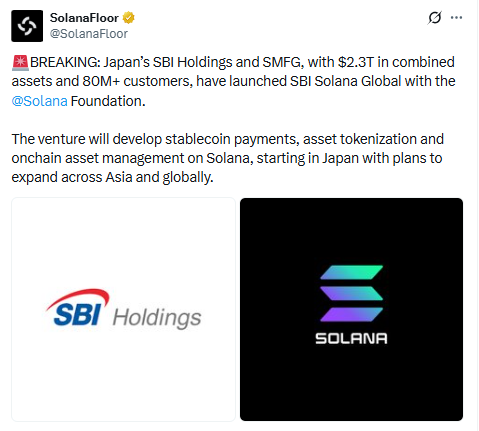
Source: Solana Floor, November 25, 2026 @ 2:41 PM IST.
SBI Solana Global is a Japanese on-chain finance company built around the Solana blockchain. It was previously SBI R3 Japan, a venture of Holdings and SMFG that was built around R3's permissioned Corda ledger.
Coinpaper notes that the unit has built financial technology experience since 2019. A stablecoin is a token pegged to a currency, such as the yen or the US dollar.
Tokenization means turning an asset, such as a bond or fund share, into a Solana in Institutional Finance blockchain token. Both are central to the new company's plan.
The venture was first announced on July 13, 2026. Back then, the Solana Foundation planned to take a stake in SBI R3 Japan, and the new name was only tentative, as reported by The Block. The November step makes the plan official.
| Item | July 13, 2026 | November 25, 2026 |
| Status | Strategic collaboration announced | Agreements completed, operations started. |
| Company name | SBI Solana Global (tentative) | SBI Solana Global Co., Ltd. |
| Ownership split | Not disclosed | Not disclosed |
| Product launch dates | Not disclosed | Not disclosed |
What Will the Venture Build?
According to Solana in Institutional Finance, the company will focus on four areas:
Tokenization of financial assets.
Tokenization of real-world assets (RWAs).
Stablecoin payments.
Onchain asset management.
The same report says the company will also explore micropayments for AI agents. Earlier coverage of the July plan listed corporate bonds, commercial paper, investment funds, and real estate as tokenization candidates, according to Solana Compass. The stated plan is to start in Japan and expand across Asia and globally.
SBI Holdings is a Japanese financial group with a growing digital asset business. SMFG is one of Japan's three megabanks and is described by Finance Magnates as a global systemically important bank (G-SIB). The Solana Foundation is the nonprofit that supports the Solana network.
The widely quoted figure of $2.3 trillion in combined assets and more than 80 million customers needs careful attribution. As per source attributes it to Solana, and Source notes that it comes from Solana's post and not from the joint press release. It is therefore a Solana claim, and it describes SBI and SMFG together, not the new venture.
SBI has been active in stablecoins before this launch. The Block reported that SBI had launched JPYSC, described as Japan's first trust bank-backed yen stablecoin, weeks before the July announcement. Crypto.news adds that it also worked with Ripple to bring the dollar-backed RLUSD stablecoin to Japan through SBI VC Trade after regulatory approval, and it moving to acquire the exchange Bitbank.
This shows that follows a multi-chain approach. Ripple remains a key partner, and Solana is now the base for the new tokenization and payments company.
The venture also fits a wider pattern. In the United States, DTCC plans to connect its tokenization service to Solana in Institutional Finance in the second half of 2027, and the Solana Foundation reported a record $5 billion in RWA value in its October 2026 roundup. Japan adds an Asian anchor to that institutional trend.
Several key details remain open:
The size of the Solana Foundation's stake and the ownership split.
The capital committed to the venture.
The management team.
Which stablecoin the payment rails will use.
Launch dates for individual products.
Revenue expectations and regulatory approvals for specific services.
These points are confirmed by MLQ and Financial Markets. Until they are published, SBI Solana Global is best described as an operating structure with a mandate, not a set of live products.
Execution risk. No product dates exist. The venture must show real issuance and payment volume before it can be judged.
Regulatory risk. Japan has a stablecoin and digital securities framework, but each product will still need the right approvals. Rules for tokenized securities may also change.
Network reliability. Solana has had no full outage since February 2024, but a routing failure on August 12, 2026, took roughly 29% of staked SOL offline, as described in the Solana in Institutional Finance Foundation's reliability post. Block production continued. Risk-averse financial firms still watch this closely.
Competition. It also works with Ripple, and other Japanese banks have explored their own stablecoins. Solana is one option in a multi-chain plan.
Market risk. News of institutional adoption does not guarantee a higher SOL price.
Three signals matter most: publication of the ownership split and capital, the first product launch date, and the first measurable volume in yen stablecoin payments or tokenized bonds. Readers can follow the joint press release, the Solana Foundation's monthly roundups, and public block explorer data.
SBI Solana Global is now an operating company focused on stablecoin payments, asset tokenization, and on-chain asset management, starting in Japan. It adds an Asian anchor to Solana's wider institutional push.
The venture is still early, though. Ownership, capital, and product dates are undisclosed, and the $2.3 trillion figure describes the partners, not the new company. Real issuance and payment volume will show how far it goes.
Disclaimer
This article is for informational purposes only and is not financial advice. Crypto assets are volatile and risky. Readers should research independently and consult a licensed adviser before any decision.
Frequently Asked Questions (FAQ)




Owned by:-
DCG Tech FZCO, UAE
Delivery Partner:-
Gabbar MediaTech Pvt Ltd.
Copyright © 2026 Coin Gabbar. All Rights Reserved












