Solana Tower BFT: How Consensus Works Before Alpenglow

Solana Tower BFT is the consensus mechanism that Solana has used since launch; it lets thousands of validators agree on the order of transactions. It also tells them when a block can no longer be reversed.
It is a Solana-specific version of practical Byzantine fault tolerance that uses Proof of History as a shared clock. Its planned replacement makes this guide both a technical explainer and a fresh piece of crypto news.
What Is Solana Tower BFT in Crypto Consensus?
Consensus is the process that lets a decentralized network decide which transactions count. It also decides the order of those transactions, and no central operator is needed.
Byzantine fault tolerance, or BFT, describes systems that keep working even when some participants fail or act dishonestly; Solana Tower BFT applies this idea to a very fast chain.
Validators vote on blocks, and each vote becomes harder to reverse over time. The Solana network has used this mechanism since its launch in March 2020, so it sits under every transfer, swap, and staking reward on Solana.
How Does Solana Tower BFT Work With Proof of History?
Proof of History is a cryptographic clock that stamps transactions with a verifiable order; validators therefore do not need to send many messages just to agree on time.
Tower BFT uses this clock to measure how long each vote stays locked; this removes a large amount of back-and-forth messaging from the process. A leader produces a block in a slot, and the other validators replay it.
Each validator then casts a vote that points to a slot on a specific fork. The clock supplies the order while the votes supply the agreement, so the two parts work as a pair.
How Do Validator Votes and Lockouts Work in Tower BFT Consensus?
Every vote carries a lockout, which is a period when the validator cannot vote for a conflicting fork; each new vote on the same fork doubles the lockout of the earlier votes beneath it.
A validator with a deep stack has therefore made a strong commitment to that chain. Switching forks would mean waiting out a very long lockout; this discourages flip-flopping and protects the network from chain splits.
Under this design, validators post their votes as on-chain transactions, and a block counts as final only after 32 slots’ worth of votes pile up. Stake weight matters too, since a block is treated as confirmed once validators holding a large majority of staked SOL have backed it.
How Long Does Solana Tower BFT Take to Finalize a Block?
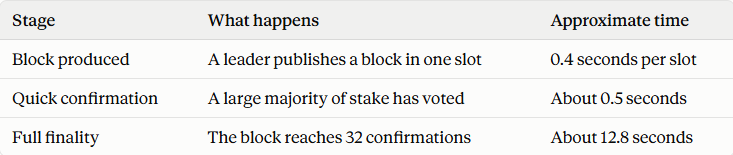
Solana separates quick confirmation from full finality. A block reaches confirmed status within about half a second, but full finality needs 32 more blocks on top, which takes roughly 12.8 seconds.
The number comes from simple math, because 32 confirmations times a 400-millisecond slot equals 12.8 seconds.
The table below shows each stage in order.
Exchanges, bridges, and payment apps often wait for the longer window when large sums are involved. A block could in theory still be dropped before the lockout stack is complete.
What Fault Tolerance Does Solana Tower BFT Offer?
Classic BFT systems stay safe as long as less than one third of the stake behaves badly, and Solana Tower BFT follows that limit.
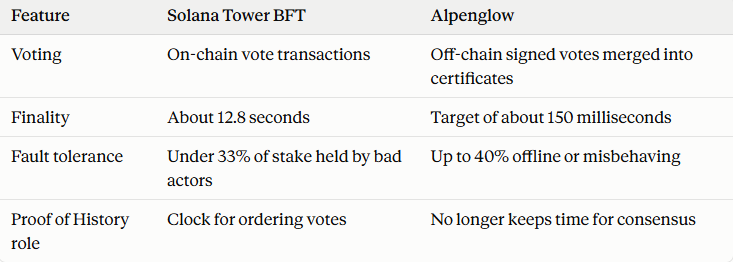
Anza’s materials put the Tower BFT limit at under 33% of stake held by bad actors, while Alpenglow is built to keep running with up to 40% of stake offline or misbehaving; the gap matters for crypto security.
A network with more room for attacks and outages is harder to stall or split.
What Does Tower BFT Cost Validators and the Network?
Because votes are ordinary transactions, they use block space and cost fees. Validators pay 0.000005 SOL per vote transaction, which adds up to roughly 1.1 SOL per day.
An editorial calculation backs this up; a 400-millisecond slot gives 216,000 slots per day, and a validator voting in every slot would pay about 1.08 SOL daily.
Across a large validator set, this vote traffic also fills a meaningful share of each block. That is one reason developers looked for a design that moves voting off the chain.
Solana Tower BFT vs Alpenglow: What Changes on Mainnet?
Alpenglow is the largest consensus overhaul in Solana’s history; validators approved it in September 2025 with more than 98% of votes in favor.
Anza scheduled the mainnet switch for October 21, 2026, and Tower BFT stays in charge for another 5,000 slots, about 18 minutes, before Alpenglow takes over.
The first release ships Votor, the new voting engine, while Rotor, the block spreading piece, comes later.
The table below compares the two designs side by side.
Reports available on October 22 describe the switch as scheduled, and one report says only Votor launched first.
Readers should confirm the final result on the official pages of Anza and the Solana Foundation.
Which Risks and Limits Matter for Solana Validators and Stakers?
A consensus upgrade carries risk, because the change touches every validator at once. Operators running unsupported software may need to switch clients before activation.
Bugs or delays could also affect performance during the handover. SOL holders reportedly need to take no action, while developers and validator operators may need to prepare.
Raw transaction counts may look lower after votes leave blocks; this can confuse dashboards that count vote transactions as user activity. These points are general notes, and the official network notes remain the best guide.
Conclusion: What Solana Tower BFT Means for Solana’s Future
Solana Tower BFT gave the network fast confirmation by combining Proof of History with lockout-based voting. It carried Solana from its 2020 launch into mainstream use.
Its main costs were on-chain vote traffic and a finality window of about 12.8 seconds; those are the limits that Alpenglow aims to remove.
Readers who follow Solana consensus news should check the live status from Anza and compare finality data after the switch. Speed targets should be treated as goals until real network numbers confirm them.
Disclaimer: This article is for educational purposes only and is not financial or investment advice. Readers should verify details through official channels and do their own research before making any decision.