South Korea Crypto News: KuCoin and MEXC Hit, Who Else Got Blocked?

South Korea Crypto News: KuCoin, MEXC, BingX and 24 More Sites Blocked
As of October 13, 2026, South Korea blocks crypto exchanges at the website level, and the move leads South Korea crypto news today.
The Financial Intelligence Unit (FIU) said a media and communications review commission ordered domestic access restrictions on 27 unregistered platforms after reviews on October 6 and 7, according to Etoday.
The headline is KuCoin blocked in South Korea, alongside MEXC and BingX. The FIU treats all of them as unregistered crypto exchanges, since they operate without the required filing.
South Korea 27 Unregistered Crypto Exchanges: What Was Announced?
The order targets unregistered VASPs, short for virtual asset service providers. Servers at home face service termination, while overseas servers face a domestic block.
Item | Detail |
Sites targeted | 27 |
Operators referred to investigators | 44 |
Penalty for operating unregistered | Up to 5 years in prison or 50 million won |
Which Crypto Exchanges Are Blocked in South Korea?
The South Korea crypto exchange block list names KuCoin, MEXC, Phemex, XT.com, Bitrue, CoinW, Poloniex, BTCC, BingX and BitMart, among others.
With the South Korea crypto exchange website blocked, restrictions now reach web access, not only apps.
The MEXC South Korea block and BingX South Korea block extend an earlier app download restriction, where the FIU asked Google and Apple to stop new installs and updates, per an earlier FSC release.
The MEXC blocked in South Korea status comes from the same October order.
Is KuCoin Banned in South Korea? What Changes for Users
South Korea crypto news reports describe an access block or service termination, not a formal ban.
Etoday reported that registered operators must limit transfers with these platforms, and credit card purchases on them are barred.
Crypto exchange registration requires ISMS certification and a filing, even for overseas firms with Korean-language sites.
Can Koreans Still Use KuCoin? Withdrawal Steps
Domestic access to these sites is cut off. The Digital Asset eXchange Alliance (DAXA) will offer DAXA withdrawal guidance for blocked exchanges. This user withdrawal guidance covers how to move assets, per the FIU.
Regulator advice, per Etoday:
Withdraw assets and deposits at once if a platform is unregistered
Be wary of ads promising high returns, principal protection or global listings
Check the FIU website for the 28 registered operators
South Korea Crypto News: What About Fees and Mirror Sites?
A June joint inspection found average fees of 1.5% to 10% at flagged firms, against 0.16% at the five major domestic won operators, up to 62 times higher, per Etoday.
The South Korea FIU unregistered exchanges drive continues, with further blocks planned on mirror domains, also called alternative domains, that restart service after a block.
Wu Blockchain also covered this news in its tweet on X, noting the 44 referrals.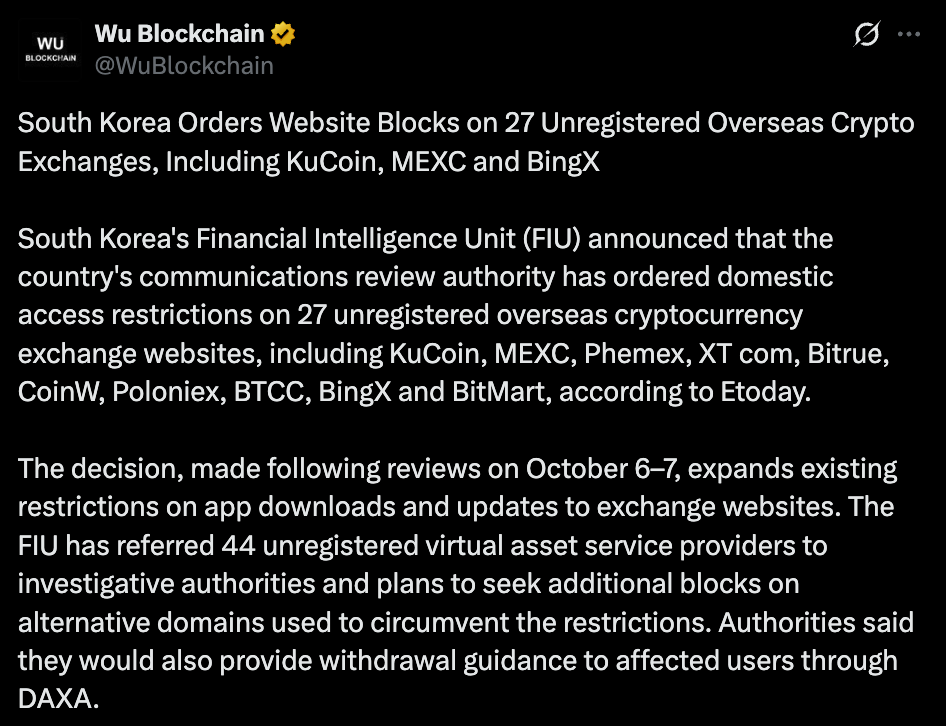
Expert View: What Could the Korea Overseas Exchange Ban 2026 Mean?
Analysts tracking Korean crypto regulation may read the order as a shift from app limits to full web enforcement.
Offshore exchanges serving Korean users could face faster action, since proof of harm is no longer required.
For South Korea crypto regulation news today, the open questions are how quickly new domains get targeted and how smooth withdrawals prove. Readers of crypto news today should treat user impact as unsettled.
Anyone following crypto news will watch the next review. With overseas crypto exchanges blocked, South Korea crypto news may turn on that outcome.
Disclaimer: This article is for information only and is not financial, legal, or investment advice. Digital assets are volatile, and you can lose money. Verify details with official sources before making any decision.









