Stablecoins and US Debt: Can They Help Finance Federal Borrowing?


Can Stablecoins Help Finance the Growing US Federal Debt?
Crypto and the national debt rarely share a sentence. But stablecoins and US debt are now tied together, since dollar-linked tokens sit inside one of the biggest bond markets on earth. Could they carry some of the load?
Why Is US Federal Debt Increasing Year After Year?
People are living longer, and the bill lands on the government. The IW, a German research institute, puts US government debt at roughly 122% of GDP in its October 2025 report. Life expectancy rose from 70.2 years in 1966 to 78.4 in 2024. That pushes up Medicare, Medicaid, and Social Security costs.
Revenue hasn’t kept pace. Federal spending sits near 24.4% of GDP, while federal income tax revenue has fallen to about 10.6%, according to the IW.
Net interest now tops defense spending, at about $1.05 trillion versus $965 billion in FY2026, per US Treasury data.
Why Do Investors Still Buy Treasuries Despite the Risks?
The dollar made up 57.8% of global reserves in 2024, and it was on one side of over 88% of currency trades in 2022.
That’s changing, slowly. The dollar’s reserve share was 71.5% in 2001. Foreign investors held over 50% of Treasuries during the financial crisis, but only about 30% in early 2025, per J.P. Morgan figures the IW cites.
Not everyone is calm about it. Former House Speaker Paul Ryan argued in a June 2024 Wall Street Journal op-ed that a debt crisis would likely start with a failed Treasury auction.
How Do Stablecoins and US Debt Connect Through T-Bills?
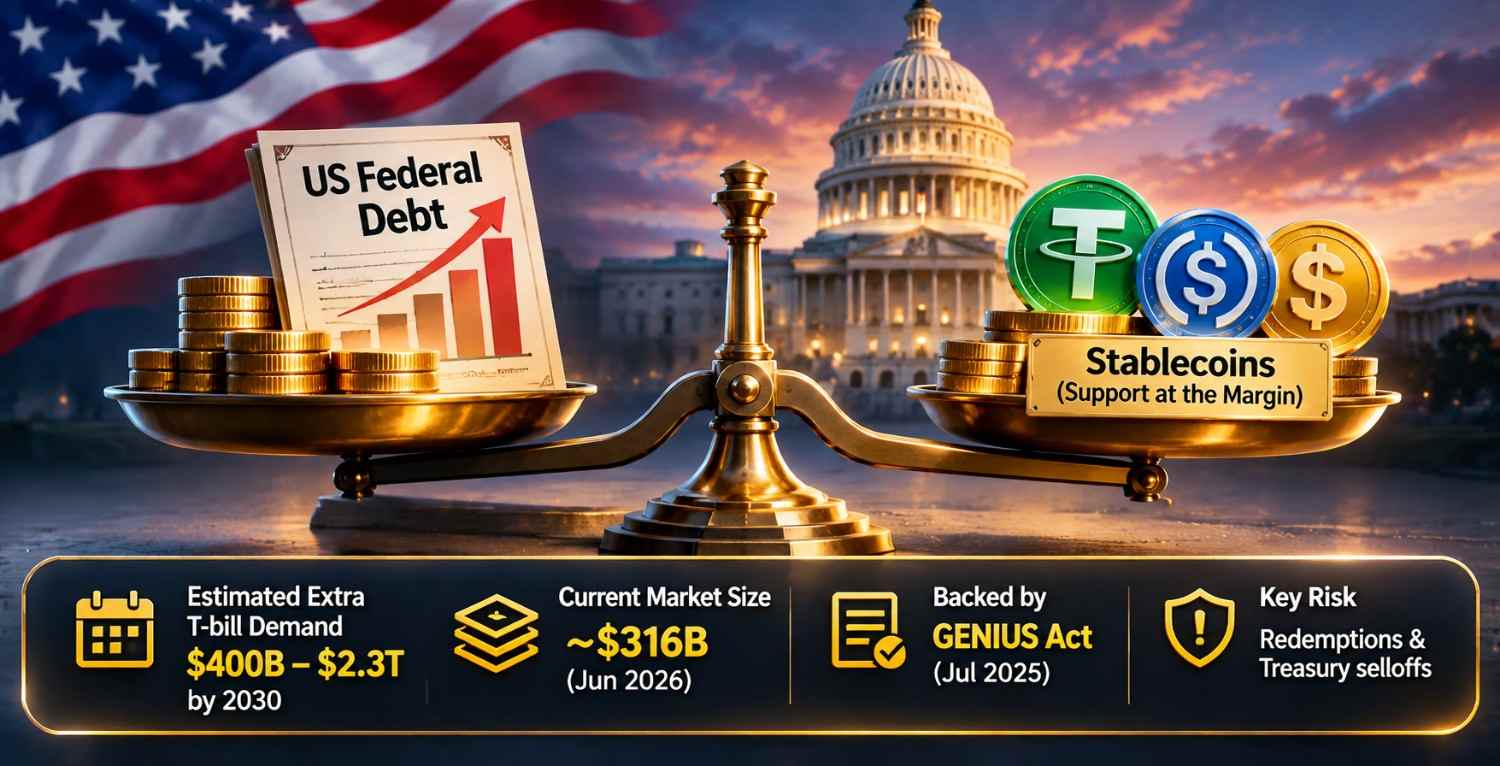
The GENIUS Act became law in July 2025, establishing new rules for stablecoins. Brookings said issuers must back tokens at a minimum one-for-one using eligible reserves such as T-bills.
How do stablecoins support US Treasury demand?
Issuers take the cash people pay for tokens and park it in short-term government paper. Those stablecoin Treasury holdings make them a quiet buyer. The market was nearly $270 billion in June 2026, according to Brookings.
Do stablecoin issuers buy Treasury bills?
Yes, Tether disclosed that it had over $141 billion in direct and indirect exposure to US Treasury securities by the end of 2025. That made it the 17th-largest holder in the world, ahead of South Korea and Germany.
Could Stablecoins Create New Demand for US Government Debt?
Nellie Liang of Brookings and Brent Neiman of the University of Chicago tested several growth paths. Their first-round estimates of net new T-bill demand run from $400 billion to $2.3 trillion by 2030.
The source of the growth matters. If savers pull cash out of money market funds, those funds sell Treasuries, and net demand shrinks.
Overall, the pair think stablecoins and US debt could work together, with a modest lift for government debt financing.
What Risks Do Stablecoins and US Debt Create for Financial Stability?
Stablecoin risks to financial stability start with runs. The IW compares these coins to money market funds. In 2008, the Reserve Primary Fund faced over $40 billion in redemption requests within two days.
A big issuer in the same spot might have to sell Treasuries fast, which could push prices down. The IW doesn’t call that likely.
Liang and Neiman warn that leaning on bills shortens the average life of federal debt. The law also requires reserve Treasuries to mature in 93 days or less.
Vahan Roth, a precious metals tokenization executive writing for GIS Reports, says issuers must buy bills as demand grows. That hands governments a funding source that hides fiscal strain. It’s an opinion, not a finding, and Roth admits issuers remain small next to foreign investors. The IW estimates they hold about $150 billion of US government debt, roughly 0.5% of the market.
How Could CBDCs Affect Stablecoin Adoption and the Dollar?
A digital dollar from the Fed, called a CBDC, is the rival idea. The Congressional Research Service says P.L. 119-101 temporarily bars the Fed from issuing one through 2030.
CRS adds that a CBDC could partly displace stablecoins.
The IW lists de-dollarization as a worry. It says stablecoins could slow that trend.
Can Stablecoins Help Finance US Federal Debt, or Just Soften It?
Every source agrees stablecoins add steady demand for short-term Treasuries. Where they split is on size and meaning.
Source | View |
Brookings | A modest gain with trade-offs |
IW | A possible stability risk, though not a likely one |
GIS Reports | A way to postpone hard choices |
Totals differ too. Brookings puts the market near $270 billion in June 2026, while GIS says it topped $300 billion in 2025. DefiLlama data showed about $316 billion in June 2026. Treat each as a rough guess.
Stablecoins and US debt do meet in the T-bill market, yet US federal debt is still driven by aging, thin revenue, and rising interest. Stablecoins can help at the margin but can’t fix the gap.
Expert Opinion: What Does This Mean for the Debt Story?
CoinGabbar analysis suggests the link between stablecoins and US debt rests on a helpful but small buyer, not a cure for the deficit.
Watch Treasury’s quarterly refunding announcements, GENIUS Act rules, and the CBDC ban through 2030. Our CFTC crypto rules explainer covers the regulators.
Disclaimer: This article is for information only. It isn’t financial or investment advice. Crypto and bond markets can move fast, and nothing here is a guarantee of any outcome.
















