Token Migration Mint Burn: How Errors Can Inflate Token Supply

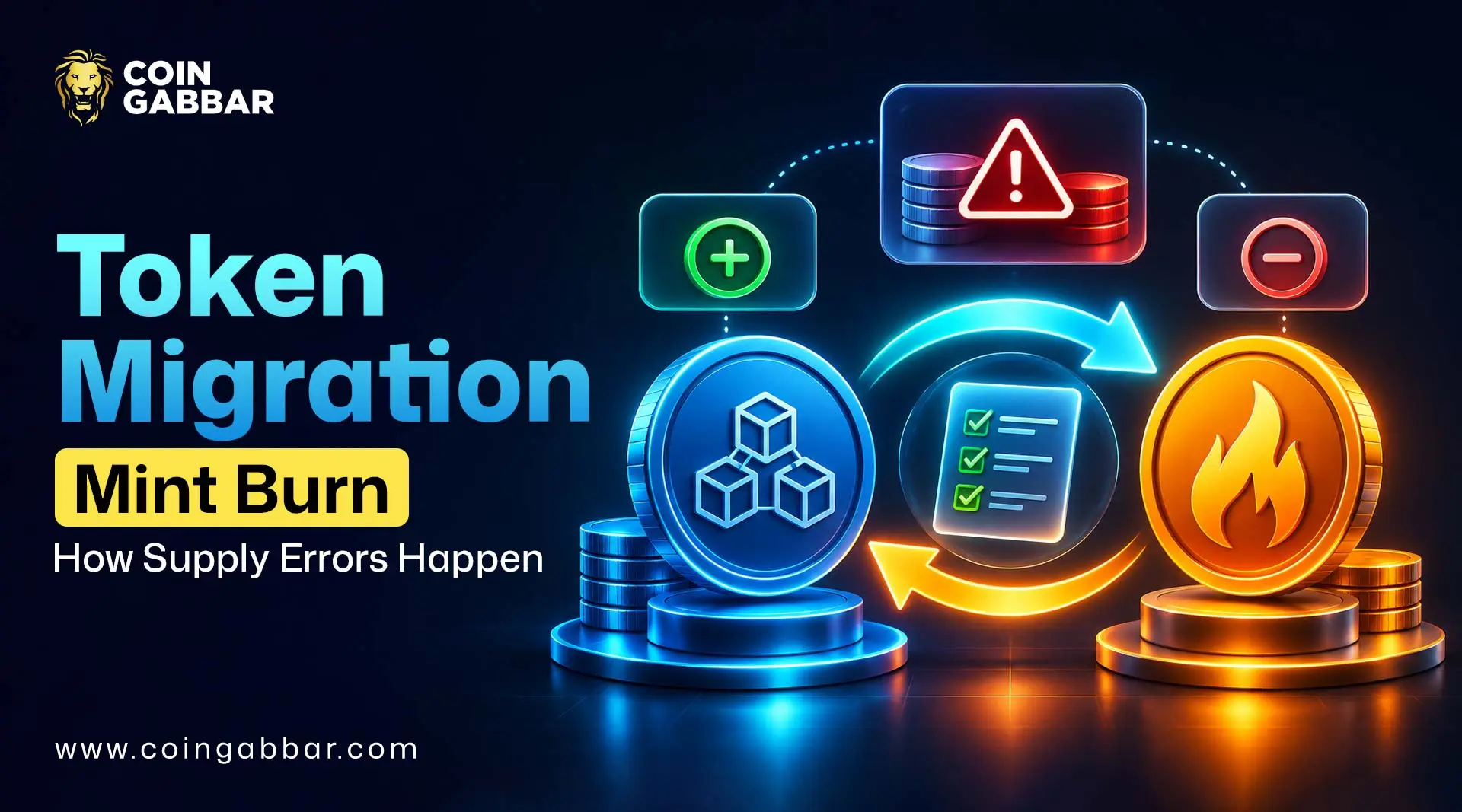
How Can Token Migration Mint Burn Errors Increase Token Supply?
Token migration and mint burn look like routine housekeeping. Old tokens are destroyed, new tokens are created, and the totals should match.
When the totals differ, extra tokens appear that nobody planned. Holders get diluted, and liquidity pools can drain within hours.
An inflated supply rarely announces itself. The price usually moves first, which is why the mechanics matter.
What Is Token Migration Mint Burn?
A token migration moves holders from an old token to a new one. On Ethereum, that usually means swapping one set of ERC-20 tokens for another.
The old token is burned, meaning it is removed from supply. A matching amount of the new token is minted, which means the contract creates it.
Chainlink describes burn and mint transfer as destroying an asset on an origin chain and issuing an equal amount on a destination chain. It needs no liquidity pools or wrapped tokens.
Done properly, total supply stays constant. That is the promise behind every token migration mint-burn plan.
How Does Burn and Mint Differ From Lock and Mint?
Lock and Mint keeps the original asset in a vault while a wrapped copy circulates elsewhere. Chainlink (LINK) points out that such vaults become targets for attackers.
Burn and mint removes the vault but adds a different risk. Whoever controls minting holds real power over supply.
How Does a Token Migration Mint Burn Keep Supply Balanced?
According to Aave's migration documentation, LEND holders swapped at a fixed rate of 100 LEND for 1 AAVE. Total supply shrank from 1.3 billion tokens to 16 million.
Aave's token design notes flag rounding. Rounding half up could let users migrate slightly less than the ratio and collect more AAVE.
The design accepts a small precision loss instead. A person sending 1.000000000000000022 LEND receives 0.01 AAVE and loses the last few units.
Where Do Token Migration Mint Burn Errors Inflate Supply?
The public record shows a few patterns repeating.
Weak Mint Permissions
Any token migration mint/burn contract depends on who can call mint. The ERC-5679 standard says minting must raise total supply and burning must lower it. It warns that poorly guarded mint access can cause fraudulent issuance and a higher total supply.
Decimal and Ratio Mismatches
Decimals set the smallest unit of a token. Each extra decimal place multiplies an amount by ten, so a cross-chain token migration mint burn can scale a transfer fast if decimals differ.
Chainlink's documentation says older v1.5.1 pools did not properly enforce inbound rate limits when decimals differed, while v1.6.0 and later handle them.
Missing Limits and Unverified Burns
Chainlink states that no rate limits apply unless an issuer configures them. Its burn and mint article names the infinite mint scenario, where a compromised verification layer or stolen issuer keys could let an attacker mint without limit.
Error type | What goes wrong? | Effect on supply |
Open mint permission. | The wrong address can be called Mint. | Unlimited new tokens |
Wrong ratio or rounding | Old tokens convert into too much new supply. | New supply exceeds old supply. |
Decimal mismatch | Amounts scale incorrectly across chains. | Mint is larger than the burn. |
Unverified burn message | Mint runs without a real burn. | Tokens exist on two chains. |
No rate limit | Nothing caps mint volume. | Damage grows with every call. |
What Did a Real Mint Bug Look Like?
On 28 December 2020, Cover Protocol's rewards contract, Blacksmith, was exploited to mint COVER tokens in huge amounts. The team said it restricted the contract's minting access.
The fix involved a migration. Cover's later governance proposals describe moving holders to a new COVER token with a capped supply.
The case shows how a mint bug can force a token migration mint burn exercise that then needs its own careful limits.
Which Safeguards Reduce Supply Risk?
A token migration mint-burn plan usually stacks several controls:
A public conversion ratio and published contract addresses, so outside observers can check the math.
Mint rights held by governance or a multisig wallet, which needs several approvals instead of one key.
Rate limits on mint volume, set before launch because they are off by default in Chainlink's pool contracts.
Reviews of smart contract audit findings on every supported chain, since an audit guarantees nothing.
A fast way to revoke minting rights, as Cover did during its exploit.
What Risks Remain After a Token Migration Mint Burn?
Upgradeable contracts carry their own danger. If an admin holds the upgrade key, the contract logic can change after launch, including minting rules. That is why proxy contract risks deserve a close look.
New tokens sold into thin liquidity can drag the price down fast, often before holders have time to react.
An inflated supply also warps the numbers. When the supply count is off, FDV and circulating market cap both paint a false picture, since each one rests on it.
What Does the Evidence Suggest?
Burn and mint solves one problem and concentrates another. Vault risk falls, but minting authority becomes the asset that most needs protection.
This is analyst interpretation, not a confirmed rule. A token migration mint burn window is short, yet one mistake inside it can outweigh years of careful tokenomics. A token unlock calendar can also show how much extra supply may reach the market.
Conclusion
A token migration mint-burn process swaps old tokens for new ones while keeping the supply steady. Chainlink, Ethereum, and Aave documentation shows how that works when permissions, ratios, and limits are set correctly.
What stands out is how often the weak point is mint control, not the burn. What remains uncertain is how well each project applied those controls.
Then, check the published ratio, contract addresses, mint roles, and rate limits on official project pages. Research as of November 17, 2026.
Disclaimer:
This article is for information only and is not financial advice. Crypto assets carry a high risk of loss, and token migrations can fail or be exploited. Always research independently before deciding.