Token Unlock Cliffs Explained: What HYPE's $1.2B Friday Tests


Why Is the HYPE Unlock Drawing So Much Attention?
Token Unlock Cliffs grab attention when the number is big, and the latest HYPE release is worth about $1.2 billion. Tracking data shows 14,175,778 HYPE coming out on October 29, 2026.
At the tracker price of $84.85 seen the same day, that's close to $1.2 billion. Traders are asking whether the market can take in that much new supply.
What Is a Token Unlock Cliff?
A cliff is a waiting period. When it ends, a locked batch of tokens is free to move all at once. Say 10 million coins unlock on one fixed date: from that day, holders can send or sell them, unless some rule says otherwise. Such Token Unlock Cliffs create sharp supply events that the market can see coming.
How Token Vesting Works in Crypto
Vesting is the schedule that decides when tokens can be used. A public crypto vesting schedule lists each date and amount, so traders can plan around it.
Cliff Vesting vs. Linear Vesting
Cliff vesting frees a big batch on one date, while linear vesting frees small amounts every day or month. A cliff packs it all into a single day.
Why Crypto Projects Lock Tokens
Locks keep founders and early backers tied to the project's long-term growth. This token vesting cliff explained guide covers the basics in more detail.
HYPE's $1.2B Unlock: What Investors Need to Know
Each monthly unlock cliff on the Hyperliquid token unlock calendar also shows up on the crypto token unlock schedule. All figures below come from tracking data checked on October 29, 2026.
-
How Many HYPE Tokens Are Being Unlocked?
The batch holds 14,175,778 HYPE, about 1.4% of the 1 billion maximum supply. The August 29 batch had the same token count.
-
Who Receives the Unlocked Supply?
Tracking data splits the batch into insiders at 46.6%, the community at 46.3%, and the Hyper Foundation at 7%. That puts roughly 6.6 million units with insiders. Insider tokens carry the most risk, since early holders often bought in at low prices.
-
How Large Is the Unlock Compared With Circulating Supply?
One tracker puts circulating supply near 239.4 million, so the batch equals about 5.9% of it. Another tracker shows 222.45 million, which lifts the ratio to about 6.4%. That gap is why HYPE circulating supply deserves a check on more than one dashboard.
What Do the Allocation Chart and Unlock Graphic Show?
The allocation chart sets maximum supply at 1.00 billion. Future emissions and community rewards hold 38.888%, Genesis distribution 31%, core contributors 23.8%, the Hyper Foundation 6%, community grants 0.3%, and HIP-2 0.012%.
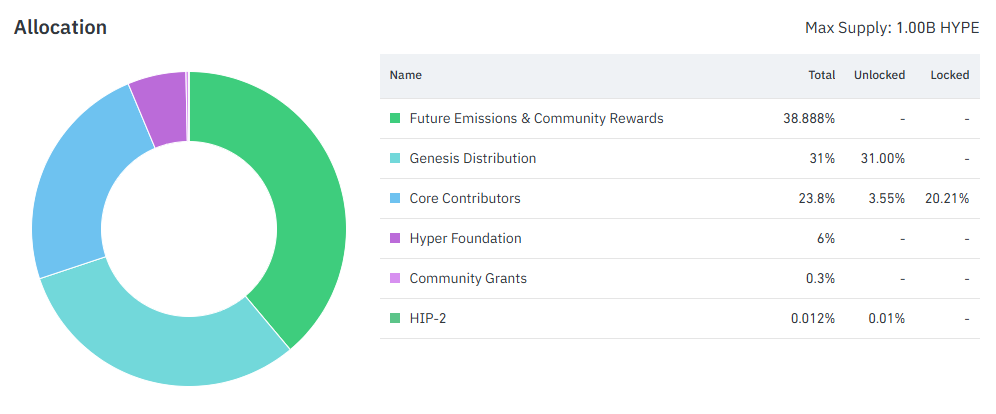
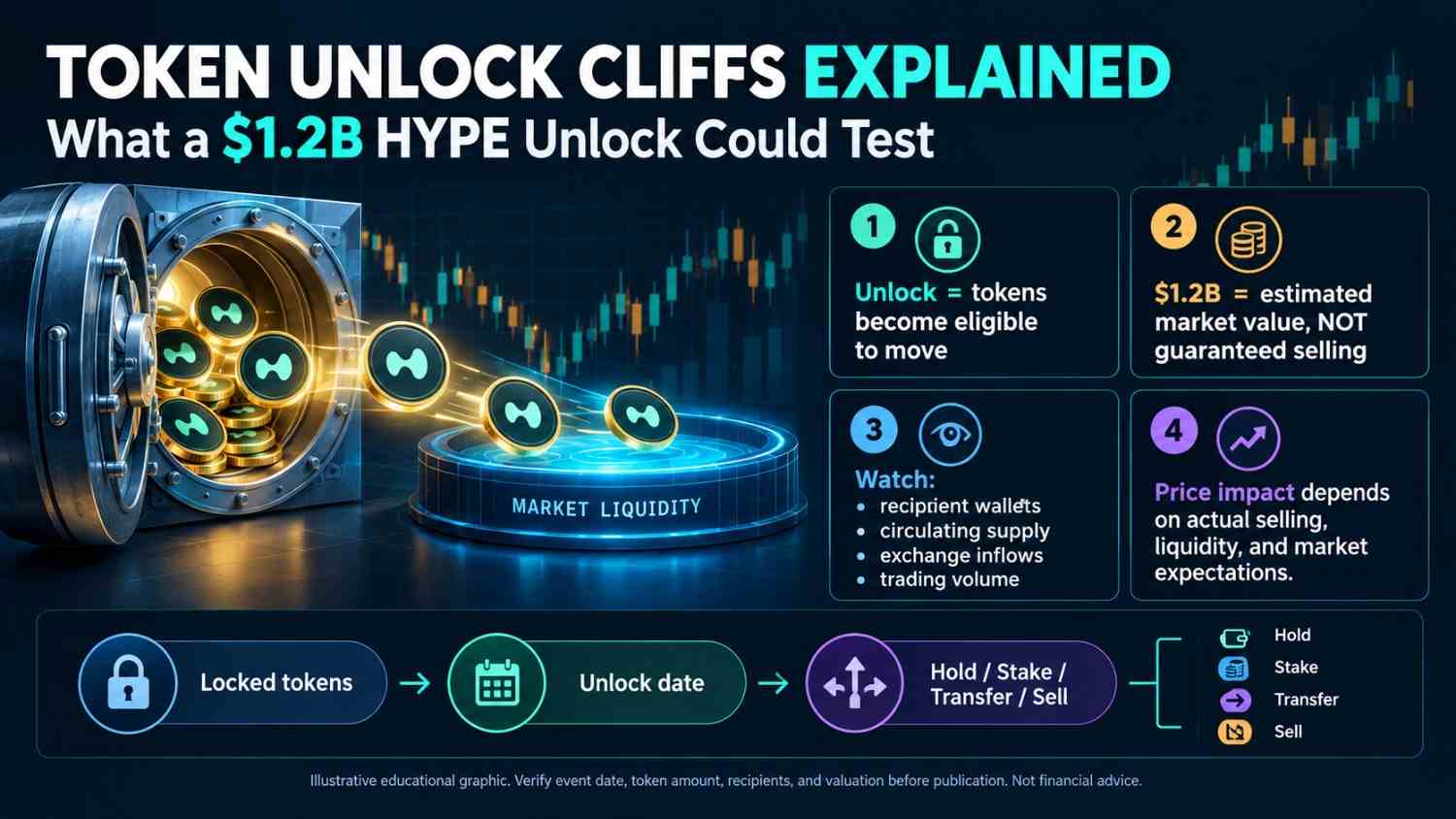
The Genesis allocation is fully unlocked. Core contributors have 3.55% unlocked and 20.21% still locked. The unlock graphic shows a simple path: locked tokens reach an unlock date, then holders can hold, stake, transfer, or sell.
Why a $1.2B Token Unlock Could Test HYPE's Price
Token Unlock Cliffs add possible supply, but the real token unlock price impact depends on what holders do and how much demand the market has.
-
Potential Selling Pressure From Early Holders
Insiders with low entry prices sit on big paper gains, so even partial selling could add supply fast. Still, an unlocked balance is only a choice to sell. Many holders stake or keep their tokens.
-
Market Liquidity and Order Book Depth
Order book depth shows how many buy orders sit near the current price. In a thin book, a few large sell orders can move the HYPE price sharply within minutes.
-
Why Traders May Sell Before the Unlock
Some traders sell or short ahead of a known date to avoid expected swings. That early move can push price down before any recipient sells a single token.
Can Strong Demand Absorb New Token Supply?
Hyperliquid's Assistance Fund buys back the asset using trading fees. A Nasdaq-listed treasury company also reported holding 29.3 million HYPE on June 30, 2026.
Will HYPE Drop After the Token Unlock?
No one can forecast it, and no price target applies here. Three scenarios frame the range.
In the bearish case, recipients send tokens to exchanges and sell into thin books, and traders using borrowed money add to the move. In the bullish case, holders keep or stake their tokens while buybacks and treasury purchases go on, so price could stay steady.
The neutral case is that the date is public, so expectations may already sit in the price. Such Token Unlock Cliffs then pass with only limited price movement, and attention shifts to the next release.
What Traders Should Watch Before and After the Unlock
Tokens moving on-chain aren't confirmed sales, and a deposit to an exchange doesn't prove an actual sale either. Rising deposits from recipient wallets still deserve attention, since holders may also move tokens to store or stake them.
A volume spike with shrinking depth points to stress, while high volume with steady depth shows the market soaking up the flow. Comparing the price in the days before and after the date helps tell early bets apart from real selling.
The October 6 contributor release of 3.75 million HYPE was reported to go to one buyer in a private deal, which shows that unlocks don't always hit exchanges.
One tracker lists a core contributor release of 9,916,667 units on November 6, 2026. Actual claims have often run below schedule, such as 1,745,746 HYPE in November 2025, so the scheduled figure works more like a ceiling.
How to Evaluate HYPE Token Dilution
Token dilution in crypto happens when new supply grows faster than demand. A simple three-step check works for future Token Unlock Cliffs too.
First, divide the unlock value by market cap: $1.2 billion against a reported $18.98 billion gives about 6.3%. Second, compare the release with daily trading volume, buyback spending, and net exchange flows. Third, check who gets the tokens, because community and foundation tokens often fund programs and grants, while insider tokens can be sold for profit. That split changes the risk.
Final Verdict: What the HYPE Unlock Really Means
Token Unlock Cliffs are big supply events, but they don't decide price alone. The October 29 release adds about 1.4% of maximum supply and roughly 6% of circulating supply.
The result will depend on who really gets the tokens, how much they sell, how much liquidity the market has, and how the wider crypto market moves.
Disclaimer
This article is for learning only and isn't financial advice. Crypto assets carry high risk, prices can change fast, and tracker data may differ or change. Readers should do their own research and talk to a licensed advisor before making any decision.