What Is a Token Buyback and Burn? PUMP's 332M Example

Why Do Crypto Projects Destroy Their Own Tokens?
Token buyback and burn is one of the most popular ideas in crypto, and the pitch is easy to follow. A project makes some money, uses it to buy its own token, and then gets rid of those coins for good. But real life is messier than the headline, and many readers can’t tell a true supply cut from a well-timed announcement.
This guide covers how each step works, how the two parts fit together, what the 332 million PUMP buyback showed, and where things can go wrong.
What Is a Token Buyback, and What Are Its Main Features?
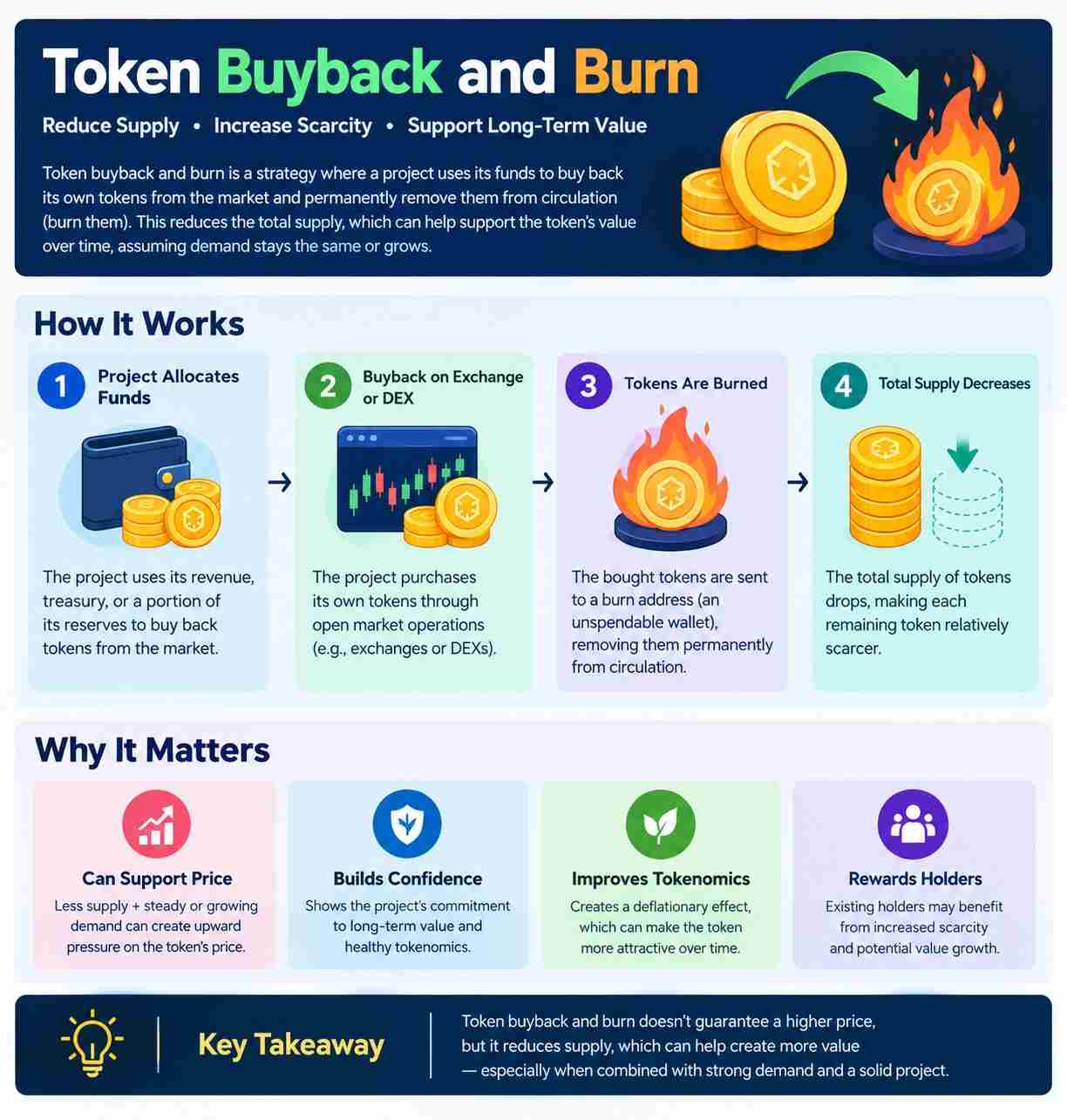
A token buyback is when a project spends its own money to buy its token from the market. The purchase can happen on a regular or decentralized exchange.
The money often comes from fees, trading income, or saved-up reserves. Buying adds demand, so the price may get a short lift. Here’s the thing: a buyback alone doesn’t cut supply.
If the project keeps them in its treasury, they still count in the total, and they can return to the market later through sales, rewards, or grants.
The main features are simple. The cash comes from income or reserves, the timing is flexible, and the project can keep what it bought, give it out as rewards, or destroy it. That choice is why the word "buyback," on its own, proves very little.
What Is a Crypto Token Burn and How Does It Work?
A crypto token burn takes tokens out of circulation for good. The project routes them to a "burn address" or “dead address” that is a special wallet. There is no one in possession of the key, and nothing sent there can be retrieved.
The transaction cannot be undone, and it is visible to anyone. There is a reduction in the circulating supply and the total supply as well.
A project can destroy tokens it already owns, or a "buyback" can turn a slice of every fee, as Ethereum has done with its base fee since August 5, 2021.
The main features of a burn are that it’s permanent, anyone can verify it, and it costs little when the tokens already sit in the project’s wallet.
How Does Token Buyback and Burn Work Together?
When both are joined, the process has four steps. The project sets aside money from income or reserves, buys its token on an exchange, and sends the bought tokens to a verified burn address, and the total supply drops. The buying adds demand, and the burn removes supply for good.
Say 1 billion tokens trade at $0.10, so the market value is $100 million. Supply is reduced to 900 million after 100 million are used up by the project, and if the supply value is constant, price will be around $0.111 after the project is done.
But if demand fades and the market value falls to $81 million, the price drops to about $0.09, lower than the start. Turns out, supply is only half the story.
How Does a Stock Buyback Compare With a Token Buyback and Burn?
In a stock buyback, a company buys back its own shares. Fewer shares remain, so each one owns a bigger piece of future profit. Token buyback and burn borrow that idea. Still, the two aren’t the same.
A token usually gives no ownership, no dividend, and no legal claim on company profit, unless the project’s real rights say otherwise.
A burned token is gone for good. Yet projects can still release new tokens later, as rewards or team shares.
What Did the PUMP 332M Buyback Show?
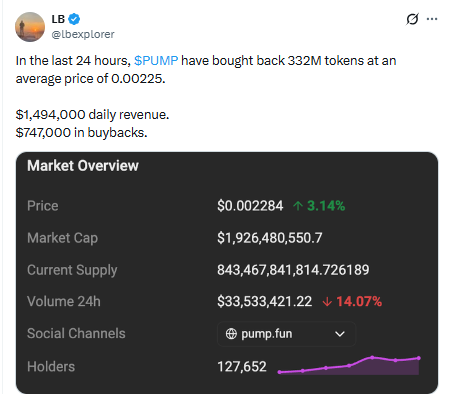
As of August 5, 2026, the Pump.fun platform had bought back 332 million PUMP at an average price of $0.00225. Data shared on X showed $747,000 spent on buybacks from $1,494,000 in daily revenue, which is exactly half.
The same snapshot listed a price of $0.002284, a market value near $1.93 billion, a supply of about 843 billion tokens, and 127,652 holders. On that supply, 332 million tokens equal roughly 0.04%, a small slice for one day. PUMP rose 13.42% in 24 hours, according to market reports.
Don’t read too much into the timing. Open interest, which is the total value of open futures bets, also grew 18.10% to $211.31 million, so traders using borrowed money helped the move.
And a buyback isn’t a burn. Reports cover the purchase, yet the lasting supply effect depends on whether the project destroyed those tokens or kept them.
Why Do Projects Use It, and What Are the Risks?
Projects use token buyback and burn for four reasons. They want scarcity, they want to cancel out new tokens handed out as rewards, they want to show confidence, and they want remaining holders to own a bigger share of a smaller supply. Less supply with steady or growing demand can push the price up, though nothing guarantees it.
Demand can fall faster than supply, as the example showed. New tokens can also outpace burns, and one industry review found over $19 billion worth of tokens burned while many supplies kept growing. A project that burns $10 million a year but hands out $50 million in rewards isn’t shrinking its supply. Some burns go to wallets the team still controls.
So why do burn announcements move prices before anyone checks the numbers? Four checks give a clearer picture. First, confirm on a block explorer that the wallet is a real burn address. Second, find where the money comes from and whether it repeats.
Third, compare the amount burned with the amount released, since net supply change is what counts. Fourth, separate the announcement, the approved budget, the finished purchase, and the finished burn.
At first, the burn seems like the main story. On second thought, the funding source and the net supply numbers decide whether it’s real. Programs paid by steady income and backed by published supply data deserve attention. Announcements without those numbers are mostly marketing.
Conclusion
Token buyback and burn joins two separate actions, buying tokens and destroying them, and only the second one cuts supply for good. The PUMP case shows a purchase paid from income with clear numbers, yet the burn still needs proof on the blockchain.
Readers should check the burn address, the funding source, and the net supply trend before trusting any scarcity claim.
Disclaimer
This article is for informational purposes only and isn’t financial or investment advice. Crypto assets are volatile and can lose value quickly, and past results don’t predict future returns. Readers should research independently and consider a licensed advisor before making any decision.