TREAT Token Explained: New Utility Layer in Shiba Ecosystem

TREAT Token Explained: What It Is and How It Works in 2026
TREAT Token Explained starts with a simple question: what’s the fourth token in the Shiba Inu family, and why did it take so long to show up? Shiba Inu news today mostly talks about SHIB burns, Shibarium, and the Shiba Inu price, but TREAT has quietly become one of the most discussed pieces of the Shiba Inu ecosystem.
People searching for it usually want three answers: what it does, how many tokens exist, and when the locked ones get released. This guide uses the project’s own published numbers, its official pages, and public news reports to answer those questions.
What Is TREAT, and How Does It Fit Into Shiba Inu Tokens?
Any TREAT Token Explained story begins in the Shiba Inu whitepaper, which the community calls the Woofpaper.
There, TREAT shows up as the last unreleased token next to SHIB, LEASH and BONE. It waited years without a release date before the project brought it back.
News reports say TREAT is meant to power a planned privacy-focused layer 3 network built on Shibarium, the Shiba Inu layer 2 chain. That network plans to use fully homomorphic encryption, which is a way of working with data while it stays locked and hidden.
Early posts from the team also called TREAT a reward token for ShibaSwap, the metaverse, and the Shiba Inu gaming future, so its job may end up wider than privacy. The official TREAT page, run by the Shib Doggy DAO Foundation, describes it as a way to earn rewards.
Reports on the private sale say about $12 million came in from investors outside the United States. The same reports mention a warning from the lead developer that copycat TREAT tokens on tracking sites weren’t official.
That warning still matters. At least one other community token uses the same name and ticker, with a different supply and contract. So every address needs a check through official channels before anything goes into a Shiba Inu wallet.
How Is the TREAT Supply Split Across Five Pools?
In this TREAT Token Explained breakdown, the project’s published tokenomics split the supply into five pools, and each pool has its own unlock plan. Ecosystem growth gets the biggest share, while the small foundation pool waits the longest before any tokens move. Pools meant for the community hold 62% of the supply, an unusual setup for a project with a private sale.
Allocation | Share | Published vesting |
Ecosystem Growth | 32% | 28.25% at TGE, then 41 months linear |
Community and Launch | 30% | 30% at TGE, then 34 months linear |
Protocol Development | 20% | 8.33% after a 1-month cliff, then 33 months linear |
Protocol Sales | 14% | 15% at TGE, 3-month cliff, 11 months linear |
Foundation | 4% | 11 month cliff, then 24 months vesting |
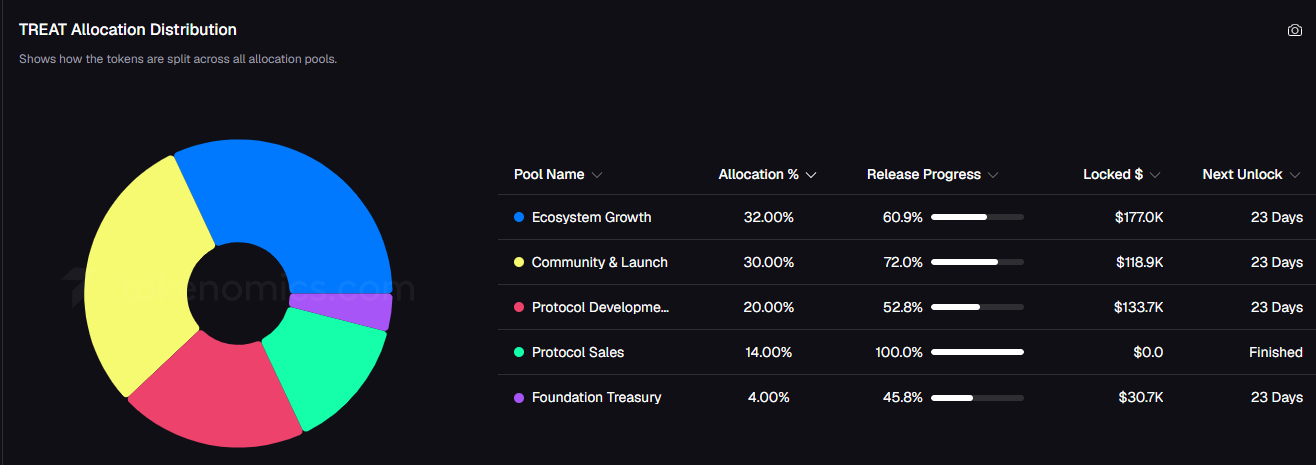
TGE stands for token generation event, the day tokens are first created and handed out. A cliff is a waiting period before any unlocks start, and linear vesting means tokens are released in equal steps over time. They come up with the quantity of new supply on the market each month.
What are the most important numbers in the TREAT Vesting Plan?
Published data shows a total supply of 10 billion TREAT, with the TGE on January 13, 2025. Tracking data updated in March 2026 put the circulating supply at about 5.51 billion tokens, roughly 55% of the total.
That same data lists the protocol sales round at $0.0085 per token, which works out to a fully diluted valuation near $85 million and about $11.9 million raised. Readers of any TREAT Token The explained guide should keep two terms apart here: market cap counts only the tokens in circulation, while fully diluted valuation counts every token that will ever exist.
Tracking data also says 46.15% of all tokens come out in the first year, and most pools keep unlocking every month after that. Meanwhile, the Shiba Inu price, meaning SHIB itself, still trades at a tiny fraction of a cent in recent market data, so TREAT moves on its own supply and demand, not on SHIB charts.
The official graphic and outside tables don’t match on every TGE number, so exact unlock amounts should be checked against the project’s own documents.
What Does the Available Data Say About TREAT Right Now?
The strongest point is the community-heavy split, since 62% of supply sits in pools meant for ecosystem growth and community projects. Long vesting on those pools spreads releases over three and a half years.
The main worry is unlock pressure. More than half the supply already circulates, new tokens arrive every month, and demand has to grow at a similar speed for the balance to hold.
Turns out, that’s the real test for TREAT Token Explained as a topic, because the layer 3 network that gives the token its purpose has no confirmed launch date in the sources reviewed.
The biggest unknown is timing. Plans tied to the Shiba Inu whitepaper roadmap, the Shiba Inu DAO and the gaming side of the ecosystem all depend on delivery, and delivery has been slow before. A presale price never equals a future market price.
What Risks Should Shiba Inu Holders Check First?
Any TREAT Token Explained review has to start with fake tokens. Copycat contracts have existed since the token was announced, and one wrong address can cost real money, so official links and a private recovery phrase are the basics. Thin trading is the second risk, because low volume lets a few orders move the price a lot.
Unlocks add a third. Audit status for the TREAT contracts wasn’t confirmed in the sources reviewed, and an audit wouldn’t guarantee safety anyway. Last of all, promises about future privacy, rewards, or gaming are still plans, not finished products. Readers who follow Shiba Inu tokens closely should stick to official announcements and on-chain data.
Is TREAT Worth Watching in the Shiba Inu Ecosystem?
TREAT Token Explained in Short: a rewards, governance, and privacy-linked token with a 10 billion supply, a community-heavy split, and a multi-year unlock plan. What stands out is the long vesting and the big community share.
Far less certain are the layer 3 timeline, real usage, and the gap between published tables.
Readers who track it should verify contract addresses, check the next scheduled unlocks, and follow official channels, since the outcome stays uncertain and depends on delivery.
Disclaimer
This article is for information only and isn’t financial, investment, or legal advice. Crypto assets carry high risk, prices can fall fast, and past data doesn’t predict future results. Readers should do their own research and talk to a licensed adviser before any decision.