Ukraine Crypto Tax Bill Passes: What Changes Next?


Ukraine Crypto Tax Bill: 271 Votes, Tax Rules and 2027 Implementation
Ukraine Crypto Tax Bill: 271 Votes, Tax Rules and 2027 Implementation
The Ukraine crypto tax bill passed its second reading and was passed as a whole on 25 November 2026, but it is not law yet. According to Liga.net (published 25 November 2026, 11:17 Kyiv time), 271 lawmakers voted in favor of Bill 10225-d. The next steps are signature, official publication, and a planned start on 1 July 2027.
Until then, no tax rate or licensing rule from the Ukraine crypto tax bill is active. Earlier legal groundwork is covered in the CoinGabbar guide to crypto during war.
What happened to the Ukraine crypto tax bill on 25 November 2026?
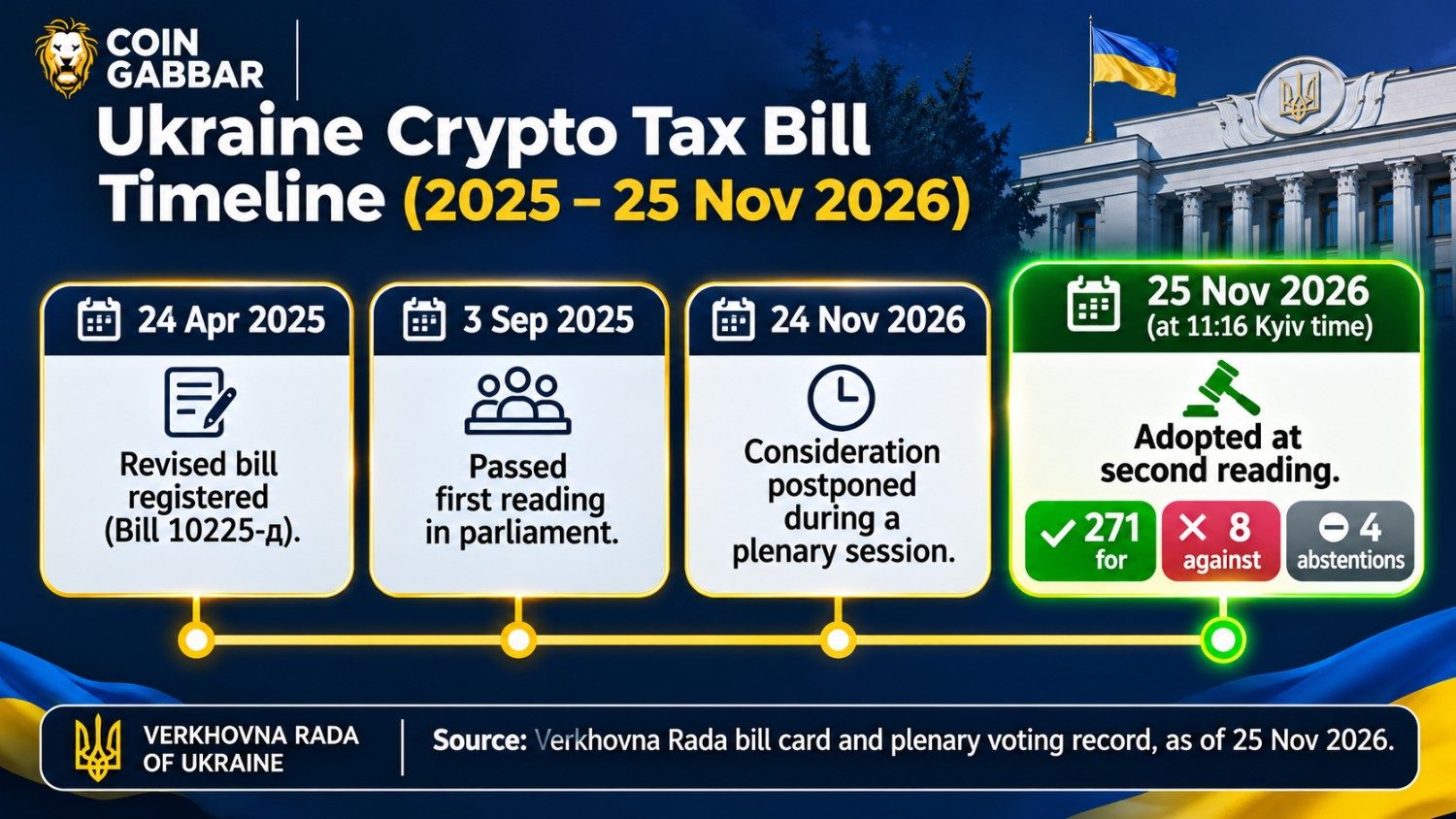
Bill 10225-d amends the Tax Code and related laws to regulate virtual asset transactions. It passed its first reading on 3 September 2025 with 246 votes, per Interfax-Ukraine (3 Sep 2025).
The Rada's own first-reading release says the draft was built on the EU's MiCA regulation.
The second-reading path was short:
Date | Parliamentary step | Source |
4 Nov 2026 | The Finance Committee backs the bill for second reading. | Kurs.com.ua, 4 Nov 2026 |
5 Nov 2026 | The National Bank of Ukraine (NBU) publicly declines to back it. | Ukrainska Pravda, 5 Nov 2026 |
24 Nov 2026 | Finwire, 24 Nov 2026 | |
25 Nov 2026, 11:16 AM (EET, UTC+2) | Second reading passes; 271 votes in favor | Liga.net, 25 Nov 2026 |
Source note: dates checked on 25 November 2026. The full tally (8 against, 4 abstentions, 32 not voting) comes from the official Rada bill card and should be confirmed there before publishing.
Approval of the Ukraine crypto tax bill is a legislative milestone. It does not let exchanges operate under the new system or apply the proposed rates.
What taxes does the Ukraine crypto tax bill set out?
Under the Ukraine crypto tax bill, the tax base is the annual financial result: sale proceeds minus documented purchase cost. The tax is on profit, not on total sales.
Tax item | Reported rule | Source and date |
Standard individual tax | 18% income tax plus 5% military levy | Finway, 25 November 2026 |
Existing holdings | 5% personal income tax through the end of 2028 | UA News, 25 November 2026 |
Crypto-to-crypto swaps | Incrypted, 25 November 2026 |
Source note: table retrieved 25 Nov 2026 from news coverage of the adopted text. The signed law is the only binding source.
The transitional 5% is a personal income tax rate. Whether the 5% military levy also applies to qualifying existing holdings is not stated in the sources checked, so a combined 10% should not be assumed.
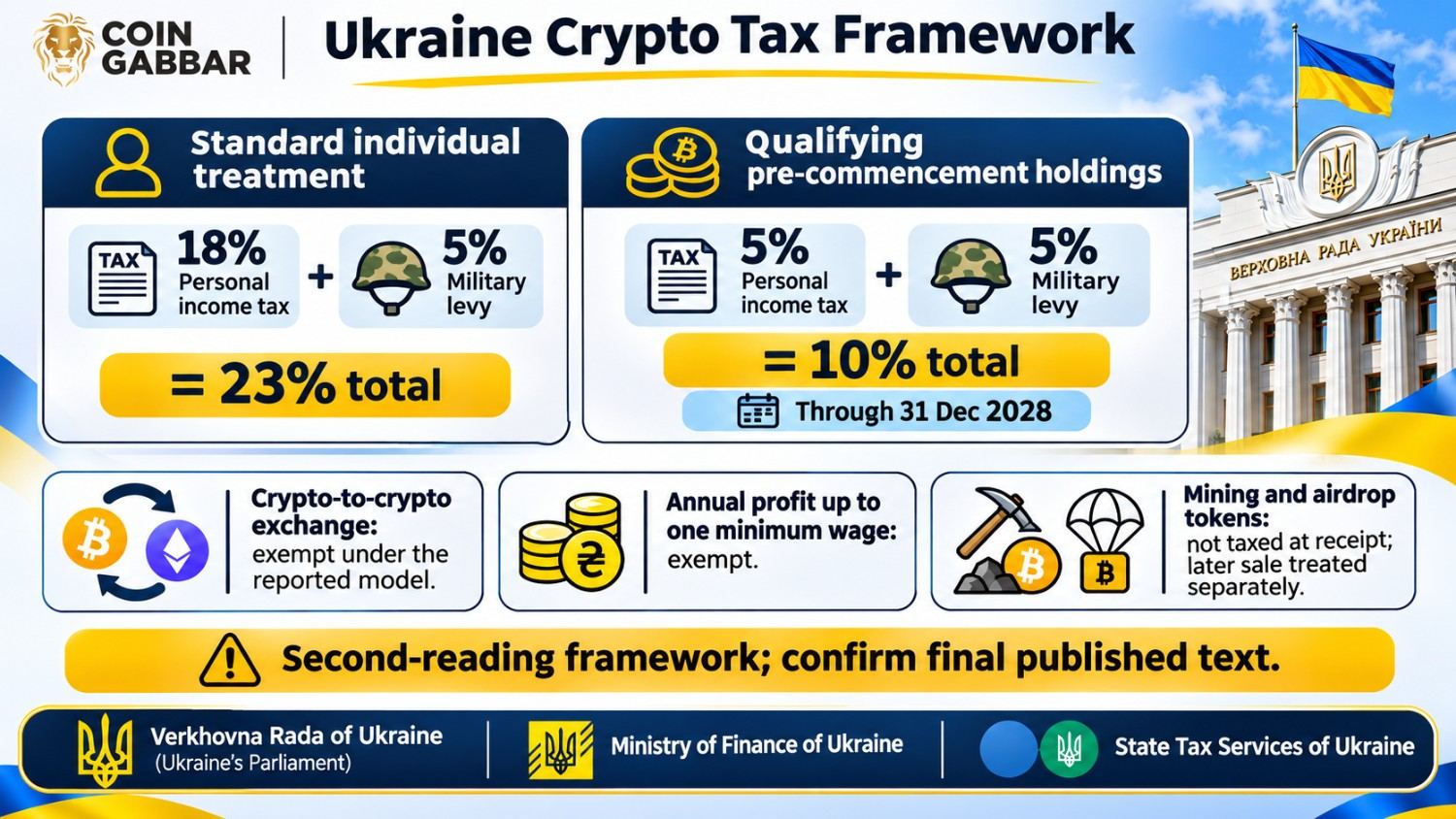
Other reported terms, such as an annual exemption of one minimum wage and registration of service providers with the State Tax Service, also need the signed text.
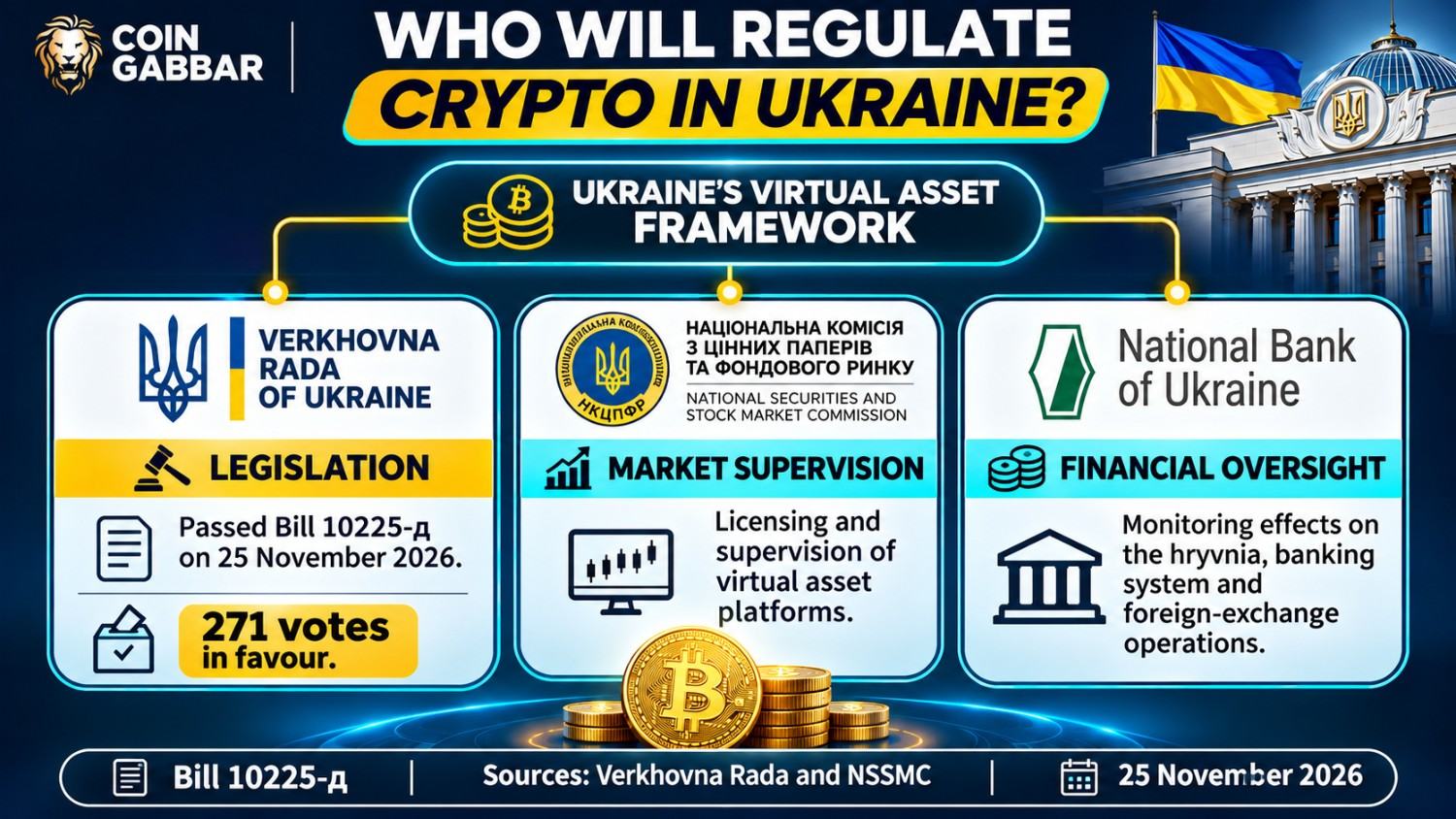
Who will regulate crypto in Ukraine under Bill 10225-d?
The NSSMC, Ukraine's securities regulator, is set to license and supervise crypto platforms, according to its statement of 23 Nov 2026. The National Bank of Ukraine (NBU) watches the hryvnia, banks, and foreign-exchange flows.
The split was not smooth. The NBU said it received the final committee text only late the evening before the committee meeting. Deputy Governor Oleksii Shaban raised objections at that meeting, and the bank refused to back the text on monetary-sovereignty grounds, DT-KT reported on 5 Nov 2026. Parliament voted anyway. Licensing rules will show how much of that objection survived.
When could the Ukraine crypto tax bill take effect?
The planned start of the Ukraine crypto tax bill is 1 July 2027, subject to signature and publication. The NSSMC statement of 23 Nov 2026 gave that date before the vote. As of 25 November 2026, the signed law was not located in the sources checked. Update trigger: official publication of the law or a change to the start date.
What should crypto holders and businesses do after the vote?
Start with the paper trail. For each coin, a holder needs the purchase date, quantity, and price, plus exchange statements and wallet histories. Transfers between a personal wallet and a platform need records too, because they can look like sales.
Anyone who bought before 1 July 2027 should keep proof of cost, since the 5% transitional rate depends on it. Exchanges face a different job: working out how registration and customer reporting will apply once the signed text appears.
For source checks, the Rada bill card shows the signature status, the NSSMC site shows licensing, the NBU site shows foreign-exchange rules, and the signed law shows the final rates.
Watch item | Where to verify |
Vote result and signature status | |
Licensing and supervision rules | |
Hryvnia and foreign exchange rules | |
Final tax rates | Signed and published law text |
What does the Ukraine crypto tax bill mean for the market?
The vote ends a long stalemate. The bill passed its first reading on 3 Sep 2025 and took 14 months to reach this point. Exchanges now have until 1 July 2027 to prepare, which is a real window. The risk sits in the details.
The NBU objection, the unanswered military-levy question on old holdings, and the missing presidential signature could each slow licensing. Demand for a legal route is clear, a pattern also seen in the crypto in the Global South market.
In short, the Ukraine crypto tax bill passed Parliament on 25 November 2026 with 271 votes but is not in force. Watch for the signature, publication, and the 1 July 2027 start.
Key takeaways
Status (25 Nov 2026): Parliament adopted Bill 10225-d. Signature status must be confirmed on the Rada bill card.
Planned start: 1 July 2027, per Forbes Ukraine (5 November 2026).
Tax: 18% personal income tax plus a 5% military levy on crypto profit, with a 5% transitional rate through 2028 for existing holdings.
Disclaimer: This article is educational and is not financial, legal, or tax advice. The bill has passed Parliament, but the signed law governs. Consult a qualified Ukrainian tax professional for personal situations.












Frequently Asked Questions (FAQ)




