
United Fidelity Shutdown: Could Bitcoin Benefit From the Fallout?

United Fidelity Shutdown: Is Another Banking Crisis Taking Shape?
United Fidelity Bank, a $5.9 billion lender based in Evansville, Indiana, was closed by federal regulators on November 27, 2026. The United Fidelity Shutdown is the largest U.S. bank failure since Republic First Bank in April 2024, per the Reuters report.

Source: Official X Post (November 28, at 06:53 UTC)
Depositors kept their money, but the FDIC announcement confirms a steep cost to the insurance fund, and bitcoin and crypto are already part of the debate.
Why the United Fidelity Shutdown Happened: CRE Losses and Weak Capital
Regulators behind the United Fidelity Shutdown called the bank unsafe or unsound and unlikely to meet depositor demands, then named the FDIC receiver.
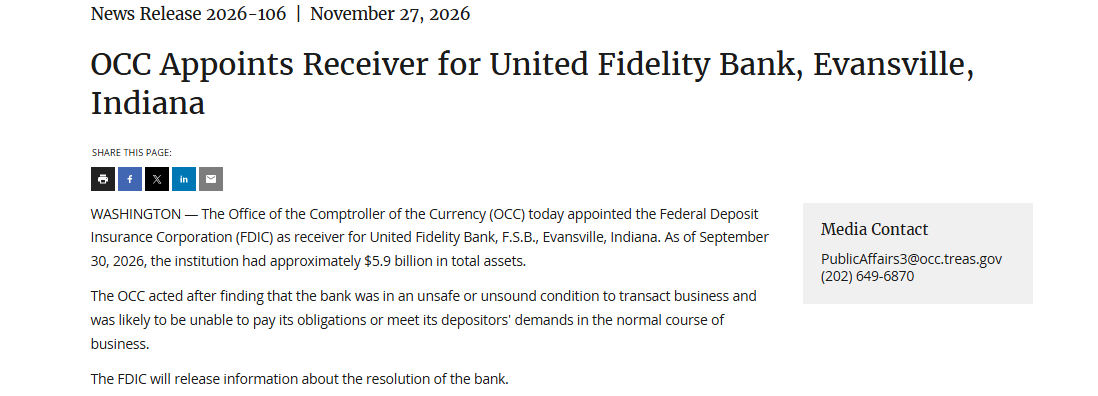
Source: OCC News Release 2026-106
Official detail is thin, but the record points to commercial real estate. The lender grew fast in multifamily and affordable housing loans tied to developer Pedcor Companies, a link that drew regulator concern in 2024. A 2023 OCC consent order and a 2024 Federal Reserve order, targeted oversight, capital planning and concentration risk.
Third-quarter call report data showed souring loans and thin capital, with some analyses putting nonperforming loans near 70% of the portfolio.
Key Numbers: Deposits, Loans and the $1.83 Billion FDIC Loss Estimate
Key figures from the United Fidelity Shutdown, as of September 30, 2026, per the same FDIC announcement:
Total assets: about $5.9 billion
Deposits: about $5.4 billion, with First-Citizens assuming roughly $4.5 billion
Loans assumed: about $3.1 billion
FDIC loss estimate: $1.83 billion, about 31% of assets
Branches: 22, across Indiana, Illinois, Florida, Colorado and the U.S. Virgin Islands
First-Citizens Bank & Trust won a competitive bid for substantially all deposits and assets. Customers keep access through checks, ATMs and debit cards, with insurance intact. A loan-book discount of about $2.6 billion signals deep damage to asset quality.
Bitcoin and Crypto as Next Hope: Self-Custody Meets a Fearful Market
No direct crypto exposure has been reported at the bank, yet the United Fidelity Shutdown revived an old pitch: when banks stumble, bitcoin looks like the alternative. Supporters point to self-custody, a fixed supply and settlement outside the banking system. Bitcoin also rose in the weeks after the 2023 regional bank failures, which keeps that hope alive.
The wider crypto market today is less friendly. Bitcoin sits just under $60,000 while fear runs extreme, per CoinMarketCap data from November 28 (06:55 UTC):
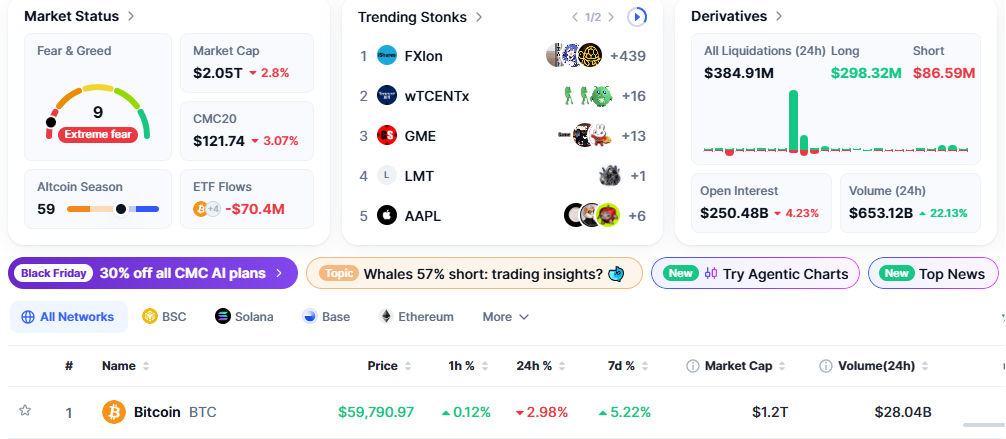
Bitcoin price: $59,790.97, down 2.98% in 24 hours but up 5.22% over seven days
Fear & Greed Index: 9, extreme fear
Total market cap: $2.05 trillion, down 2.8%
24-hour liquidations: $384.91 million, with longs at $298.32 million
ETF flows: net outflow of $70.4 million
So far, the bank failure has not produced a clear rally. Bitcoin could benefit if more banks wobble, but that is a possibility, not a pattern to count on. Self-custody also swaps deposit insurance for full responsibility over private keys.
What Comes Next for Depositors, Shareholders and Other Regional Banks
After the United Fidelity Shutdown, attention turns to lenders with heavy multifamily or commercial property books. Next steps are mostly mechanical:
Customers: move to First-Citizens, with systems conversion later and loan payments unchanged
Shareholders: holding company investors sit outside the receivership and face a likely total loss
FDIC: liquidates remaining assets, while bank assessments refill the insurance fund
The United Fidelity Shutdown looks contained, with no depositor run and no sign of wider contagion. The real test is the next round of call reports. If other property-heavy lenders show similar strain, regulators have shown they will close banks quickly, and the bitcoin vs banks argument will grow louder.
Disclaimer: This article is informational and is not financial or investment advice. Deposits above standard FDIC insurance limits can carry risk.






