US Budget Deficit 2026 Hits $1.99T: Why Debt Interest Is Surging


US Budget Deficit 2026 Hits $1.99 Trillion, Up 12% in a Year
The US budget deficit 2026 is in, and it is a big one. Washington spent about $2 trillion more than it collected in the year that ended September 30, up 12% from a year earlier.
This guide explains where the money went, why the gap grew, what bond yields are doing, and what Treasury Secretary Scott Bessent says about it.
The headline figures come from the Treasury’s official September statement, checked against the Congressional Budget Office’s October review.
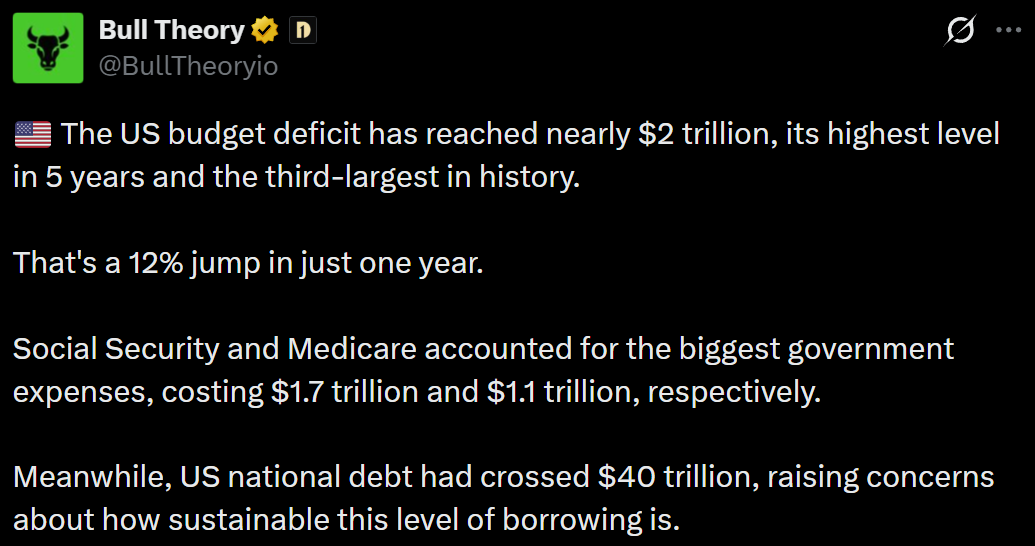
Source: Bull Theory on X
What Are the Headline Numbers?
| Fiscal year | Receipts | Outlays | Shortfall |
| FY2025 | $5.24T | $7.01T | $1.78T |
| FY2026 | $5.40T | $7.40T | $1.99T |
| Change | +3% | +6% | +12% |
CBO’s preliminary count is $1.993 trillion, which is $218 billion more than last year. The post calls it the highest in five years and the third-largest ever. Spending grew twice as fast as revenue.
September alone showed a $28 billion gap, against a $198 billion surplus a year earlier, though CBO notes that a holiday payment shift exaggerates that swing.
Where Did the Money Go?
| Item | FY2026 cost | Change |
| Social Security | $1.65T | +5% |
| Medicare | $1.07T | +8% |
| Medicaid | $723B | +8% |
| Net interest on the debt | $1.14T | +11% |
| Military | $916B | +5% |
CBO preliminary estimates. Medicare is net of offsetting receipts.
The post names Social Security and Medicare as the biggest costs, at $1.7 trillion and $1.1 trillion, and CBO’s tables agree.
The fastest-growing big item is interest on the debt: $1.14 trillion, up $115 billion. By our arithmetic, that is now larger than Medicare and about $227 billion above military spending.
CBO says interest rose because the debt is bigger and long-term rates are higher.
Why Did the Gap Grow?
CBO says spending rose by $386 billion while revenue rose by $169 billion. Four details stand out:
-
Income and payroll taxes rose $255 billion (6%), the main revenue gain
-
Corporate tax receipts fell $70 billion (16%) because a 2025 law allows larger deductions for business investment
-
Customs duties fell $22 billion (11%), with about $130 billion in tariff refunds after the Supreme Court’s February ruling
-
Education spending rose $41 billion, mostly because of how student loan costs were recorded
What Does the US Budget Deficit 2026 Mean for Debt and Yields?
The national debt has crossed $40 trillion, and the Treasury’s Fiscal Data site shows about $40.3 trillion this month.
Borrowing costs are high too. The Federal Reserve’s H.15 data show the 30-year yield at 5.60% on October 8 and 9, with the 10-year between 5.19% and 5.24% over the five days it lists.
The St. Louis Fed’s series puts the 30-year at 5.43% on October 15.
The post says both yields are at their highest in more than 20 years, a claim this article did not verify independently.
What Does Bessent Say?
Bessent has said the country can “grow our way out of” its debt, as the post notes.
The post adds that markets are not buying that story. Yields can rise for many reasons, so treat that as the author’s view, not proof.
What CBO does show is the cost of the problem: higher long-term rates are already raising interest payments, which feed straight back into the gap.
What Should Readers Watch Next?
For anyone tracking the US budget deficit 2026 story, four items matter:
-
The next monthly reports from CBO and the Treasury, which start the new fiscal year
-
The 10-year and 30-year yields, and whether they stay above 5%
-
Net interest, which CBO puts at $1.14 trillion for the year
-
Whether growth, as Bessent argues, starts to narrow the gap
Conclusion
The US budget deficit 2026 result shows a government spending $7.4 trillion against $5.4 trillion in revenue, with interest costs now bigger than Medicare.
The facts are clear, but whether growth can fix the problem is still a debate. Watch the yields and the monthly reports to see how the argument plays out.
Disclaimer
This article is for educational and informational purposes only and is not financial or investment advice. Crypto assets are high risk, their prices can be very volatile, and you can lose some or all of your money. Always do your own research and consider speaking with a licensed financial advisor before making investment decisions.






