

A tariff is a duty collected when goods enter the country. The importer of record pays it to U.S. Customs. The foreign seller does not write that check.
A $10,000 import with a 10% tariff adds $1,000 in duty. The importer then pays $11,000. It may absorb the cost or raise prices.
Glossary
Pass-through: the share of a tariff that reaches consumer prices.
Liquidation: a forced close of a leveraged trade when margin runs out.
Open interest: the total value of open futures contracts.
How Has US Tariff Policy Changed Since 1789?
Tariffs are an old tool of U.S. policy. A Journal of Economic Perspectives study from Summer 2026 built a dataset of U.S. tariffs back to 1789. It found a long shift toward rates set by trade deals.
Two turning points stand out in US tariffs explained through history:
1930: The Smoot-Hawley tariffs kept U.S. rates high. The U.S. Office of the Historian notes that scholars disagree on how much retaliation it caused. World trade fell about 66% from 1929 to 1934.
1934: From the Reciprocal Trade Agreements Act onward, the U.S. generally sought lower tariffs through trade deals, per the same source.
Why Did US Tariff Policy Change Again in 2025 and 2026?
The Federal Reserve Bank of Dallas reported on 6 October 2026 that the average U.S. tariff rate climbed from 2.9% in January 2025 to 14.8% in December 2025. Imports still grew 4.5% in 2025. The Dallas Fed links that to early buying and data center hardware.
Then the law shifted. On 20 February 2026, the Supreme Court ruled in Learning Resources v. Trump that the IEEPA emergency law does not let the President set tariffs. Sections 232, 301, and 122 remain.
Section 232 covers national security. It applies to steel, aluminum, copper, and vehicles.
Section 301 covers unfair trade practices. It needs an investigation, comments, and a hearing.
How Do US Tariffs Affect Consumers and Businesses?
The core data in US tariffs explained comes from Fed research.
The NY Fed found in its September 2026 revision that about 26% of a tariff increase reaches consumer prices. Direct effects make up 64% and indirect effects 36%. The indirect part takes nine to twelve months.
The Federal Reserve Board paper, revised in August 2026, found a pass-through of about 0.15, or 0.20 with import penetration. Spending on affected goods fell about three times as much as prices rose. Lower-income households carried a heavier burden.
How Did Crypto Markets React to Tariff Shocks?
The clearest case came on 10 October 2025. CoinShares reported that a 100% tariff announcement on Chinese imports set off a $19 billion liquidation wave. It said the true loss could exceed $50 billion. Bitcoin fell as low as $104,782.88 across 10–11 October, more than 14% below its Friday high of $122,574.46.
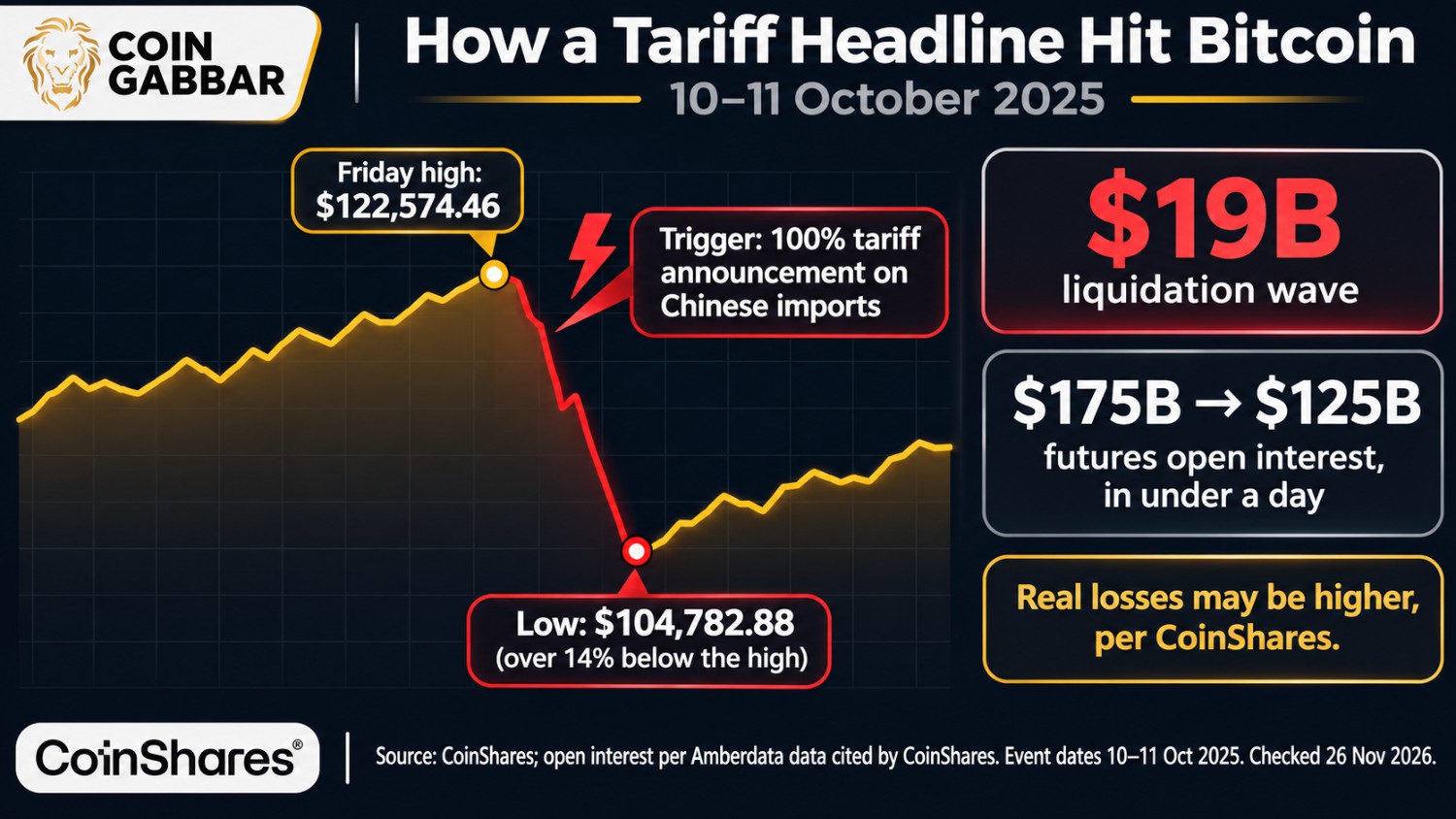
The tariff was the trigger. Leverage was the amplifier. CoinShares cited Amberdata data showing futures open interest fell from $175 billion to $125 billion in under a day. Thin order books and auto sell-offs made it worse.
The main lesson from US tariffs explained in market terms is simple. Trade headlines hit crypto hardest when positions carry heavy borrowing. Calm markets can turn fast.
What Do the New November 2026 Proposals Mean for Crypto and India?
The newest chapter of US tariffs explained is still a draft.
On 25 November 2026, USTR proposed new Section 301 tariffs on 14 economies after investigations that began on 11 March 2026, per a Holland & Knight summary of the USTR notice. Mexico and Norway have no determination yet.
These are proposals, not tariffs in force. Written comments are due 5 January 2027. Hearings begin 25 January 2027. No final date has been announced.
Economy | Proposed rate | With a trade agreement |
India | Up to 25% | 17% |
Vietnam | Up to 35% | 20% |
Singapore | Up to 20% | 10% |
China | Up to 20% | Not stated |
European Union | 15% | Not stated |
Source note: Holland & Knight, 25 November 2026. Rates are net of some existing duties. Section 232 goods are exempt for 13 of the 14 economies.
For India, the proposal is up to 25%, or 17% with a qualifying agreement. Indian traders should note that tariff news can move prices before any duty starts.
No source reviewed here shows how crypto will respond to these proposals. The 5 January 2027 and 25 January 2027 dates are known event risks. In the October 2025 case, leverage mattered more than the headline.
Will Tariffs Change Global Trade and Crypto Demand?
The WTO outlook of 8 October 2026 expects merchandise trade volume to grow 3.9% in 2026 and 4.1% in 2027. Trade has held up so far in this US tariffs explained outlook.
On 4 November 2026, the BEA reported (8:30 A.M. EST) a $105.0 billion trade deficit for September 2026.
Whether crypto works as a hedge in US tariffs and explains debates is an open question. The sources reviewed here do not settle it. Treat hedge claims with care until data backs them.
A Simple Pass-Through and Leverage Check
This original illustration uses the NY Fed pass-through of about 26% and the $10,000 import above. A 10% tariff adds $1,000. About $260 reaches shelf prices over time. Firms absorb the rest.
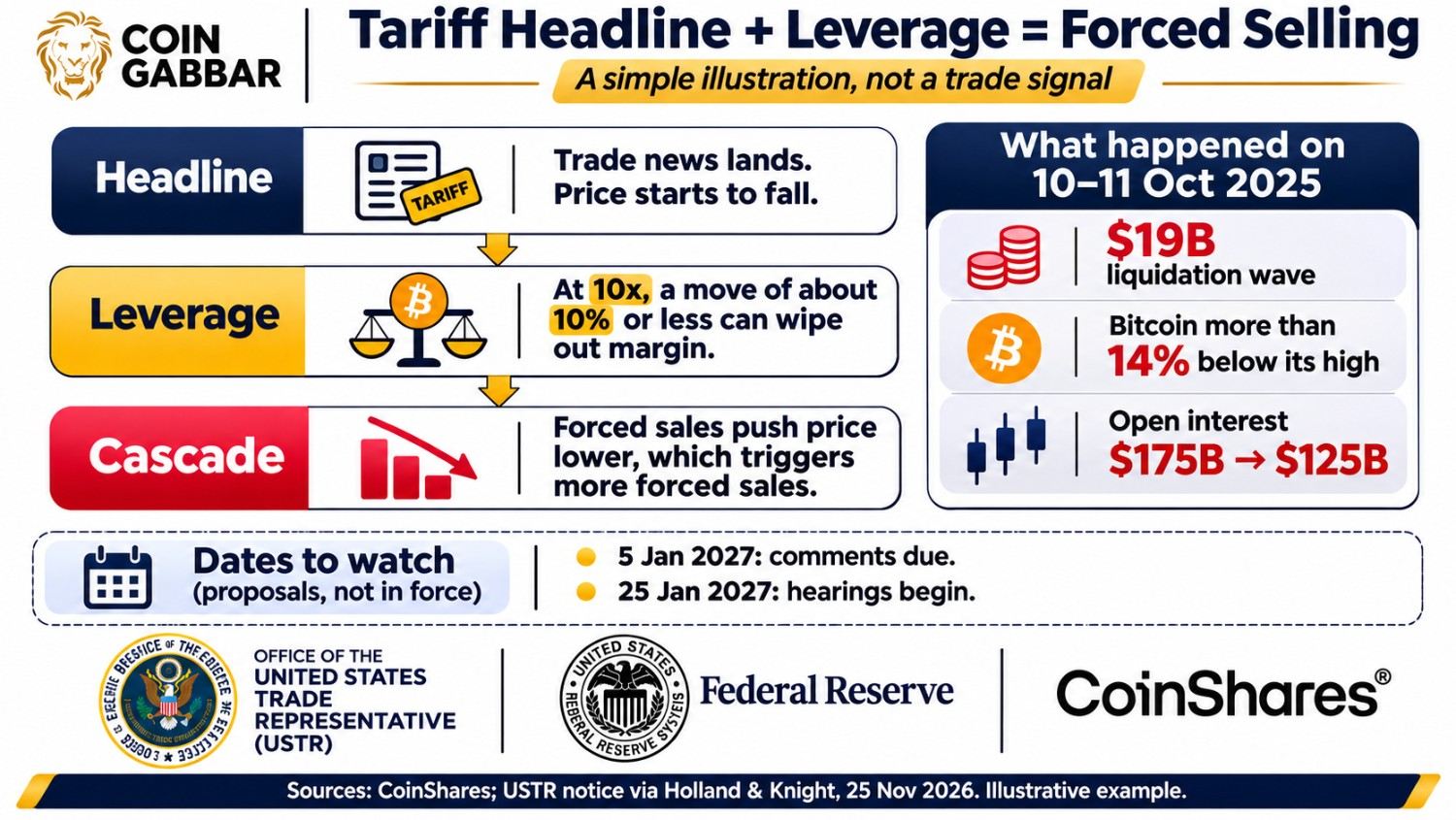
For leverage, a trader at 10x can face liquidation after an adverse move of about 10% or less. The 14% bitcoin drop in October 2025 was larger than that. This US tariff explanation example is illustrative only.
Checklist for Crypto Traders and Importers
Use this US tariffs explained checklist for crypto traders before acting.
Mark 5 January 2027 and 25 January 2027 on the calendar.
Lower leverage before known event dates.
Check whether goods fall under Section 232.
Confirm the origin country rate if importing.
Follow USTR for the final action.
Disclaimer: This article is for educational and informational purposes only. It is not financial, investment, legal or trade advice. Cryptocurrency prices are volatile, and leveraged trading can lead to the loss of more than the amount invested. Tariff proposals described here were not in force as of 26 November 2026 and may change. Figures come from the sources linked in the article and carry their own dates. Readers should verify current details and consult a qualified professional before making any financial or business decision. CoinGabbar and the author do not accept liability for decisions made from this content.
Frequently Asked Questions (FAQ)




Owned by:-
DCG Tech FZCO, UAE
Delivery Partner:-
Gabbar MediaTech Pvt Ltd.
Copyright © 2026 Coin Gabbar. All Rights Reserved












